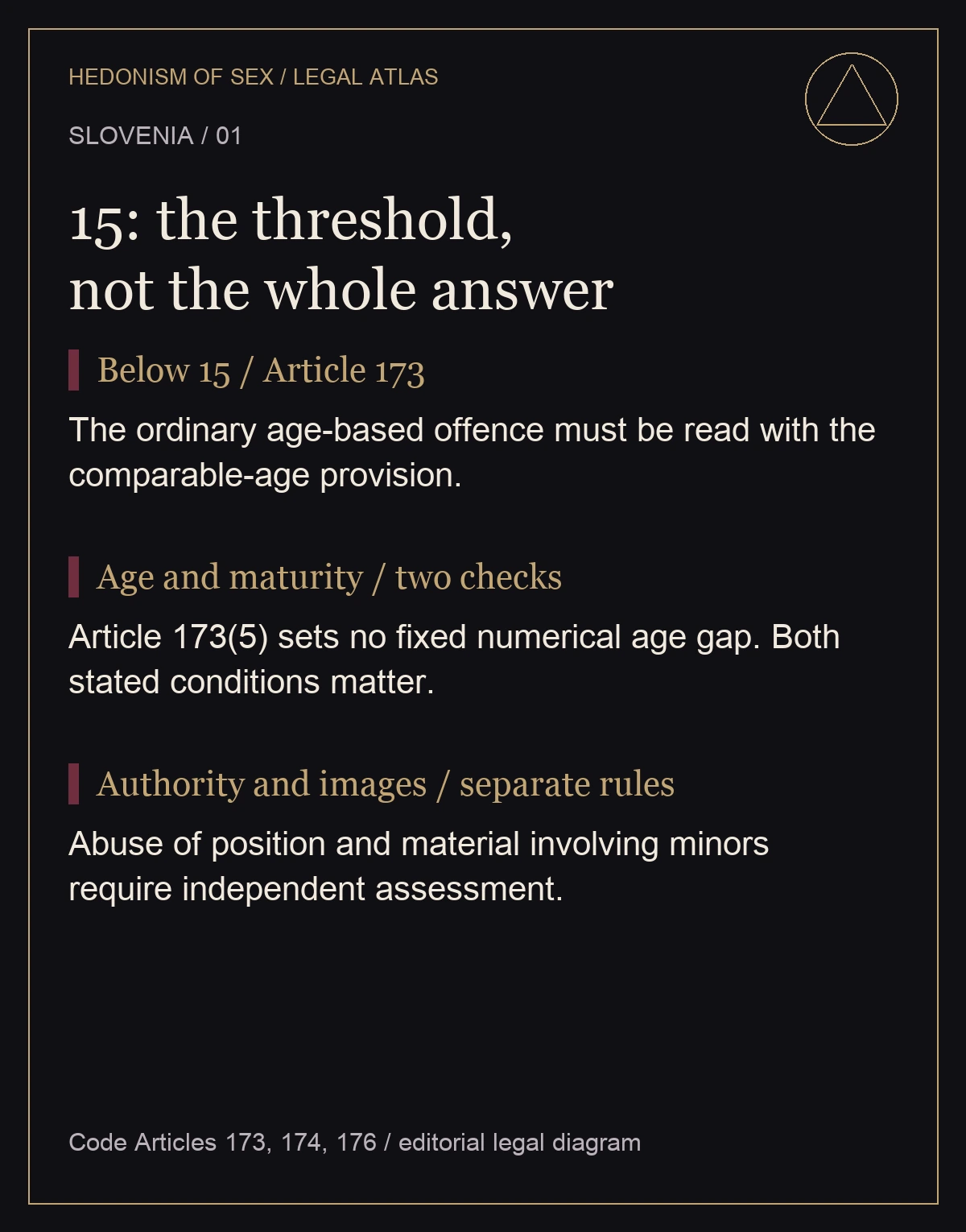
Slovenia’s ordinary age of sexual consent is 15. Criminal Code Article 173(1) addresses intercourse or another sexual act with a person who has not reached 15, expressly covering a person of either the same or a different sex. Paragraph (5) says the act in paragraph (1) is not unlawful where it involves a person of comparable age and corresponds to that person’s mental and physical maturity. It does not specify a fixed number of years. Current Criminal Code, Article 173.
The useful distinction is between an age-based offence, a relationship involving authority or dependency, non-consensual conduct and an offence involving images. One answer cannot be carried across all four. This guide explains the conditions, the scope of the peer provisions and the October 2026 amendment to online-meeting solicitation.
The national threshold and continuing protection
This is a national Criminal Code framework. Article 10(1) applies Slovenian criminal law to everyone committing an offence within Slovenian territory. A visitor does not gain an exemption because their home country uses a different age. Ljubljana, Maribor, the coast and the rest of Slovenia fall within the same national framework. Cross-border conduct may also raise jurisdictional questions under the following articles. Code Article 10.
Article 173(1) uses the protected person’s age, below 15. It does not make the other person’s adulthood an express condition of that paragraph. The peer provision and the applicable rules governing young offenders therefore need to be distinguished from the age of the protected person. Do not interpret the ordinary threshold as a statement that only adults can be responsible for the basic offence. Article 173(1) and (5).
Reaching 15 does not resolve every question. Article 174 deals with abuse of position or dependency, including the specified entrusted-care circumstances after 15. Articles 175 and 176 separately address exploitation involving minors and sexual material involving minors. The contact threshold is not a general permission to purchase sexual services, obtain images or exploit a position of trust.
| Situation | Provision | Condition to examine |
|---|---|---|
| A sexual act involving someone below 15 | 173(1), (5) | Protected age; comparable age and maturity exception |
| Authority, dependency or entrusted care | 173(3), 174 | Relationship and abuse of position |
| Sexual material involving minors | 176(3), (5) | Specific conduct and the separate image conditions |
| Soliciting a meeting through technology | 173.a | Purpose, concrete steps and the paragraph (2) qualification |
Comparable age and maturity: both conditions matter
Article 173(5) has two linked elements: the other person must be of comparable age, and the act must correspond to the protected person’s level of mental and physical maturity. An age difference alone does not answer the second question. Conversely, a claim that someone is mature does not erase the comparable-age requirement. Article 173(5); official consolidated text, Article 173(5).
There is no statutory two-, three- or five-year allowance in this paragraph. Do not import a number from another country. The Croatian contact exception, for example, uses a numerical difference; Slovenia’s wording uses comparable age and maturity. These are different legal tests.
Hypothetical example: two young people are close in age. That is relevant to one part of Article 173(5), but the available information still does not establish whether the act corresponded to the younger person’s mental and physical maturity. A short description such as “they were classmates” cannot settle the complete legal assessment.
The paragraph expressly concerns the act in Article 173(1). It should not be turned into an exemption for forced conduct, abuse of an entrusted position or every other offence in the chapter. Article 173(2) separately addresses the specified vulnerability, force or threats, while paragraph (3) addresses abuse of position involving a child below 15 entrusted for teaching, upbringing, treatment, protection or care. Article 173(2)–(5).
Keep exact dates of birth and the event date, but recognise the limit of arithmetic. They help establish age; they do not themselves establish maturity, voluntary participation or the absence of exploitation.

Consent, capacity and abuse of position
The 2021 consent reform
Article 170 addresses intercourse or equivalent sexual conduct without consent. Its consent provision requires an outwardly perceptible, unequivocal and freely expressed willingness, together with the capacity to make that decision. Article 171 applies the corresponding approach to the other sexual acts described there. The 2021 amendment added these provisions; absence of physical force is not by itself an answer to a non-consent allegation. KZ-1H, Articles 1–2.
Article 172 separately addresses the specified abuse of a person’s mental illness, temporary mental disturbance or severe intellectual disability where the person cannot give consent. The legal conditions should be read carefully; the provision is not a claim that everyone with a diagnosis lacks capacity. A prior relationship, a previous agreement or reaching 15 does not establish a person’s present decision. KZ-1H, Article 3, replacing Code Article 172.
Protection linked to the relationship
Article 174(1) addresses abusing a position to induce sexual acts involving a person who is subordinate or dependent. Paragraph (2) separately addresses a teacher, educator, guardian, adoptive parent, parent or another person who abuses their position in relation to a person over 15 entrusted for teaching, upbringing, protection or care. The text is not simply an ordinary age-of-consent rule, and its protection should not be described as ending automatically at 18. Code Article 174.
Article 175(2) separately concerns exploitation connected with a minor’s prostitution and the other conduct specified there. A 15-, 16- or 17-year-old meeting the basic contact threshold does not remove this protection. Examine exploitation and the particular conduct independently. Code Article 175(2).
The separate exception for images
Article 176(3) addresses the listed acts involving pornographic or other sexual material that includes minors or their realistic depictions. Those acts include acquisition, making, distribution, sale, import, export, other offering, possession, specified access through technology and disclosure of the minor’s identity in such material. Material and conduct both matter; a rule about contact does not determine whether a file may be acquired or shared. Code Article 176(3).
Article 176(5) is a distinct, limited exception. Introduced by KZ-1I, it concerns the part of paragraph (3) consisting of acquisition, making, possession or obtaining access through information or communication technology. It requires conduct between minors of comparable age who agreed to it, correspondence with their mental and physical maturity, and material depicting those persons. KZ-1I, Article 19.
- Check the people: the paragraph refers to minors of comparable age.
- Check agreement and maturity: both are express conditions.
- Check the depiction: the material must depict those persons.
- Check the conduct: the exception names particular acts; it does not include a general distribution, sale or public-posting permission.
Hypothetical example: two minors agree to make material depicting themselves. That description does not yet settle comparable age, maturity or every other condition. If someone later forwards it to a group chat, the original agreement does not convert paragraph (5) into a distribution exemption. An adult recipient cannot rely on the paragraph’s reference to conduct between minors.
Other provisions also remain relevant. Article 176(1) concerns making pornography accessible to a person below 15. Paragraph (2) addresses the specified involvement of minors in production or performances and knowingly attending such a performance. The paragraph (5) exception does not broadly exempt those paragraphs. Article 176(1), (2) and (5).
For sexual recordings or messages more generally, Article 143(6) separately addresses public publication without the person’s consent where this seriously harms their privacy. An agreement to create a recording should not be treated as an agreement to publish it. The precise public-publication and privacy conditions matter. Article 143(6).

Online meetings and the October 2026 amendment
Article 173.a(1) addresses soliciting a person below 15 through information or communication technology to meet for the specified sexual offence or for making the specified sexual material, followed by concrete acts towards bringing about that meeting. It is important to examine the purpose and those concrete acts rather than equating every message with this particular offence. Code Article 173.a(1).
Paragraph (2) contains a qualification where the purpose is the act under Article 173(1) and the conditions in Article 173(5) are met. That cross-reference should be read exactly: it does not itself establish a broad exception for soliciting production of sexual images. Any image situation requires its separate provisions. Article 173.a(2).
The October 2026 amendment changed the punishment in paragraph (1). KZ-1K replaced “up to one year” with imprisonment from one to three years. It did not replace Article 173’s ordinary threshold or its comparable-age and maturity wording. The official Gazette was issued on 2 October 2026; Article 2 starts the Act on the fifteenth day after publication, 17 October 2026. KZ-1K, official Gazette PDF, Articles 1–2.
Common questions
Does Slovenia have a fixed three-year peer exception?
No fixed three-year difference appears in Article 173(5). The wording requires comparable age and correspondence with mental and physical maturity. Do not substitute another country’s numerical rule.
Does the contact exception also permit distributing sexual images?
No. Article 176(5) has its own conditions and specifies particular acquisition, making, possession and access conduct. It does not list general distribution, sale or public posting.
Does an authority relationship stop mattering once someone is 15?
No. Article 174 separately addresses abuse of a subordinate or dependent position and specified entrusted-care relationships after 15. The conduct and relationship must be assessed independently.
Sources, dates and practical next steps
- PISRS Criminal Code, NPB 14. Current government-hosted unofficial consolidation including KZ-1K; checked 6 November 2026.
- Official consolidated Code, Gazette 50/2012. Original statutory context, including Articles 173(5), 173.a and 174; requires subsequent amendments.
- KZ-1H, Gazette 95/2021 of 15 June 2021. Consent reform; Article 4 sets commencement fifteen days after publication, 30 June 2021.
- KZ-1I, Gazette 186/2021 of 30 November 2021. Article 19 introduces the image exception; Article 45 sets commencement fifteen days after publication, 15 December 2021.
- KZ-1J, Gazette 16/2023. Later amendment reviewed alongside the current consolidation.
- KZ-1K, Gazette 1564/2026 of 2 October 2026. Original official publication establishing the online-meeting penalty change and commencement rule.
For an actual incident, collect the event date, both exact ages, the relationship, what each person agreed to, and the precise handling of any material. Those facts support a qualified Slovenian lawyer’s assessment; a country chart cannot replace it. For comparison, return to the country library or read the separate Croatia guide.