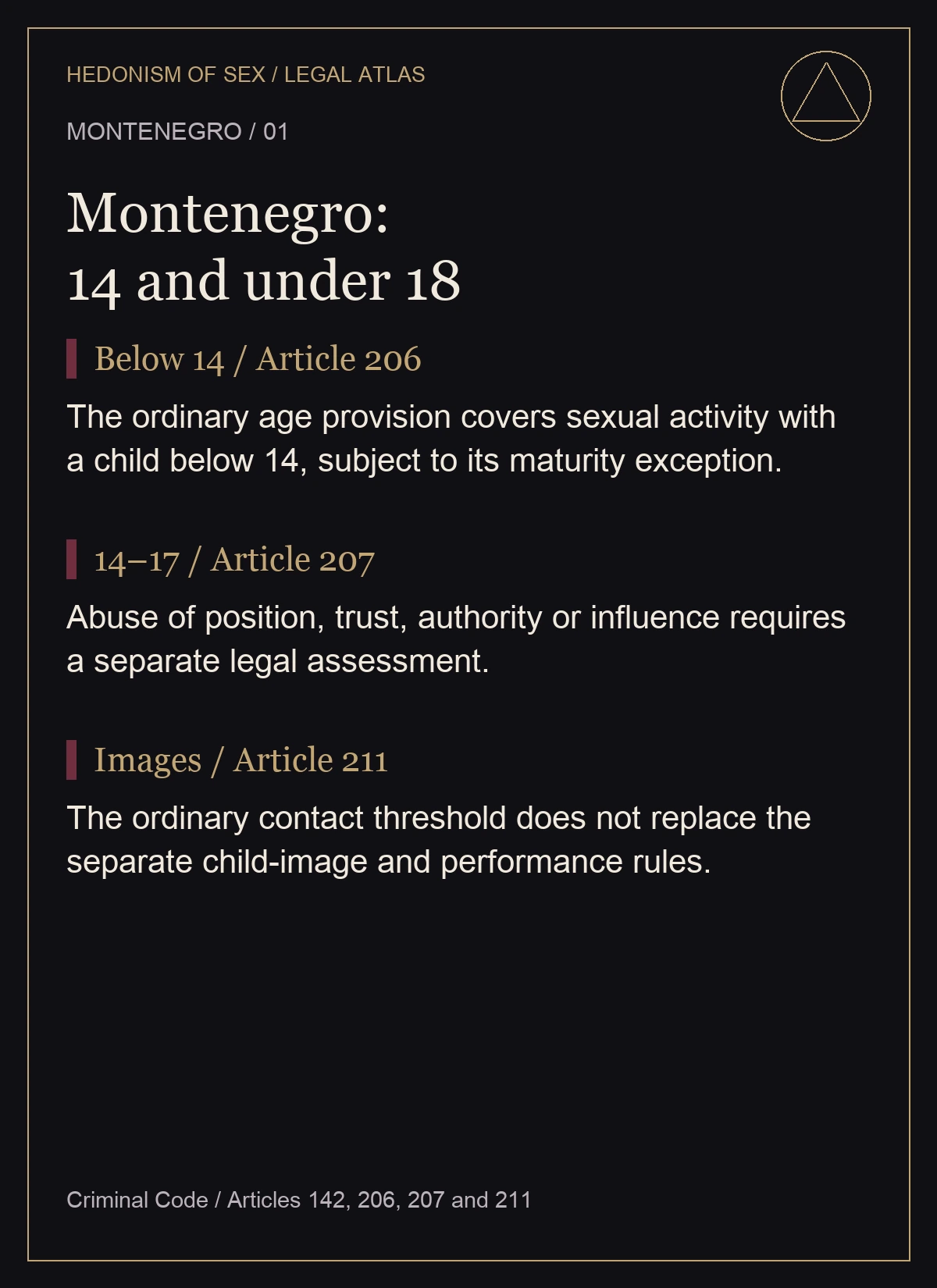
The ordinary age threshold is 14. Criminal Code Article 206(1) addresses sexual activity with a child below 14. Article 206(4) contains an exception based on the absence of a significant difference in the participants’ mental and physical maturity. It gives no fixed numerical age gap. Other offences protect people aged 14–17 and adults against specified abuse, coercion and exploitation. Code through 2023, Articles 205–211b, read with Gazette 137/2026, amendment Articles 31–34.
Research scope. This guide reads the prosecutor’s historical consolidation through 110/2023 together with the original amendments in Gazettes 123/2024, 121/2025, 117/2026 and 137/2026. All 33 pages of those amendments were examined. The later government proposal was separately checked in Parliament’s register and original submission: it remained marked as pending, rather than enacted, at the check date. This is AI-assisted editorial research, without independent lawyer review, and does not decide an individual case.
Fourteen is the contact threshold; childhood continues to 18
Article 206(1) uses the express boundary of a child who has not reached 14. The September 2026 amendment expands its description from intercourse or an equivalent act to include other sexual activity. The provision is therefore broader than a rule about a single narrowly defined act. The text does not make adulthood of the person alleged to have committed the offence a general condition. Amendment Article 32; baseline Article 206.
The code separately defines a child as a person below 18 and a minor, in its specific terminology, as someone who has reached 14 but not 18. These definitions were already present in the 2023 consolidation and are retained in the replacement Article 142 enacted in September 2026. The reform did not newly make every person below 18 a child. The distinction matters when reading offences that use those different terms. Replacement Article 142(7)–(8).
| Question | Relevant rule |
|---|---|
| Sexual activity involving someone below 14 | Article 206(1), with the separate maturity exception in 206(4). |
| Abuse involving a person aged 14–17 | Authority, trust and dependence protections, including Article 207. |
| Child sexual-abuse material | Article 211 and its definitions; the ordinary contact threshold does not replace them. |
| An adult arranging a prohibited meeting or requesting specified material | Article 211b; the meeting and request provisions have different elements. |
The exception uses maturity, not a two- or three-year gap
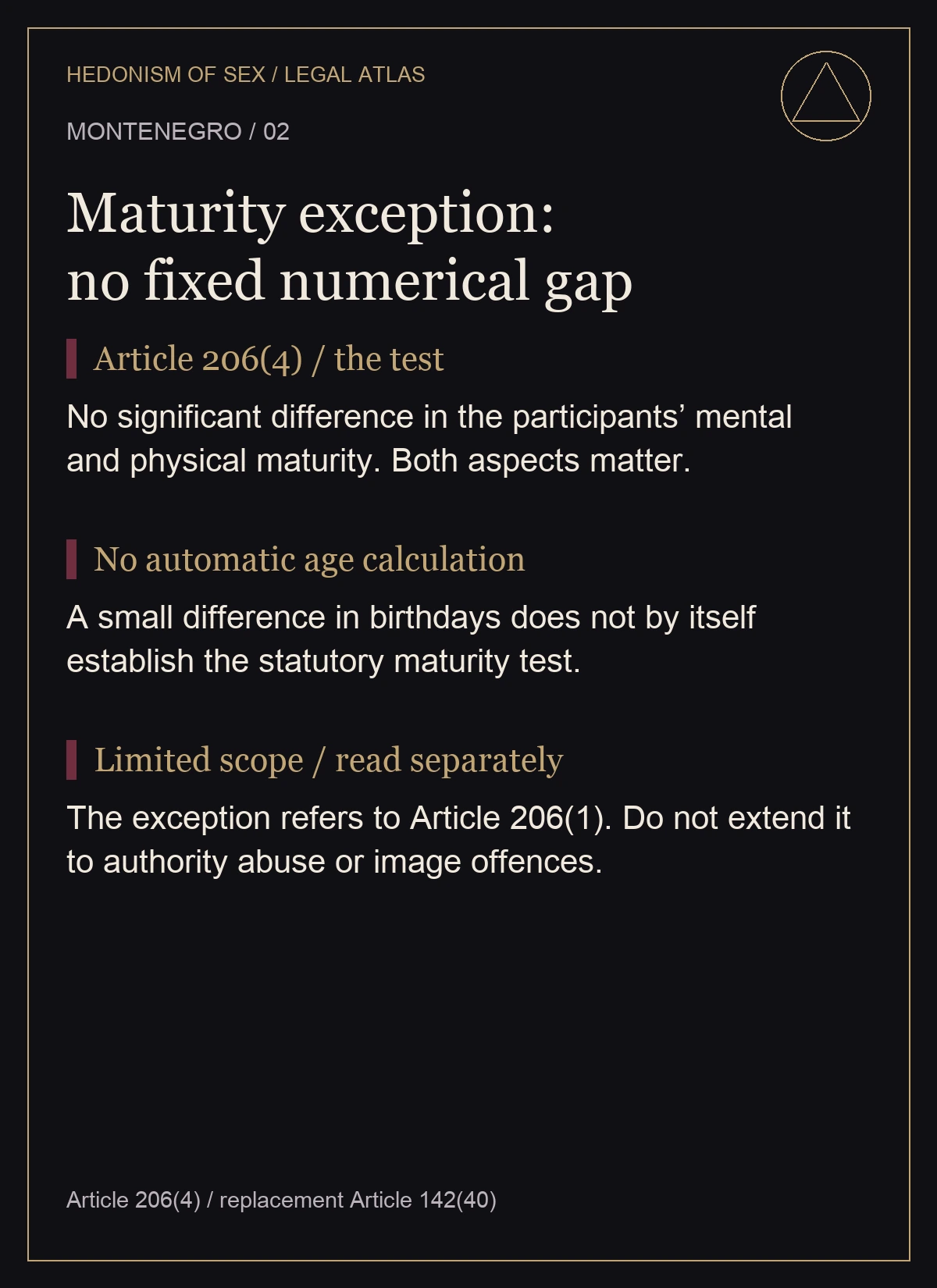
Article 206(4) provides that the perpetrator will not be punished for the offence in paragraph 1 where there is no significant difference between that person and the child in their mental and physical maturity. Both aspects appear in the wording. The provision does not state that an age difference of two, three or five years automatically satisfies the test. A numerical exception used in another country cannot be substituted for Montenegro’s text. Article 206(4).
The legal effect of the phrase also deserves care. The replacement Article 142(40) expressly states that the expression “will not be punished” means that in the relevant case there is no criminal offence. Read together, those provisions should not be described simply as a lower sentence that a court may choose after an otherwise unchanged conviction. Nor should the exception be converted into a general permission applying throughout the code. Article 206(4) expressly refers to paragraph 1 of Article 206. Replacement Article 142(40).
For example, two hypothetical participants with a small chronological age gap cannot establish the exception merely by subtracting their birthdays. The statutory maturity assessment still needs evidence and interpretation. Conversely, describing every case below 14 without mentioning paragraph 4 would omit an express part of the law. This guide provides no appearance-based or physical-development checklist for assessing another person.
The exception also does not answer whether there was force, exploitation of inability to resist, abuse of authority, a prohibited image request or another separately defined offence. Those questions must be examined independently. Neither a relationship label nor an assertion that both participants agreed resolves every statutory element.
Trust and dependence can matter after a person turns 14
Article 207(1) addresses inducing the specified sexual conduct by abusing a position where the other person is subordinate or dependent. Its wording is not confined to a child below 14. Article 207(2) separately addresses abuse by a teacher, educator, guardian, adoptive parent, parent, step-parent or another person involving a minor entrusted for education, upbringing, care or nursing. Article 207(1)–(2).
The September 2026 amendment extends paragraph 2’s description to a person who otherwise enjoys the minor’s trust or has a position of authority or influence over the minor. It also adds an express attempt provision for Article 207(1). An older summary limited to a short list of professional job titles can therefore miss the current wording. The relevant relationship and the abuse required by the provision remain important; a title alone is not a substitute for examining all elements. Amendment Article 33.
In a hypothetical case involving a 16-year-old and a person responsible for their care or training, asking only whether 16 exceeds 14 is inadequate. The enquiry must also examine entrustment, dependence, trust or influence and the alleged abuse. The same reasoning explains why a country age chart cannot function as permission for a particular relationship.
Age does not remove protection against coercion or incapacity
Article 205 addresses the specified conduct involving exploitation of mental illness, delayed mental development, another mental disturbance, helplessness or another condition leaving the person unable to resist. Article 208 addresses other prohibited sexual acts under its specified cross-referenced circumstances. These provisions are separate from the ordinary age boundary. Articles 205 and 208, with 2026 amendment Article 34.
Care is needed with older English explanations of Article 204. The historical 2023 consolidation describes its first paragraph in terms of absence of consent. Amendment Article 31 replaces that paragraph with wording addressing compulsion by force or threat and also changes paragraph 3 concerning sexual activity with a third person. A current account must read the enacted replacement alongside the remaining paragraphs and related offences. It should not quote the old first paragraph as the current text. Amendment Article 31.
As a practical matter, reaching a statutory age is never a substitute for freely choosing to participate. A person can refuse, withdraw agreement or need help regardless of age or relationship. Determining the precise offence in a disputed case requires the actual facts and the applicable provisions, rather than a conclusion drawn from this guide’s headline.
An arranged meeting and an image request are different offences
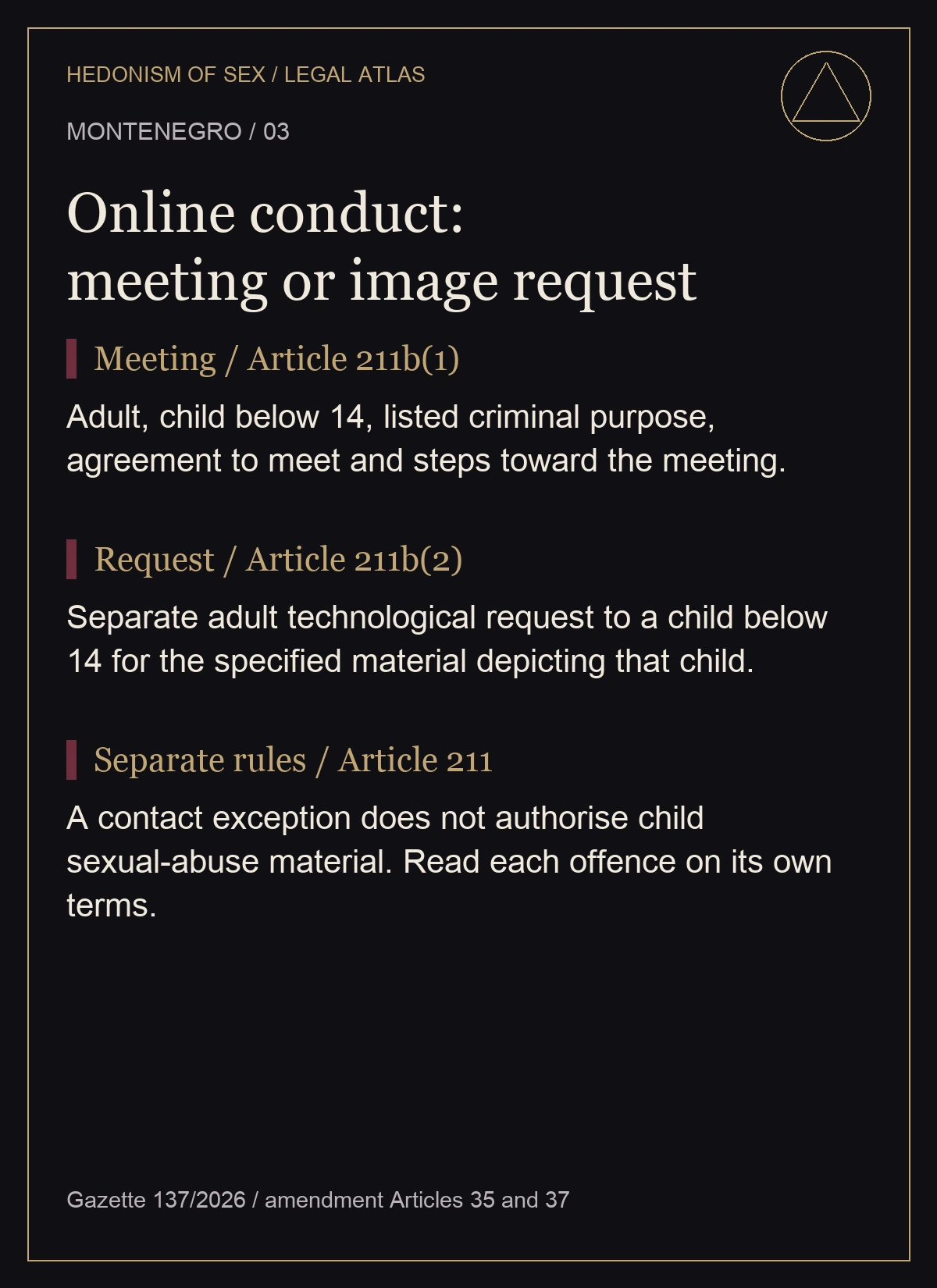
Article 211b’s meeting provision concerns an adult acting with the intention of committing one of its listed offences, using information and communication technology or another means to agree a meeting with a child below 14, and taking action so that the meeting occurs. The agreement and further steps are part of that provision’s wording. A completed in-person meeting is not stated as a necessary element. Baseline Article 211b; amendment Article 37.
September 2026 adds a different paragraph: an adult who, through information and communication technology, induces a child below 14 to supply material depicting sexual abuse of that child falls within Article 211b(2). This paragraph does not repeat the meeting-and-steps requirement. Its wording also does not state that the requested material must actually arrive. The absence of a meeting or a delivered file should therefore not be assumed to answer every online offence. New Article 211b(2).
The below-14 wording of that particular request offence does not make requests involving a 14–17-year-old generally permissible. The separate Article 211 offences involving a child, together with the code’s below-18 definition, still need examination.
Images and performances have their own under-18 protections
The replacement Article 211 addresses exploitation of children to produce the specified material and performances, as well as knowing and unauthorised recording, production, offering, making available, distribution, import, export, acquisition, technological access, sale, display and possession of the defined material. Its access and possession wording does not require a general intention to redistribute. Replacement Article 211(2)–(3).
The definition covers the specified visual depictions of real or simulated sexually explicit conduct and sexual organs for primarily sexual purposes. It includes people appearing to be children, realistic depictions and the specified digitally generated or altered material, including artificial intelligence. The content must meet the legal definition: an ordinary nonsexual photograph of a child is not automatically within it. Calling a qualifying depiction fictional or computer-generated is not a reliable answer to the express definition. Article 211(8).
Performances are also regulated. The replacement provision addresses knowing attendance, including through information and communication technology, and defines the relevant live presentation separately. Its definition includes the specified realistic depictions and digital forms. The absence of a saved file does not make every performance outside the provision. Article 211(4) and (9).
No express general numerical peer or private-couple exception appears in the replacement Article 211 examined. Article 206’s maturity exception should not be copied into it. The new Article 211e instead protects a child who, as a direct victim of the listed offences in Articles 210, 211 and 211b, was compelled to participate in criminal activity as a direct consequence of those offences. That is a specific victim-protection provision, rather than permission for another participant to request or circulate material. Amendment Article 39, new Article 211e.
Payment and exploitation require separate scrutiny as well. Article 210 addresses its specified prostitution-related conduct involving a child, including use of the child’s sexual services. Its definition includes money or another benefit promised or given, whether to the child or a third person. The ordinary contact age does not authorise purchasing sexual activity involving a child. Article 210.
September 2026 changed more than the headline age rule
Besides the conduct, authority and online provisions described above, the reform adds specific aggravating circumstances for the listed sexual offences against a child. It permits a permanent ban on activities involving direct and regular contact with children after conviction for the specified offences against a child. The permanent ban is expressed as a power to impose that measure, not an automatic consequence in every case. New Article 42b; amended Article 117(4).
The law also adds a provision stating that prosecution and execution of punishment do not become time-barred for offences against sexual freedom committed against a child. That statement must be distinguished from a promise about every historical case: the law applicable in time, any already elapsed periods and the procedural position require legal analysis. New Article 129(2).
Publication and commencement are distinct
The September amendment was adopted on 16 September 2026, promulgated on 18 September and published in Official Gazette 137/2026 on 21 September. Article 74 provides entry into force the next day: 22 September 2026, also recorded in the Gazette’s official metadata. The parliamentary adoption date is not the commencement date. Official record and first page; Article 74.
The original also inserts Article 486a, stating that proceedings begun before commencement will finish under the rules under which they began. However, Article 133 separately provides the ordinary law-at-the-time rule and, where the law subsequently changes, application of the law most favourable to the accused. The relationship between those provisions must not be resolved by assuming that the newest law automatically applies to every historical case. Amendment Article 73; Code Article 133.
A later government bill proposes deleting Article 486a specifically because of the potential conflict with Article 133. Its parliamentary submission includes a forwarding letter dated 29 October 2026 and a two-article proposed law. Parliament’s record dated 4 November 2026 identifies it as EPA 1243, act 23-1/26-26, with status U proceduri—pending. At this guide’s check on 6 November, the proposal is therefore reported as a proposal, not an enacted deletion. Its next-day commencement clause would operate only following the required enactment and publication. Parliamentary status and original submission.
Common questions
Is every sexual relationship above 14 lawful?
No. The ordinary age threshold answers one question. Abuse of authority or dependence, coercion, inability to resist, exploitation and other statutory restrictions remain separate questions. Image offences have their own elements.
Does Montenegro have a fixed close-in-age exception?
Article 206(4) states a mental- and physical-maturity test, without a fixed numerical gap. A small difference in birthdays does not automatically prove the exception.
Can a contact exception authorise child sexual-abuse images?
The replacement Article 211 does not incorporate Article 206’s maturity exception. Its separate definitions and offences must be read independently.
Can I use the prosecutor’s 2023 PDF on its own?
It is useful as a historical baseline, but it omits the later amendments examined here. In particular, September 2026 replaces Article 211 and changes several other provisions directly relevant to this topic.
Sources and practical next steps
For a concrete situation, record the participants’ ages on the relevant date, the conduct alleged, any care or authority relationship, whether material was requested or shared, and whether the case crosses borders. These facts help a qualified Montenegrin lawyer identify the applicable provisions and version. Contact age, marriage or cohabitation rules, criminal responsibility and image law are distinct enquiries.
- Prosecutor-hosted Criminal Code through 110/2023. Historical baseline, not a current standalone consolidation.
- Official Gazette 123/2024. Two-page original amendment; effective 24 December 2024.
- Official Gazette 121/2025. Three-page original amendment; effective 22 October 2025.
- Official Gazette 117/2026. Nine-page original environmental-offence amendment; effective 8 August 2026.
- Official Gazette 137/2026. Nineteen-page original amendment; effective 22 September 2026. Relevant individual pages are linked beside claims above.
- Parliament, EPA 1243, act 23-1/26-26. Proposed deletion of Article 486a; marked pending in the record dated 4 November 2026. Original 20-page submission includes the proposed text and explanatory memorandum.
Editorial transparency. Checked 6 November 2026. Original-language legislation governs; English explanations are editorial translations and summaries. No independent lawyer review has been completed. Corrections should identify the provision, relevant date and official source.
Continue with the country law directory, or compare the separate legal frameworks in Albania, Croatia and Slovenia. Each country’s provisions must be assessed on their own terms.