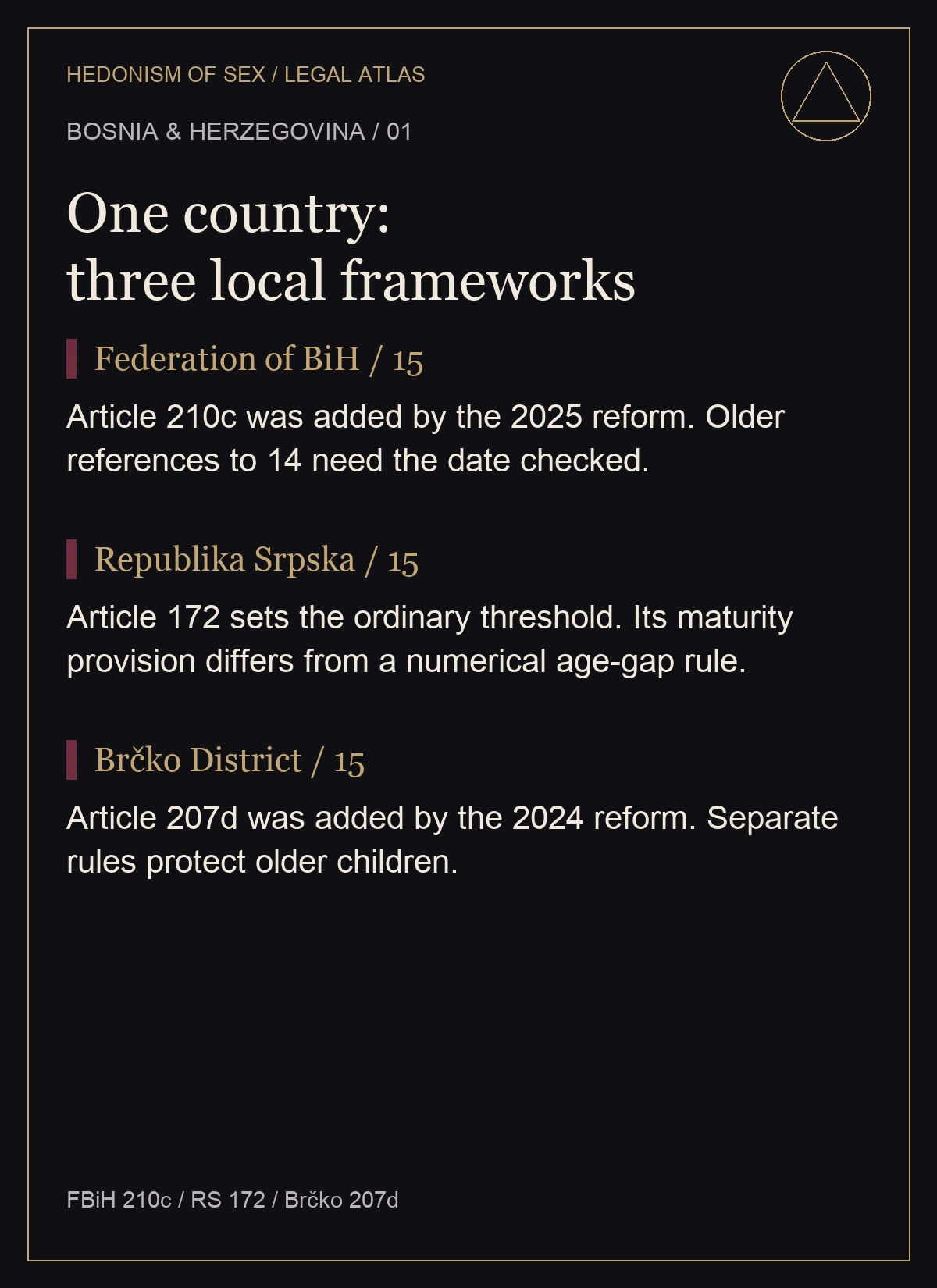
The ordinary contact-age threshold is 15 under Federation of Bosnia and Herzegovina Article 210c, Republika Srpska Article 172 and Brčko District Article 207d. The Federation and Brčko provisions state a limited no-more-than-three-year age-difference clause; Republika Srpska uses a mental-and-physical-maturity test instead. These provisions are not general permission for any relationship or image-sharing. Federation reform 58/2025, Article 44; Republika Srpska code, Article 172; Brčko reform 14/2024, Article 26.
Research scope. This guide compares the Federation, Republika Srpska and Brčko District criminal-law provisions on ordinary sexual conduct. A separate State-level Criminal Code also exists; this is not a complete survey of every State offence or cross-border jurisdiction rule. The research uses original parliamentary texts and amendments, including the Federation’s 2025 reform and Republika Srpska’s 2026 amendments. This is AI-assisted editorial research without independent lawyer review.
Start with the legal framework and the date
Different criminal codes apply within Bosnia and Herzegovina. For the age-specific ordinary-contact offences considered here, the relevant provisions are in the Federation, Republika Srpska and Brčko District codes. Identifying the place and applicable law matters even where the headline number is the same. Do not confuse Republika Srpska, an entity within Bosnia and Herzegovina, with the separate country of Serbia. Federation Article 210c; Republika Srpska Article 172; Brčko Article 207d.
| Framework | Ordinary threshold | Provision | Important qualification |
|---|---|---|---|
| Federation of BiH | 15 | 210c | 2025 reform; limited three-year clause |
| Republika Srpska | 15 | 172 | Qualitative maturity provision |
| Brčko District | 15 | 207d | 2024 reform; limited three-year clause |
Older references to 14 can reflect a former definition or former offence. The Federation’s 2025 law deleted the previous Article 207 and introduced Article 210c; Brčko’s 2024 law deleted the previous Article 204 and introduced Article 207d. A historical code downloaded before those reforms cannot establish today’s answer on its own. Federation amendment Articles 41 and 44; Brčko amendment Articles 21 and 26.
The peer provisions have different tests and limited scope
Federation: an age difference of no more than three years
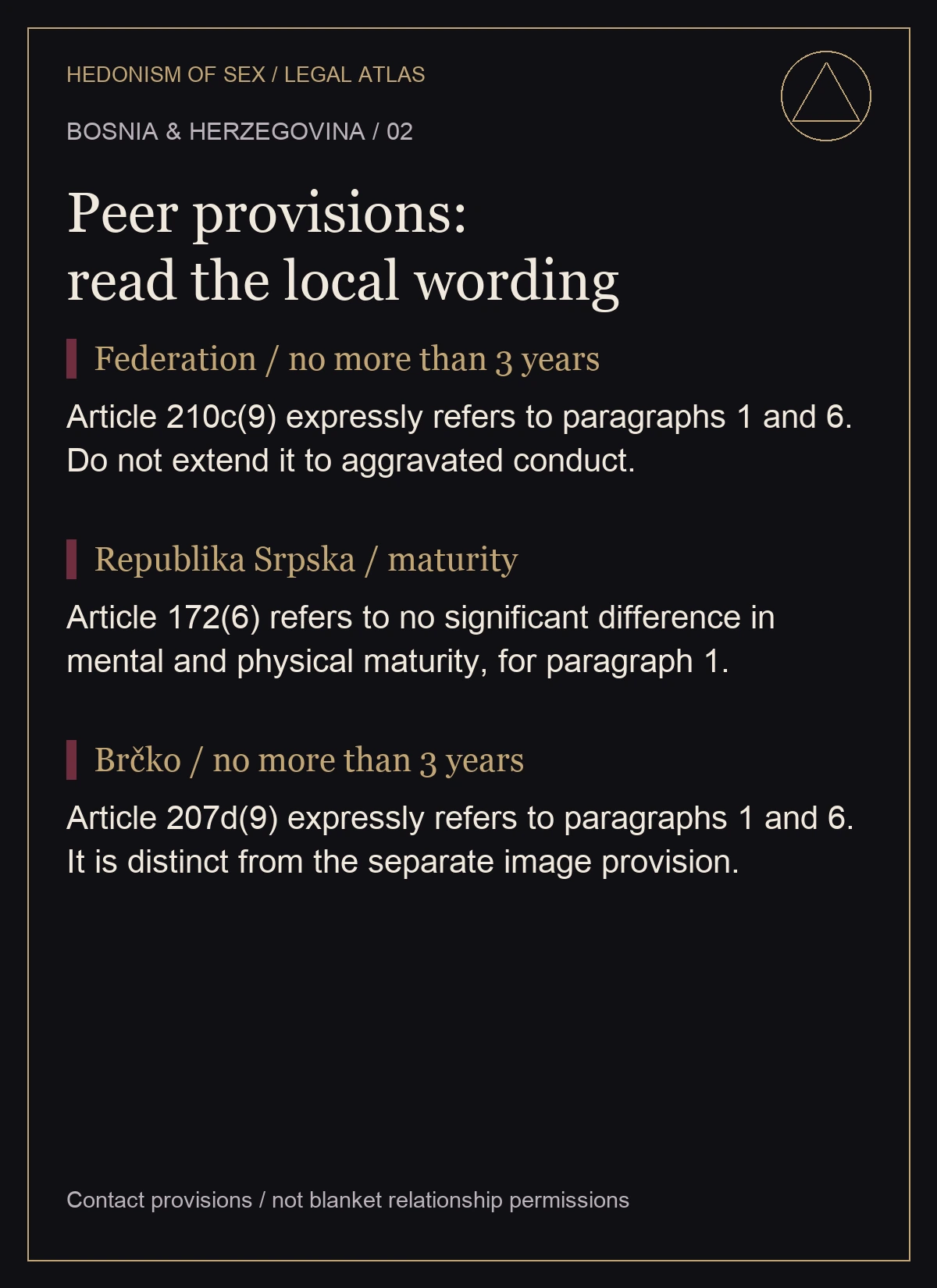
Article 210c(9) states that the person will not be punished for the paragraph 1 and paragraph 6 offences where the specified age difference is not greater than three years. Paragraph 1 concerns intercourse or an equivalent sexual act, including the specified third-person or self-directed conduct; paragraph 6 separately concerns other sexual acts. The clause itself refers to persons engaging in intercourse or an equivalent act, so its wording and express paragraph references must be read together. Article 210c(1), (6) and (9).
The numerical boundary is inclusive: a difference of exactly three years is not greater than three years, whereas three years and one day exceeds it. This is arithmetic illustrating the wording, not a finding that a particular case is lawful. Paragraph 9 does not expressly extend to the separate aggravated paragraphs involving entrusted care, force or other specified circumstances. Nor does it replace the consent requirement or create an exemption from independent offences.
Republika Srpska: mental and physical maturity
Article 172(6) uses a different test. It provides non-punishment for the paragraph 1 offence where there is no significant difference between the person and the child in their mental and physical maturity. No fixed two-year or three-year age difference appears in that clause. Its express reference is to paragraph 1; paragraph 7 separately addresses other sexual acts. This guide does not automatically extend paragraph 6 to paragraph 7. Article 172(1), (6) and (7).
A hypothetical pair close in age therefore cannot establish the Republika Srpska condition merely by subtracting birth dates. The assessment concerns both aspects of maturity and the applicable evidence. Equally, the Federation’s numerical clause should not be rewritten as if it contained this same maturity test. This guide describes the statutory non-punishment wording without importing another country’s legal definition of that phrase.
Brčko: a separate three-year clause
Article 207d(9) states a no-more-than-three-year difference and expressly references paragraphs 1 and 6. Its wording likewise refers to the persons engaging in intercourse or an equivalent act. It does not expressly extend the clause to the separate aggravated provisions. The provision is in Brčko’s own code; the fact that its structure resembles the Federation text does not make either code interchangeable with the other. Article 207d.
Parental approval is not an express replacement for any of these conditions. The protected person’s apparent willingness, the alleged offender’s age and criminal responsibility, and the availability of a particular statutory provision are separate questions. A case involving young alleged offenders also requires the applicable juvenile-law rules to be checked rather than assuming adult procedure and punishment.
Reaching 15 leaves substantial protection in place
In the Federation, the reformed Article 203(1) concerns intercourse or equivalent conduct without consent, including the specified third-person and self-directed acts. Paragraph 7 describes consent as a voluntary decision made by a person capable of making and expressing it. It gives examples of circumstances inconsistent with consent, including threats, deception, abuse of a dependent position and exploitation of a state preventing expression of refusal. Force is separately addressed in paragraph 3. Federation amendment Article 39, replacing Article 203.
Article 210d independently protects children who have reached 15 in specified entrusted-care relationships. It also addresses exploitation of psychological immaturity, thoughtlessness or helplessness, with a separate paragraph for other sexual acts. The code’s amended definition of a child is a person below 18. Passing the ordinary threshold does not remove these protections. Amendment Article 2 and new Article 210d.
In Republika Srpska, Article 173 addresses entrusted care and specified exploitation of older children. The 2021 amendment corrected paragraph 1 to refer to a child who has reached 15, rather than its former older-than-15 wording. Paragraph 2 separately includes exploitation of psychological immaturity or thoughtlessness, or a major disparity in maturity or age. Article 168 separately concerns abuse of position involving subordination or dependency. Articles 168 and 173; 15/2021 amendment, Article 39.
The Republika Srpska rape provision in Article 165 is framed around force or an immediate threat; Articles 166 and 167 separately address sexual blackmail and exploiting inability to resist. It should not be described as identical to the Federation’s rewritten consent definition. Consent remains a necessary practical question, but the legal elements must be identified under the applicable provision. Articles 165–168, read with subsequent amendments.
In Brčko, Article 200 was rewritten in 2024 to address the specified conduct without consent; paragraph 5 states the voluntary-decision and capacity condition. Article 207e separately protects older children in entrusted-care and specified exploitation situations. A disability or diagnosis alone should not be treated as proof of incapacity: the relevant provision and actual circumstances must be assessed. Amendment Article 19 and new Article 207e.
Living in an extramarital union is a separate question
All three frameworks examined contain a separate adult-cohabitation restriction involving a child below 16: Federation Article 216, Republika Srpska Article 184 and Brčko Article 213. Their wording and additional paragraphs differ. Thus, a hypothetical adult and 15-year-old cannot determine whether living together is lawful merely from the ordinary contact threshold of 15. Nor should every shared address automatically be treated as an extramarital union without assessing that legal concept. Federation amendment Article 47; Republika Srpska Article 184; Brčko amendment Article 30.
Republika Srpska Article 184(4) and Brčko Article 213(4) contain a marriage-related bar on commencing or continuing prosecution for the cohabitation offence. The Federation’s newly substituted Article 216 has three paragraphs and contains no equivalent clause. Do not copy the clause across jurisdictions or treat it as a general defence to sexual offences. Eligibility to marry is a separate family-law assessment that this guide does not determine.
The image provisions have their own limited private-use clauses
The ordinary age threshold is not an image-sharing age. Federation Article 210h, Republika Srpska Article 175 and Brčko Article 207i separately address child sexual material. The relevant definitions cover specified real or simulated sexual depictions, including certain realistic nonexistent children or persons appearing to be children; they do not make every ordinary photograph of a young person criminal material. Article 210h(6); Article 175(6); Article 207i(6).
Each examined provision has a paragraph 5 concerning production and possession by a child of material depicting that child alone or that child and another child. It requires that they themselves produced and possess the material with each participant’s consent, exclusively for their own personal use. The clause is limited to the production and possession described; it is not a general authorisation for adult recipients, public posting or forwarding to other people. Article 210h(5); Article 175(5); Article 207i(5).
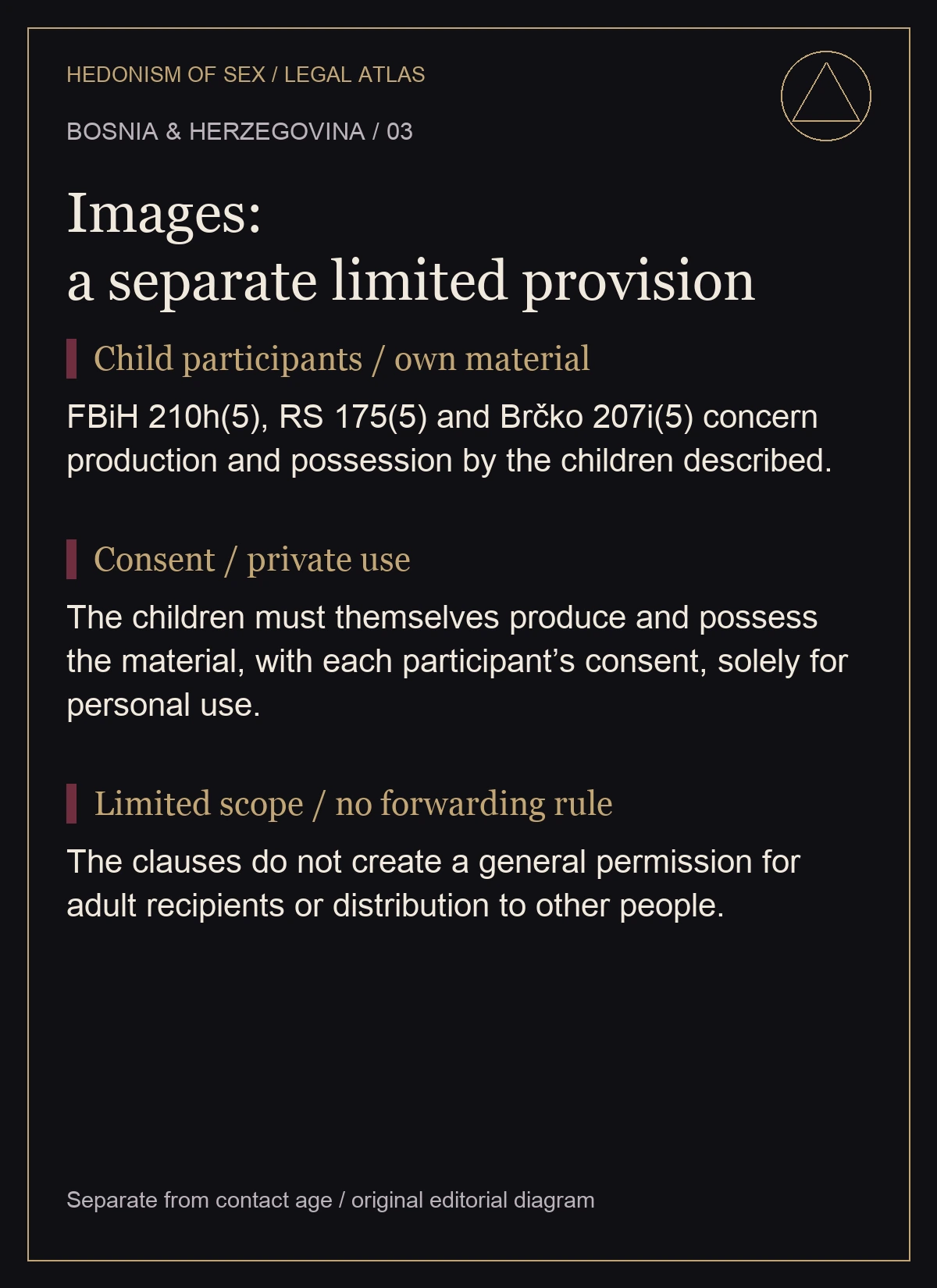
The contact-age peer clause and the image clause consequently require separate analysis. A small age gap does not itself establish the image conditions. Conversely, the limited image provision is not permission for otherwise prohibited sexual contact. No one should circulate suspected child sexual material as part of seeking an informal opinion about its legality.
Online-meeting offences use different elements
Federation Article 210e(1) concerns an adult arranging a meeting through a computer network or other information-communication technology with someone below 15 for the specified sexual or exploitation purposes, and taking steps for that meeting to occur. Paragraph 2 separately concerns collecting, giving or transmitting information about someone below 15 for the paragraph 1 offence. The text does not require a completed direct meeting in paragraph 1. Article 210e.
Brčko Article 207f has a comparable adult, below-15, arranged-meeting and steps-toward-the-meeting structure, but its own penalties and wording. Those elements should not be reduced to a statement that every online conversation is that offence. Other offences, including image offences and harassment, can require assessment before any meeting. Article 207f.
Republika Srpska Article 178 expressly includes appearance at the agreed meeting place with the specified purpose. It does not state an adult-only perpetrator condition. Paragraph 1 uses the wording child older than 15; paragraph 2 addresses a child younger than 15. This guide preserves those different formulations rather than silently replacing them with a uniform numerical formula or suggesting a lawful gap at a birthday. A boundary case needs assessment of the original wording and relevant interpretation. Article 178.
Intimate-material abuse is distinct from child-material offences
Republika Srpska’s 2023 amendment added Article 170a. It addresses abuse of trust through nonconsensual disclosure of specified material originally made with consent for personal use and resulting privacy harm. Its second paragraph separately concerns fabricated or altered intimate material used as genuine, while paragraph 3 addresses wider availability. Brčko added its own Article 186a in 2024, with distinct wording. 73/2023 amendment, Article 6; 14/2024 amendment, Article 17.
Consent to an original private recording should therefore not be treated as consent to onward disclosure. The existence of these provisions also does not resolve the separate child-material offences. This section identifies the provisions reviewed; it is not a complete catalogue of every privacy, harassment or disclosure remedy in the country.
Adoption, publication and commencement are different dates
Federation reform 58/2025: the Gazette issue is dated 1 August 2025 and Article 63 provides eighth-day commencement, giving 9 August 2025. The Una-Sana Canton government also confirms that commencement date. It should not be confused with the parliamentary votes or the 29 July promulgation. Original Gazette issue and Article 63; government commencement notice.
Brčko reform 14/2024: the original parliamentary text records adoption on 14 March 2024 and Article 42 provides eighth-day commencement after Gazette publication. The professional publisher Paragraf’s Gazette index dates issue 14/2024 to 21 March 2024, which yields 29 March under that clause. The date calculation relies on that secondary issue index; the substantive provisions here were checked against the original parliamentary PDF. For an allegation at commencement, verify the original Gazette issue rather than treating adoption as the effective date. Original amendment and Article 42; Paragraf issue index.
Republika Srpska: the 2017 original has been read with the parliamentary amendments of 2021, 2023, 2025 and 2026 relevant to this review. The 25/2026 amendment concerns substitution of short custodial sentences and excludes specified child sexual offences from its new substitution rule. The 78/2026 amendment adds other offences; neither replaces Article 172’s age or maturity provision. A more recent Gazette number should not automatically be reported as a new age-of-consent reform. Parliament’s adopted-law records; 25/2026 amendment; 78/2026 amendment.
An earlier incident requires the applicable temporal-law rules and any more-favourable-law rule to be considered. Present-day wording cannot simply be applied backwards. If conduct, travel, communications or images connect more than one jurisdiction, obtain advice about each applicable framework rather than assuming that one address decides every issue.
Common questions
Is the age of consent 14 or 15?
The current ordinary threshold in the three local provisions examined here is 15. Older references to 14 may describe law before the Federation’s 2025 or Brčko’s 2024 reform. Always check the jurisdiction, provision and incident date.
Is there one three-year exception throughout the country?
No. Federation Article 210c(9) and Brčko Article 207d(9) state limited three-year clauses. Republika Srpska Article 172(6) uses mental and physical maturity, without specifying a numerical age gap.
Can an adult live with a 15-year-old partner?
The contact threshold does not answer that question. Each reviewed framework separately addresses an adult living in an extramarital union with a child below 16. Family law and the facts need their own assessment.
Does the private-image clause permit forwarding?
It concerns the production and possession described by the child participants, with each person’s consent and exclusively for personal use. It does not create a general permission to distribute material or supply it to adult recipients.
Sources and practical next steps
For an individual situation, record the location, date and exact ages at the time. Identify any entrusted care or dependency, an intended extramarital union, payments, recordings, disclosure threats and overseas connections. A qualified lawyer can then assess the correct provisions and evidence. These facts are more useful than a single number taken from an international table.
- Original Federation amendment 58/2025 — Gazette copy hosted by Tuzla Canton’s Ministry of Interior; particularly Articles 39–44, 47 and 63.
- Judiciary legal-reference record for the Federation code — amendment list through 58/2025, checked 6 November 2026.
- Republika Srpska Parliament: original 64/2017 code — historical baseline, read with later original amendments.
- Republika Srpska Parliament: adopted-law search — original attachments for 15/2021, 89/2021, 73/2023, 31/2025, 25/2026 and 78/2026 checked for relevant changes.
- Brčko Assembly: code and amendment collection — official 19/2020 consolidation, 3/2024 and 14/2024 originals.
- Brčko 14/2024 original — contact, consent, child protection, images, meetings, cohabitation and commencement clause.
- Una-Sana Canton government notice — independent primary confirmation of Federation commencement.
- Paragraf’s Brčko Gazette index — secondary source used specifically for the 2024 publication date, as disclosed above.
Compare the independently researched guides to Croatia, Serbia and Montenegro, or return to the Law & Rights library.
Review and corrections. Checked 6 November 2026. We retain original source files, extracted text and a review register. Original AI-assisted diagrams are identified in their captions. The use of a secondary Gazette index for Brčko’s publication date is disclosed; no independent lawyer review or comprehensive survey of State-level offences is claimed.