Age of Consent in San Marino: 14, Authority and Separate Image Laws
The ordinary threshold does not resolve questions about exploitation, authority, paid sexual activity or intimate images. Here is how the provisions fit together.
San Marino’s ordinary age-of-consent threshold is 14. Criminal Code Article 173 applies to the specified sexual acts involving a person under 14 even without violence, threats or deception. It contains no express close-in-age exception. Other provisions protect people above that threshold in particular circumstances, including authority, exploitation and payment. Criminal Code collection, Articles 171–177-ter (ZIP containing PDFs).
This guide separates the age rule from offences that depend on coercion, an institutional relationship, payment or the use of images. It also explains why an international recommendation to criminalise conduct must not be presented as if it were already a domestic offence.
Article 173 protects people under 14
Article 173 applies the referenced sexual-offence penalties to the specified conduct involving a child under 14 without requiring violence, threats or deception. It also covers a person unable to resist because of physical or psychological conditions. Its second paragraph states that the offender cannot rely on ignorance of the victim’s minority as an excuse. The age rule therefore cannot be reduced to a question about whether someone appeared willing or older. Code, Article 173.
No express peer exception appears in Article 173. That is different from a country whose legislation sets a maximum age difference and a minimum age for an exception. Do not transfer an Italian or another neighbouring country’s exception into San Marino’s code. Nor should the absence of a peer clause be confused with the separate rules governing a young alleged offender’s criminal responsibility.
Article 10 states that a person under 14 is not criminally imputable. For the older minor group described there, the court assesses the capacity to understand and to act and applies the specified reduced penalty. This concerns responsibility for an offence, not permission to engage in conduct with a protected child. Code, Articles 10 and 173.
Above the ordinary threshold, coercion and incapacity remain relevant. Article 171 addresses compelling or inducing sexual acts through violence, threats, deception, hypnotic suggestion or other suitable means. Article 172 provides aggravating circumstances, including the specified penetrative conduct, partner relationships, professional exploitation, disability and minority. The text does not make a birthday a substitute for examining those facts. Ratified Decree 161/2024, Articles 11 and 13.

Authority and other specific protections can matter after 14
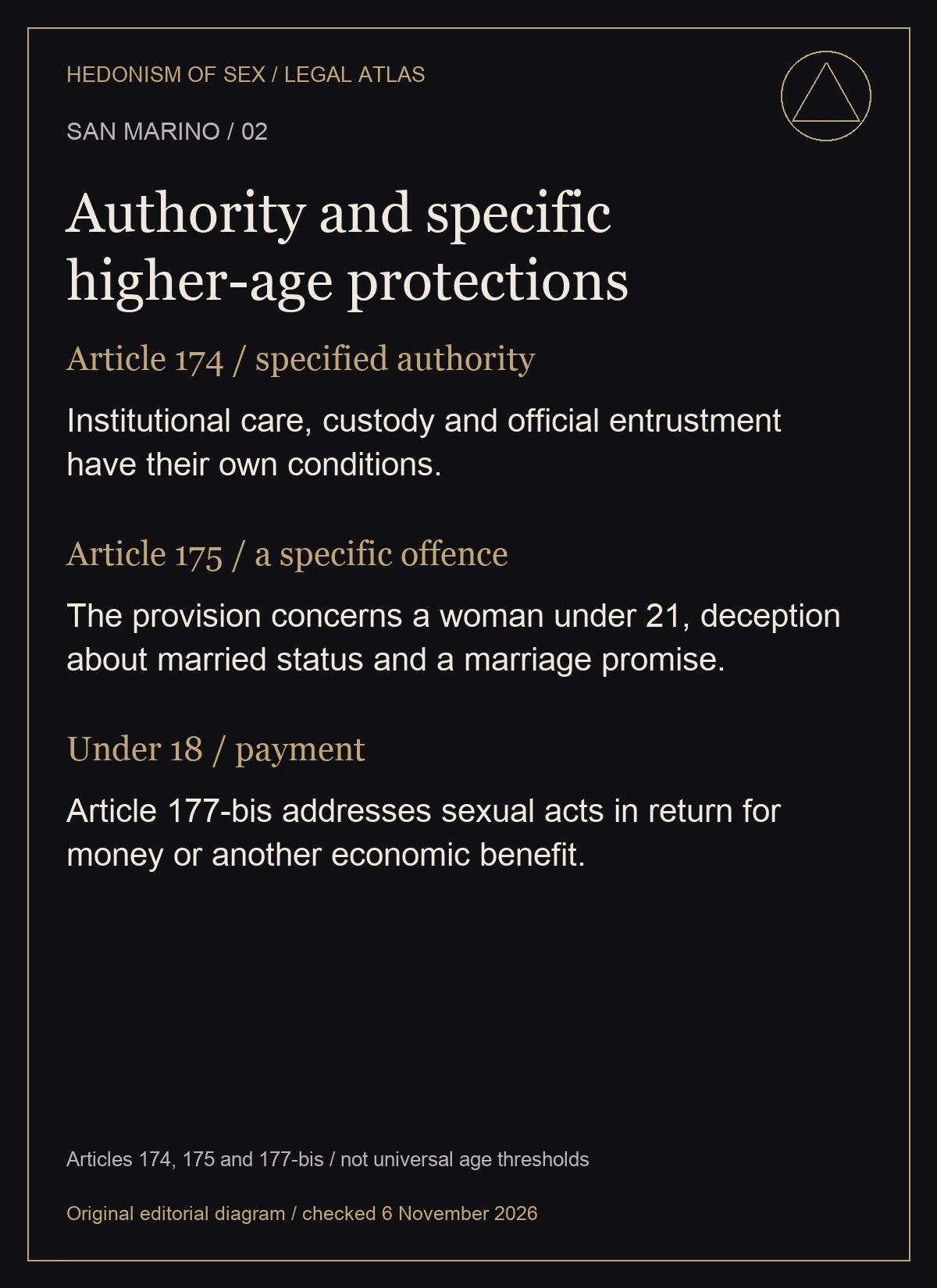
Article 174 addresses sexual acts involving a person in a hospital, hospice, boarding institution, re-education institution, arrest or detention where the offender has authority over that person, or someone entrusted to the offender for official reasons. It operates outside the cases covered by Articles 171–173. This is a provision about specified relationships and circumstances; describing it as a universal alternative age of consent would lose its actual elements. Code, Article 174.
Article 171 also provides occupational or parental disqualification where the offence is committed by the specified parent, adoptive parent, guardian, educator, teacher, healthcare professional or person entrusted with a minor for supervision, education, instruction or care. An authority relationship may therefore affect both the applicable offence and its consequences. Decree 161/2024, Article 11.
An unusual provision concerning deceptive marriage promises
The collected code retains Article 175, entitled Seduzione. It addresses intercourse with a woman under 21 induced by deception about the offender’s married status and a promise of marriage. This is a specific, gendered provision with stated conditions, not an ordinary consent threshold of 21. Its continued appearance in the checked collection is relevant to an accurate account, even though its terminology differs from modern sexual-autonomy provisions. Individual interpretation and application require local legal advice. Code, Article 175.
Sexual harassment and the 2026 amendment
Article 171-bis addresses unwanted sexual acts or behaviour, including through social communications, that harass someone in violation of sexual freedom and dignity. It separately addresses the specified education, training, work, internship or apprenticeship circumstances involving abuse of authority or official relationships. Law 28/2026 replaced this article; the current version should be read rather than the earlier 2024 wording. Law 28/2026, Article 2.
Payment and grooming have their own provisions
Article 177-bis criminalises sexual acts with a person under 18 in return for money or another economic benefit, subject to the more serious offence proviso. The ordinary threshold of 14 does not override that under-18 protection. Article 177 separately addresses inducing an under-18 person into sexual corruption and the other conduct it lists. Its existence should not be paraphrased as making every freely chosen relationship involving a 14- to 17-year-old criminal. Law 61/2002, Article 2; Code, Articles 177–177-bis.
Article 177-quinquies criminalises grooming a minor for the purpose of committing the listed sexual offences. It defines grooming through acts aimed at gaining the minor’s trust by artifice, deception, flattery or threats, including over the internet or other communications. The criminal purpose and the definition matter: the provision is not a generic prohibition on all online conversations with a minor. Decree 161/2024, Article 14.
Production, receipt and circulation are different legal questions
Article 177-ter addresses using an under-18 person to produce the specified pornographic performances or material, commercial activity, providing the material to others for payment or free of charge, and the specified distribution, publicity and related conduct. The offence is separate from the ordinary contact threshold. The original provision and the checked collection should be consulted for its definition and different forms of conduct. Law 61/2002, Article 3.
Do not substitute a treaty recommendation for a domestic offence
A Council of Europe factsheet, updated with government information in March 2025, identifies a gap concerning mere possession and distinguishes it from active production or circulation. It also records government explanations about self-produced material and passive receipt. These dated monitoring findings explain why “every private image is automatically the same offence” is an unreliable summary; they do not establish blanket permission to create or exchange material. We found no relevant later amendment in the official 2025–2026 archive search described below. Council of Europe factsheet, pages 4–5.
Unauthorised circulation of private intimate material
Article 181-ter separately addresses sending, giving, publishing or disseminating the specified private sexual images without the represented person’s consent. The first limb concerns someone who made or took the material; the second concerns someone who received or otherwise acquired it and circulates it without consent with the purpose of causing harm. Preserve that distinction rather than adding a harm-purpose requirement to every limb. Law 16/2021, Article 2.
The provision also specifies aggravated circumstances and procedural rules. Permission to receive an image is not permission to publish it, and a dispute about ownership of a device does not resolve the represented person’s consent. Where a minor is involved, both the private-image provision and the separate exploitation provisions may need analysis.

What was checked, and what the sources can prove
We read the Parliament’s collected Criminal Code updated to 27 February 2026, including the version with legislative notes, and the original relevant 2002, 2021, 2024 and 2026 instruments. The collection expressly describes itself as a working compilation rather than a source of law. We therefore compared the operative provisions with the published amendment instruments and checked later changes.
The official archive’s content search for “penale” returned six acts for 2025 and 25 for 2026. We checked all 31 returned documents. Among those results, no later amendment changing the age rule in Article 173 or the discussed image provisions was identified. This describes the scope of an actual archive check; it is not a guarantee that an index cannot omit a document. The current Article 171-bis wording was independently checked against Law 28/2026. Official legislative archive.
One later act changes the territorial definition in Article 5: Decree 79/2026 reissued a lapsed maritime amendment and was ratified on 22 July 2026. Its territorial wording must be considered if the question involves a San Marino vessel or aircraft. For specified child-exploitation offences, Law 61/2002 Article 5 also contains nationality-based rules for conduct abroad, subject to its conditions. A neighbouring country’s law may matter as well; consult our Italy guide for that separate framework. Decree 79/2026; Law 61/2002, Article 5.
Common questions
Is there an express close-in-age exception?
Article 173 contains no express age-gap exception. Criminal responsibility of a young alleged offender is a separate matter under Article 10. Code, Articles 10 and 173.
Does Article 175 make the general threshold 21?
No. It describes a specific offence concerning a woman under 21, deception about married status and a promise of marriage. It must be distinguished from Article 173’s ordinary under-14 protection. Code, Articles 173 and 175.
Can private sexual images be freely forwarded?
That conclusion does not follow from the ordinary age threshold or from a gap concerning mere possession. Production, providing material to others and unauthorised private-image circulation have separate provisions. Article 181-ter; Article 177-ter.
Sources and next steps
Checked 6 November 2026. This is an editorial English explanation of Italian-language sources, not an official translation or an individual legal opinion. No independent lawyer review is claimed. The downloadable code link is a ZIP containing two PDF versions.
- Collected Criminal Code and legislative notes.
- Law 61/2002 and Law 16/2021.
- Ratified Decree 161/2024 and Law 28/2026.
For individual advice, record the exact dates and ages, the relationship between the people involved, any authority, payment, coercion or incapacity, and what happened to any images. These facts help a San Marino lawyer identify the relevant provisions. Browse the Law & Rights library and our editorial approach for the broader project.