Age of Consent in Vatican City: Why State Law and Canon Law Must Be Read Separately
The state’s child-protection offences, a limited marriage qualification and the Church’s own penal rules answer different legal questions.
This guide helps readers identify the applicable law before considering age, authority, marriage, images or reporting. A Vatican criminal proceeding and a Church disciplinary proceeding can involve different jurisdictional rules, offences and sanctions.
Vatican City State and the Holy See are distinct
Article 2(2) of the Fundamental Law dated 31 July 2026 expressly distinguishes the state and its legal order from the Roman Curia and the Holy See’s other institutions. That distinction matters when a summary uses “the Vatican” to describe both a territory and the central institutions of the Catholic Church. Fundamental Law, Article 2.
The Law on Sources of Law identifies canon law as the first normative source and interpretative reference. It also recognises the state’s enacted legislation. Its provisions on receiving Italian legislation require the applicable Vatican reception rules; they do not make every modern Italian criminal-law amendment automatically operative in Vatican City. Article 7 refers to the received criminal code as modified and supplemented by Vatican laws. Law LXXI, Articles 1, 3 and 7.
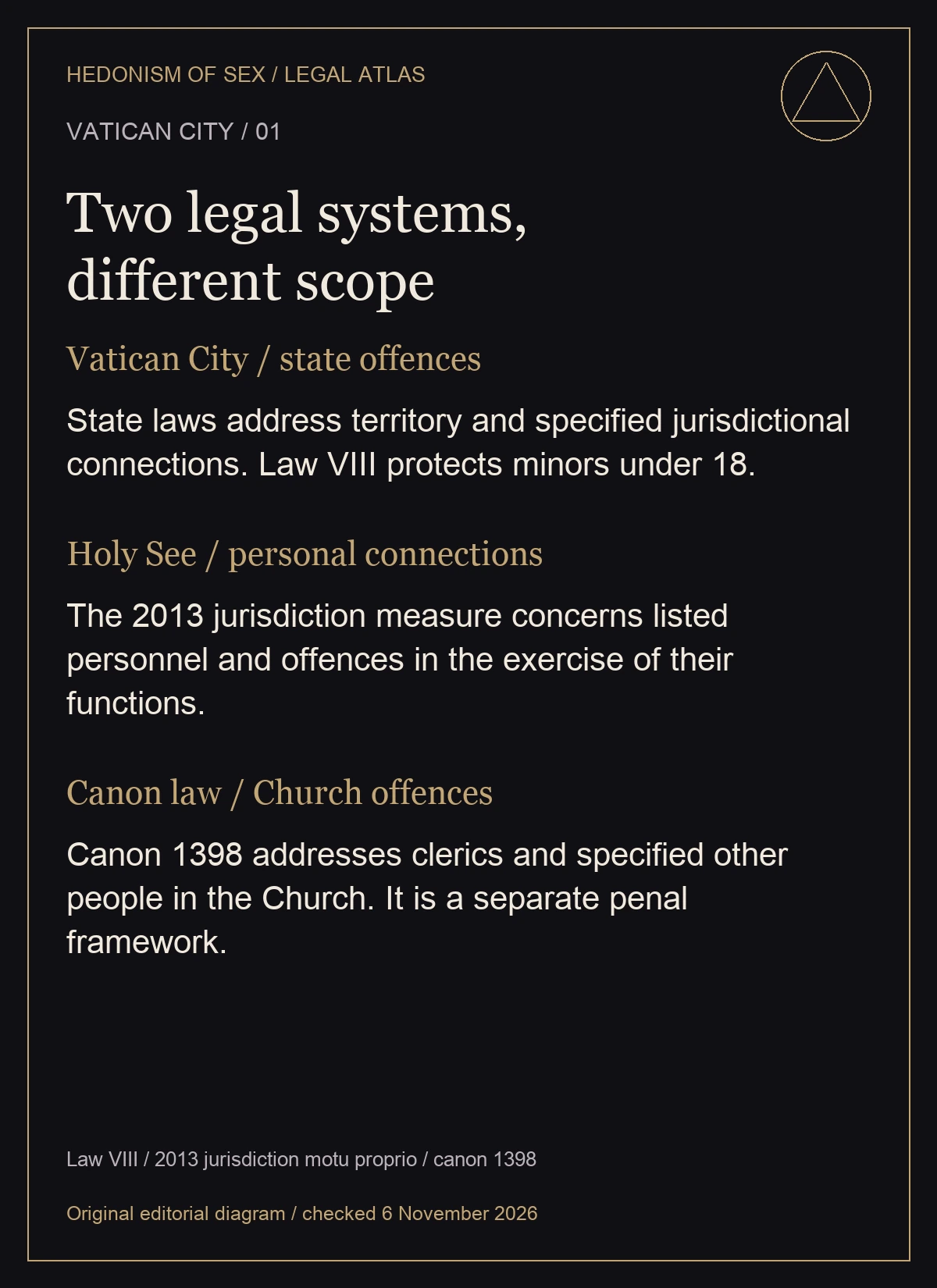
State jurisdiction can extend beyond the territory under specified conditions. The motu proprio of 11 July 2013 covers the listed Law VIII and IX offences committed by specified Holy See personnel in the exercise of their functions. It is not a statement that Vatican state criminal law automatically governs every Catholic everywhere. Separate nationality, presence and other jurisdictional provisions may also matter. 2013 jurisdiction motu proprio, points 1–5.
Article 8 uses age groups and different penalties
Law VIII Article 4 defines a minor as someone under 18. Article 8(1) criminalises sexual acts involving a person under 14, subject to the proviso for a more serious offence. Article 8(2) increases the penalty for the specified parent, ascendant, guardian, entrusted care, education, instruction, supervision or custody relationships, or cohabitation. Those relationships must be considered alongside the age provisions. Articles 4 and 8(1)–(2).
Paragraph 3 describes a minor older than 14 but younger than 16 and reduces the penalty. Paragraph 4 describes a minor older than 16 and reduces the paragraph-1 penalty by one quarter. These provisions still describe an offence; a reduced sentence is not a consent defence. The text’s precise age wording should be assessed against exact birthdays and the applicable interpretation rather than rounded into a permission on a particular birthday. Article 8(3)–(4).
No express numerical close-in-age defence appears in Article 8. Do not import one from Italy or confuse rules about an alleged offender’s responsibility with an exception to a protected person’s age. Article 9 separately excludes ignorance of age as an excuse for the listed offences involving an under-14 victim. Articles 8–9.
The marriage qualification is limited to two paragraphs
Article 8(5) states that the offence does not exist in the cases under paragraphs 3 and 4 where the sexual acts occur within the marriage bond. It does not refer to the under-14 offence in paragraph 1. It also does not repeal the separate offence in Article 7 concerning a minor compelled through violence, threats or abuse of authority. Articles 7 and 8(5).
Marriage has its own legal requirements. Law LXXI Article 4(c) provides that marriage is governed exclusively by canon law. Canon 1083 sets ordinary validity ages of 16 for a man and 14 for a woman and allows an episcopal conference to set a higher age for lawful celebration. Other impediments, consent requirements and applicable rules still need examination. These marriage ages should not be relabelled as general ages of sexual consent. Article 4(c); canon 1083.

Images, recordings and exploitation are separate offences
Law VIII Article 10 addresses production using a minor, recruitment or inducement for the specified performances, commercial activity and different forms of circulation, including free provision. Article 11 separately addresses obtaining or knowingly possessing qualifying material. Their definition concerns minors under 18 and does not depend on whether a particular relationship falls within Article 8’s marriage qualification. The checked provisions contain no express general private-image peer exception. Articles 4(d), 10 and 11.
Private recordings also require their own analysis. Law DXXXI of 6 September 2022 introduced Criminal Code Article 158-bis concerning the specified improper acquisition of private-life images or information in a home or other private dwelling and their disclosure. Article 164-quater separately concerns dissemination of the specified private recordings with the purpose of harming reputation or image, with stated exceptions and a complaint requirement. These provisions should not be compressed into an unconditional prohibition covering every possible recording or disclosure. Law DXXXI, Articles 4–5.
Law VIII Articles 5 and 6 separately address sale of minors and child prostitution. Article 4’s definition includes payment or another form of consideration given or promised to the child or another person. A claimed agreement does not remove the need to examine exploitation or the statutory conduct involved. Articles 4–6.

The 2019 protection law changes procedure and safeguards
Law CCXCVII applies to Law VIII Title II offences and specified criminal-code offences against minors or people treated as equivalent under that law. It defines vulnerability through the stated illness, impairment or deprivation of liberty that actually limits understanding, will or resistance, even occasionally. The definition should be preserved rather than equating every difficult circumstance with every element of every offence. Article 1.
Article 2 makes the covered offences prosecutable ex officio. Article 3 imposes a reporting obligation on public officials under its specified territorial, victim and official-function connections, while preserving the sacramental seal. It also allows other people with knowledge of conduct harming a minor to report it. Articles 4–7 provide protective measures, including privacy safeguards and a special representative where the child’s legal representatives have a conflict of interests. Articles 2–7.
Canon law has its own offences and personal scope
Canon 1398 addresses sexual offences involving a minor or a person with the specified equal protection, as well as recruitment for pornographic display and the stated image conduct. Its first paragraph concerns clerics. Paragraph 2 extends the stated penalties to members of institutes of consecrated life or societies of apostolic life and faithful who hold a dignity or perform an office or function in the Church. It should not be described as a state statute applying identically to every visitor to Vatican City. Canon 1398.
Canon 97 fixes canonical majority at 18. The revised Book VI entered into force on 8 December 2021. These canonical dates and definitions must be distinguished from Law VIII’s commencement on 1 September 2013 and the protection law’s commencement on 1 June 2019. Earlier events require the relevant historical law and temporal rules. Canon 97; Pascite gregem Dei.
Sources and verification limits
Checked 6 November 2026 against the official original instruments and current canonical text. We reviewed the state’s criminal-legislation index, relevant later instruments and the current Holy See legislative listings. We also searched the 18 available 2025–2026 volumes of Acta Apostolicae Sedis for relevant changes: all 13 listed 2025 issues and the five listed January–May 2026 issues. Later 2026 instruments were checked separately. No amendment to the provisions discussed here was identified in those checks.
This is an explanation of the checked instruments, rather than a certified consolidated code. Public indexes and text searches can be incomplete; an individual case requires checking the applicable law and interpretation at its date. The exact age wording of Article 8 is retained without inventing a judicial ruling about its boundaries. This is an editorial English explanation, not an official translation or an individual legal opinion. No independent lawyer review is claimed.
For a specific question, identify the place and date, exact ages, any valid marriage, the alleged offender’s role, authority or dependency, and whether images, recordings or payment were involved. Then establish which state and canonical jurisdictions apply. Our Italy guide concerns a separate national system. Continue through the Law & Rights library or read our editorial approach.