Age of Consent in Georgia: 16, Adult-Offender Rules and Separate Image Laws
The national under-16 framework, the adult-offender condition, online meetings and image protections, with explicit regional verification limits.
Georgia’s Criminal Code uses an under-16 threshold for two important age-based sexual offences, and expressly requires an adult offender. That combination matters: a list saying only “16” does not explain the position of younger peers, coercion, online meeting offers or sexual images. This guide explains those separate questions for the country of Georgia.
What the under-16 rule says
Article 140 concerns sexual penetration of the body of a person below 16, knowingly committed by an adult. The ordinary penalty in paragraph 1 is seven to nine years’ imprisonment. Paragraph 2 contains aggravated cases, including specified circumstances involving disability or pregnancy, a group, multiple victims, repetition and previous commission of listed sexual offences. It provides eight to twelve years. Criminal Code, Article 140.
Article 141 separately addresses an adult’s knowing, nonviolent “lewd act” against a person who has not reached 16. The English translation uses that legal term; it should not be replaced with an invented exhaustive list of conduct. The ordinary penalty is five to nine years, with an aggravated range of eight to twelve years. The aggravated circumstances include a victim below 14 and use of trust, authority or influence. Article 141.
These are age-based offences. A young person’s agreement does not remove their age element, and a parent’s approval is not an exception stated in either provision. Neither provision sets a different threshold according to the sexes of the people involved. The relevant questions include the conduct, both people’s ages, the required knowledge and any additional offence.

Peer cases: an adult condition is different from an age-gap exception
The Civil Code defines a person who has reached 18 as an adult. Articles 140 and 141 do not state a numerical close-in-age defence. Their text instead makes adulthood an element of the offender’s liability. Those are different legal mechanisms. A fixed age-gap exception may excuse a qualifying adult; an adult-offender condition asks whether that particular offence applies to the person at all. Civil Code, Article 12(2).
For a case involving two minors, it is therefore inaccurate simply to say that every sexual interaction below 16 automatically falls under Article 140 or 141. It is equally inaccurate to treat the adult condition as permission for coercion, exploitation or unlawful image conduct. Other offences have their own elements. Article 33 establishes a general exclusion of criminal blame for a person who had not reached 14 before the act; this is a rule about criminal responsibility, not a declaration of sexual consent. Articles 33 and 137–141.
Hypothetical example: if two young people are both minors, the adult-offender element must be considered before invoking Articles 140–141. That assessment still leaves separate questions about violence, threats, helplessness and any images. The example is an explanation of statutory structure, not a ruling that a particular relationship is lawful.
Do not import a two-, three- or four-year exception from another country. The provisions checked here do not contain one. The Council of Europe’s comparative study also lists Georgia among states without a numerical age-difference clause, but the current national wording remains the controlling source for the explanation above. Council of Europe comparative study, section III.2.
Force, coercion and positions of power still matter
The threshold in Articles 140–141 is not a guarantee that conduct involving someone aged 16 or older is lawful. Article 137 defines rape through sexual penetration involving violence, a threat of violence or abuse of the affected person’s helpless condition. Article 138 covers other sexual acts involving its specified violent, threatening or helplessness circumstances. Both have aggravated provisions, including protections concerning minors and particular relationships. Articles 137–138.
Article 139 addresses coercion into sexual penetration or another sexual act. Its listed means extend beyond physical violence: they include threats to damage property, disclose defamatory or private-life information, or disclose other information that may substantially affect the person’s rights. It also addresses abuse of helplessness or material, official or other dependence. Knowing commission against a minor is an aggravated case. Article 139.
Hypothetical example: threatening to publish private information to obtain sexual activity raises an Article 139 question even when the targeted person is above the ordinary under-16 threshold. The ages do not answer the coercion question.
A teacher, carer, supervisor or family member should not assume that being above 16 settles the issue. The relevant criminal provisions distinguish abuse of an official position, dependence, family and care relationships, and trust or influence. Their exact role differs between offences; it would overstate the checked text to invent one universal authority-related consent age. Articles 253–254 also contain separate protections against specified involvement in or promotion of prostitution, with aggravated provisions concerning minors. Articles 137–141 and 253–254.
Marriage has its own threshold: Civil Code Article 1108 permits it from 18. Do not equate that with the under-16 sexual-offence provisions or treat parental approval as a marriage exception. Forced marriage, including an unregistered marriage, is separately addressed by Criminal Code Article 150¹, with an aggravated provision where it is knowingly committed against a minor. Civil Code, Article 1108; Criminal Code, Article 150¹.
Online meeting offers: two distinct age tests
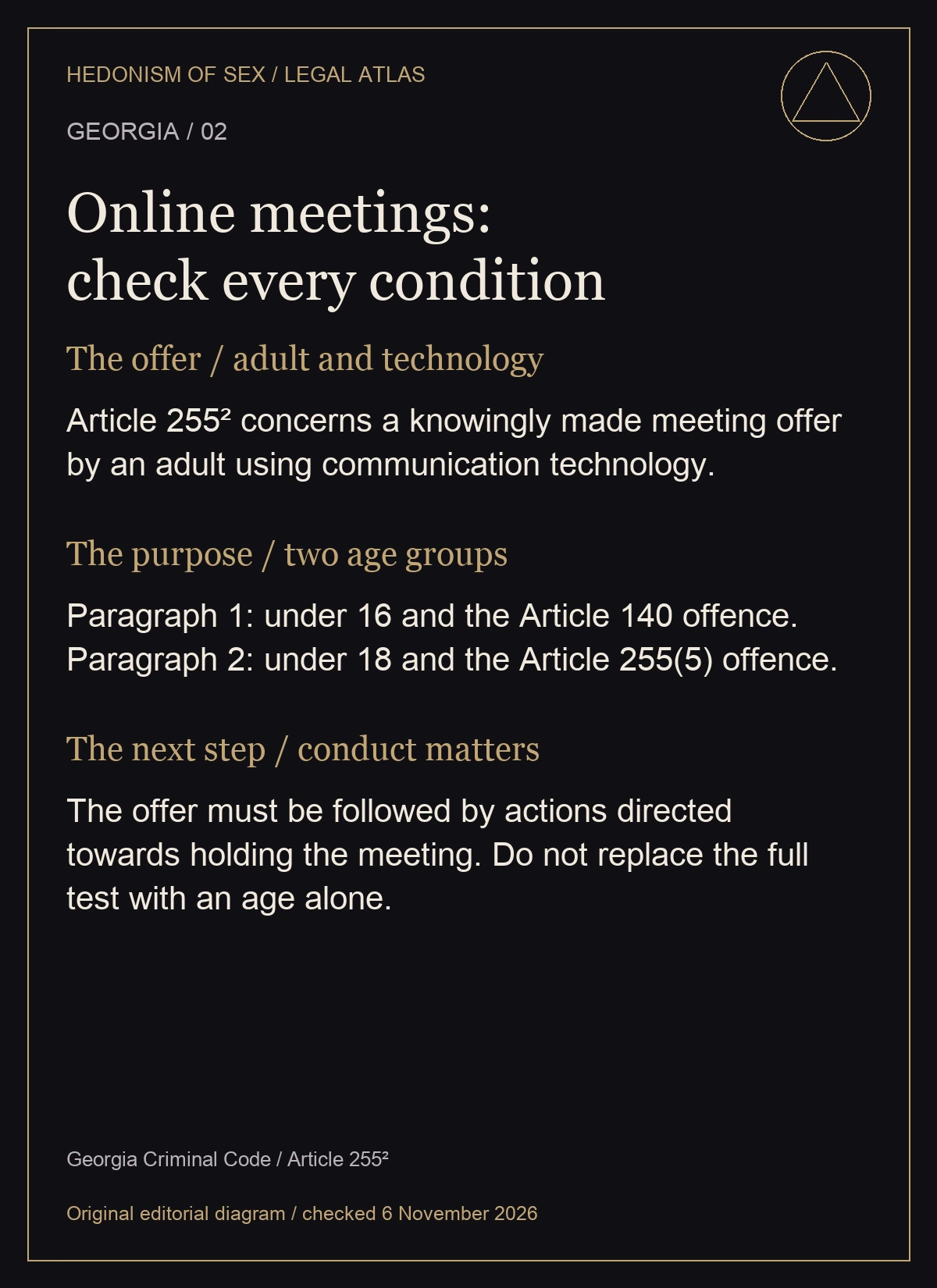
Article 255² separates two situations. Paragraph 1 concerns an adult knowingly offering a meeting to someone under 16 through information and communication technologies, for the purpose of committing the Article 140 offence. The offer must be followed by actions directed towards holding the meeting.
Paragraph 2 uses an under-18 threshold where the adult’s meeting offer is for the purpose of committing the offence in Article 255(5), concerning specified pornographic material involving minors. It also requires subsequent actions directed towards the meeting. The statutory penalty ranges are two to six years for paragraph 1 and three to eight years for paragraph 2. Article 255².
This is not a rule that every message is the completed meeting-offer offence. It has an adult-offender condition, knowledge, a specified purpose, a technological means and follow-up conduct. Conversely, a failure to establish this particular offence does not establish that every message or associated act is lawful under other provisions.
Images and private information have their own rules
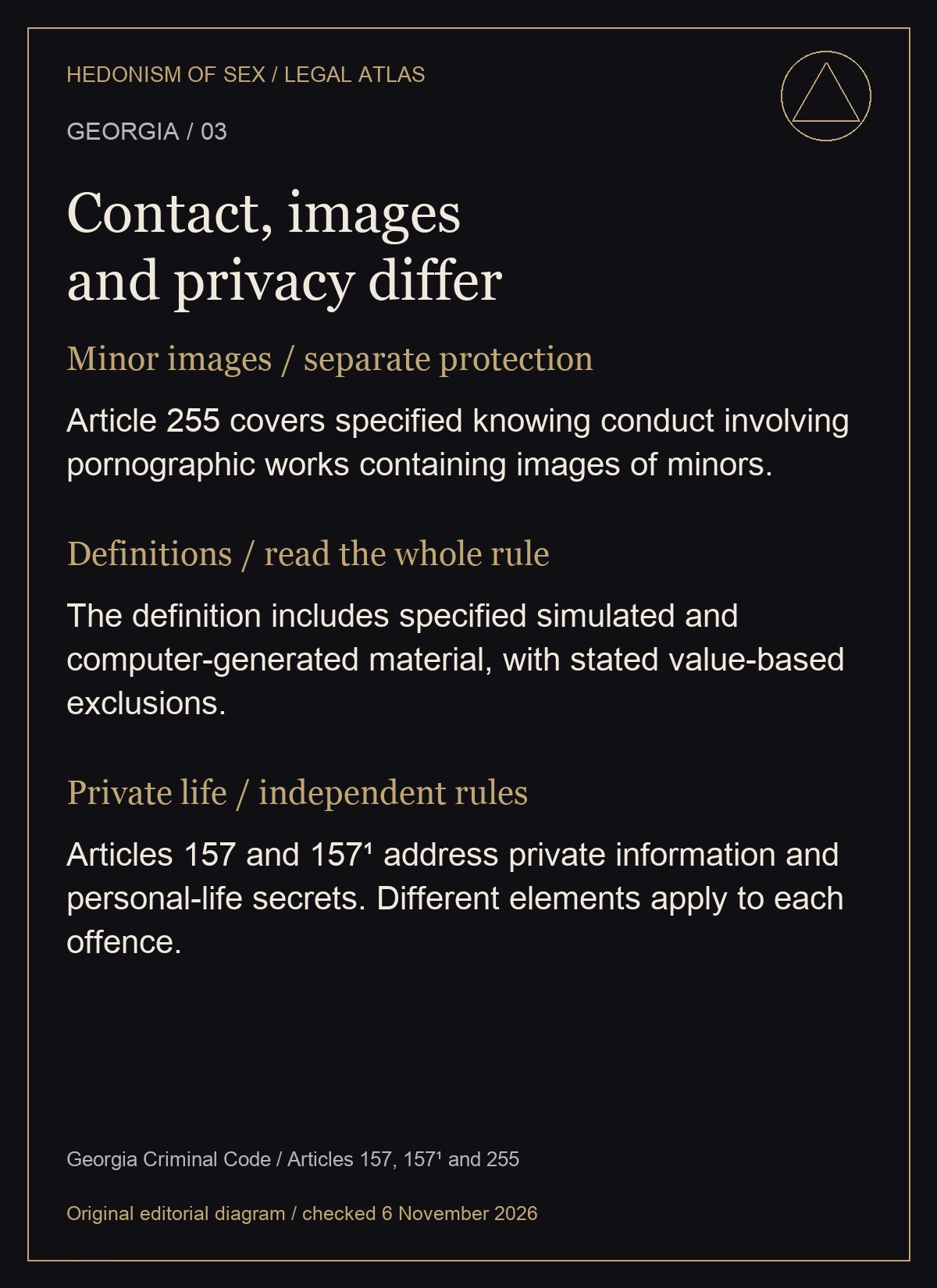
The ordinary contact threshold must not be used as an image-production or image-sharing threshold. Article 255(3) addresses specified knowing conduct involving pornographic works containing images of minors, including purchasing, storing, possessing, attending a demonstration and using the material. Paragraph 4 addresses offering, importing, exporting, dissemination, transfer, advertising and providing access. Paragraph 5 separately concerns knowing making and selling. Aggravated provisions follow. Article 255(3)–(7).
The definition includes specified visual or audiovisual material and staged performances, participation by minors or characters appearing to be minors, and actual, simulated or computer-generated sexual scenes. It also includes specified depictions of minors’ genitalia for consumers’ sexual gratification. The note excludes a work with medical, scientific, educational or artistic value. The definition and exclusions must be read together; the word “image” alone is not the entire legal test. Article 255, note 1.
No general private-exchange or peer-image exception is expressed in the checked Article 255 text. Agreement to sexual contact does not answer the separate questions about producing, keeping, sending or making material accessible. Nor should readers assume that a digitally generated depiction necessarily falls outside the definition.
The consolidated code retains an important constitutional annotation to Article 255(1), recording invalidation of its general pornography-offence wording by Decision 1/8/926 of 4 November 2022. The original decision made that invalidation effective from 1 May 2023. That annotation must not be presented as invalidating the separate minor-material provisions in paragraphs 3–7. The majority’s ruling on the clarity of the general offence must also be distinguished from the accompanying dissent concerning freedom of expression. Original Constitutional Court decision.
Privacy law is another independent layer. Article 157 addresses unlawful obtaining, storage, use or disclosure of private-life information or personal data, with a considerable-damage element in its basic provisions. Article 157¹ separately concerns secrets of personal life and does not state that same basic damage element. Both include further qualifications and notes. Their precise application requires the facts; it would be misleading to merge them into a single blanket rule about every recording. Articles 157 and 157¹.
Territory and jurisdiction need separate attention
Article 4 provides for criminal liability under the code for crimes committed in Georgia, with further territorial and vessel rules. Article 5 sets conditions for liability for acts committed abroad; citizenship, the law where the act occurred, the category of offence and international agreements can matter. A foreign visitor should not assume their home country’s threshold determines the answer, or that only one jurisdiction can be relevant. Articles 4–5.
Georgia’s Law on Occupied Territories, Articles 2–3 and 11, identifies Abkhazia and the Tskhinvali region/former South Ossetian Autonomous Region and provides a special legal regime. National law and the rules enforced by de facto institutions must be distinguished.
Abkhazia: a separate code and an incomplete currentness record
The de facto Supreme Court hosts a separate Criminal Code whose amendment list ends on 4 August 2023. It has its own sexual-offence provisions in Articles 126–130. A later original law, Law 6497 of 27 July 2026, concerns archaeology. That law does not establish that every intervening amendment has been checked. The public presidential archive also omits a known April 2025 criminal-code amendment. The 2023 file is consequently a dated source, not a certified statement of all law in force on this article’s check date.
South Ossetia: Russian-law references are not a complete local code
The Russian consular information portal describes adaptation of Russian legislation and identifies local differences. Its discussion of Russian procedural codes does not establish every current substantive sexual-offence rule, exception or amendment. We have not independently verified a complete current local framework from primary legislation.
Sources and outstanding checks
Checked 6 November 2026. This is an editorial explanation of the national provisions identified above, using Matsne’s final Criminal Code consolidation 296 and Civil Code consolidation 140, both labelled 25 June 2026. The Georgian text and the official English translation were compared for the core age and image provisions. The source archive records the original documents, retrieval results, the scope of review and unresolved regional checks.
- Criminal Code: final official English consolidation, with Georgian original-language text. The review focused on jurisdiction, criminal responsibility, sexual offences, exploitation, privacy, images and meeting offers; it was not a full commentary on the entire code.
- Civil Code: adulthood and marriage, Articles 12 and 1108.
- Law 6753 of 13 July 2020. Its commencement clause was checked against the historical official consolidation, which expressly marks the relevant amendments effective from 3 August 2020.
- Constitutional Court Decision 1/8/926: scope, statutory-clarity reasoning and operative provisions checked; the separate dissent was distinguished from the majority.
- The eight 2026 entries listed on the Criminal Code page underwent a bounded review of amendment scope and commencement. No replacement of the core age, minor-image or meeting-offer provisions explained here was identified. This was not an exhaustive survey of unlisted measures or all litigation; the unrelated 2026 cannabis judgment was checked for dispute and operative scope, not read as a complete merits analysis.
- The dated Abkhaz code and later instrument, the national territorial law and the consular source support the regional limits stated above. They do not verify every current de facto regional rule.
This material has not undergone independent lawyer review and is not individual legal advice. For a real case, retain the dates, location and relevant communications and seek advice on the complete offence elements and applicable jurisdiction. Do not circulate potentially unlawful images as a way of asking others for an informal opinion.
Continue with the Law & Rights library, compare the Turkey guide, or read our editorial approach.