Age of Consent in Armenia: 16, Adult-Offender Rules and Online Protection
The distinct roles of ages 12, 16 and 18, consent and coercion, online conduct, separate image protections and the marriage reform.
Armenia’s ordinary age-based sexual offence combines two ages: the protected person is under 16, and the alleged offender is 18 or older. A separate provision protects children under 12. Online conduct, coercion and sexual material each require additional checks. This guide explains how those rules fit together, without turning one age into a blanket statement that everything above it is lawful.
What 12, 16 and 18 mean in the criminal provisions
Article 200 applies to sexual intercourse or other sexual acts, including the specified simulated conduct, committed by a person who has reached 18 against someone who has not reached 16. It applies where the elements of the separate offences in Articles 189, 198 or 199 are absent. Those cross-references matter: the age-based provision must not obscure exploitation, force or coercion. Criminal Code, Article 200(1).
The ordinary provision includes imprisonment of up to three years among its alternative sanctions. Aggravated cases have different sanctions: Article 200(2) includes a protected person aged 12 but under 14, specified relatives or partners, a group, or particular cruelty. Article 200(3) addresses an ascendant or a person responsible for upbringing, care or treatment, and specified serious consequences. It provides five to ten years’ imprisonment. A headline penalty is not a prediction of an individual sentence. Article 200(1)–(3).
For a person under 12, Article 198(4) separately addresses the listed sexual acts and provides eight to fifteen years’ imprisonment. It is therefore misleading to present “12” as an alternative general consent age. The ordinary under-16 framework and the separate under-12 offence answer different questions. Article 198(4).

Peer cases: check the offender’s age before asking about an age gap
Article 200 expressly requires a person aged 18 or older as the offender. Articles 201 and 202 also contain that condition. They do not state a numerical close-in-age defence for an adult. An adult-offender element and an age-gap exception are different mechanisms: the first defines who can commit that particular offence; the second would excuse conduct that otherwise meets its elements. Articles 200–202.
Hypothetical example: a case involving a 17-year-old and a 15-year-old does not satisfy Article 200’s requirement that the alleged offender has reached 18. That observation does not settle a case involving force, coercion, exploitation or images. Each separate offence has to be examined on its own terms.
Hypothetical example: once the older person is 18, a small age difference is not itself an exception written into Article 200. The provision’s age elements and the other relevant offences still require assessment. A description such as “they are only two years apart” cannot replace the statutory test.
The general age of criminal responsibility is a separate question. Article 19 normally uses 16, with liability from 14 for listed offences, including Article 198. These rules do not change the protected person’s age or create a general permission for sexual conduct by younger people. Nor should the required fault or a factual mistake be decided from age labels alone; the code’s general fault provisions remain relevant. Articles 19 and 23–28.
Consent, coercion and authority remain relevant above 16
Article 198(1) concerns the specified sexual acts against a person’s will or disregarding their will, using violence, a threat of violence or the affected person’s helpless condition. Article 198(5) explains helplessness for that article through inability to resist the offender or understand the nature of the act. The under-12 provision is separately stated in paragraph 4. Do not merge those distinct clauses into an invented universal test. Article 198.
Article 199 reaches beyond physical force. Its wording includes blackmail, threats to destroy, damage or take property, exploitation of material or other dependence, and acts without a reasonable belief in the other person’s consent. It also addresses compelling someone to perform the specified acts through the listed means, subject to its cross-references to Articles 188–189. The reasonable-belief wording must not be omitted merely because the article’s heading refers to compulsion. Article 199(1).
Hypothetical example: threatening to disclose damaging private information to obtain sexual activity raises a coercion question even if the affected person is 16 or older. A claim that the ordinary age threshold has been reached does not answer the threat, dependence or consent issues.
Under-18 protection also appears in aggravated provisions concerning ascendants and people responsible for a child’s upbringing, care or treatment. The surrounding offence elements still matter. It would overstate the checked text to turn every position of influence into a single, free-standing “consent age of 18” without identifying the relevant offence. Articles 198(3), 199(3) and 200(3).
Sexual conversation and meeting proposals are different offences
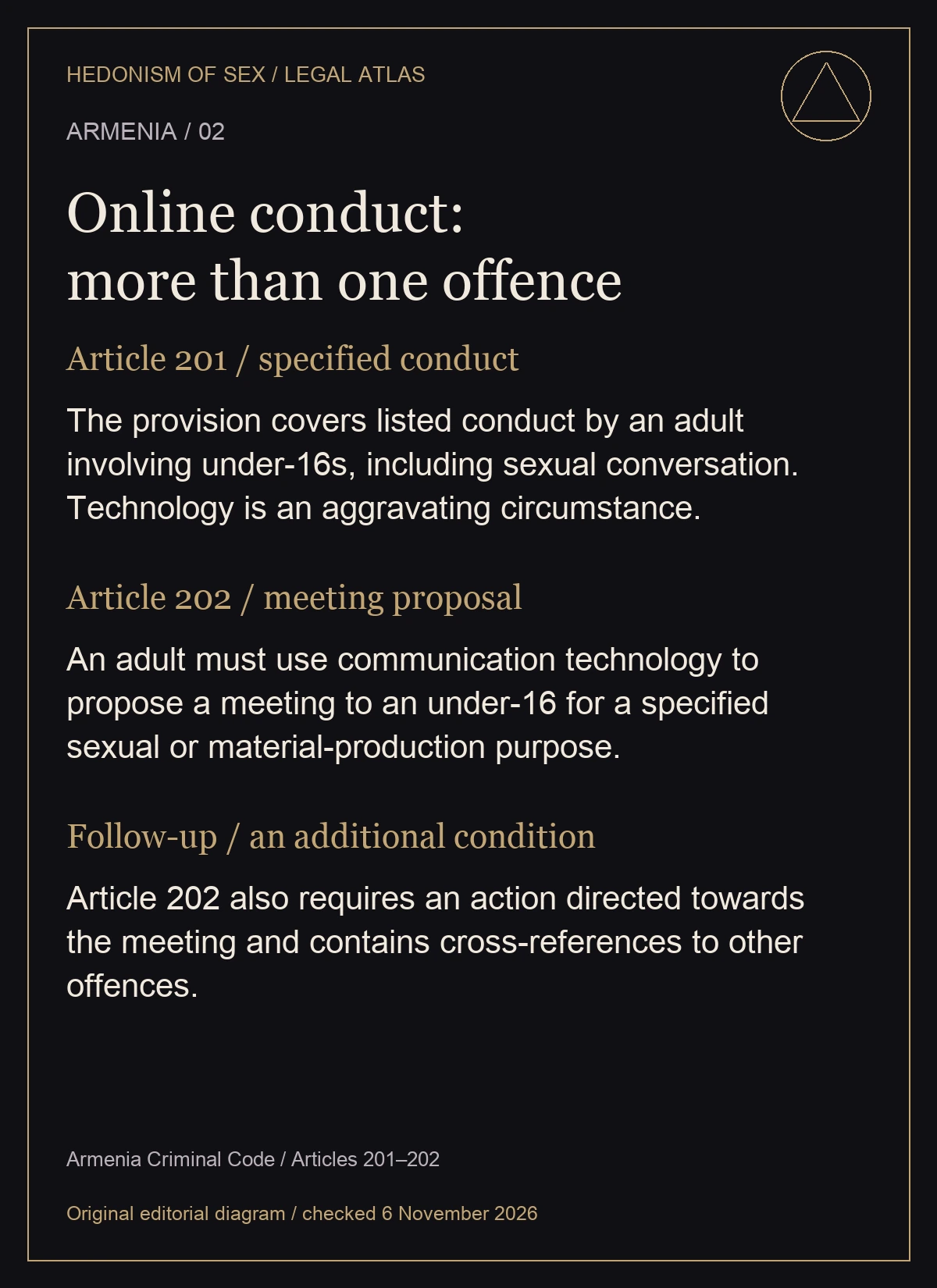
Article 201 covers specified conduct by an adult involving under-16s where the elements of Articles 198–200 are absent. The listed conduct includes distributing or displaying pornography to them, the specified sexual acts or nudity in their presence, sexual conversation, and other conduct aimed at arousing sexual desire. Use of information or communication technology is an aggravated circumstance in Article 201(2). It is not necessary to assume that every online case must first satisfy the meeting-proposal offence. Article 201.
Article 202 separately requires an adult to use information or communication technology to propose a meeting to a person under 16 and perform an action directed towards that meeting. The purpose must be the specified sexual conduct or creating or producing child sexual material. The article also states that the elements of Articles 189 or 198–201 must be absent. Its sanctions include imprisonment of up to two years. Article 202.
A meeting proposal, its purpose, the technological means and the action towards the meeting are therefore separate parts of Article 202’s test. Failure to establish one of them does not establish that related conversation or other conduct is lawful under Article 201 or another provision. Conversely, the meeting offence should not be described as automatically complete whenever someone sends a message.
Images, viewing and private-life secrets require separate checks
Article 300(2) separately addresses child sexual material. Its list includes creating, producing, acquiring, circulating, selling, exporting, importing, offering, advertising, making available, disposing of, obtaining access through communication technology, storing through the stated methods and viewing. The exact conduct must be matched to the provision; it is inaccurate to reduce the rule to a prohibition on commercial sales alone. Article 300(2).
Article 300(5) defines the material through depictions of a child in explicit real or simulated sexual activity, or the sexual-motivation depiction of a child’s sexual organ. That is a statutory definition, not a statement that every photograph involving a child is pornography. The checked article contains no express general private-image or peer-exchange exception. Article 300(3)–(5).
The under-16 contact threshold is consequently not permission to create, keep, send or view qualifying material involving a 16- or 17-year-old. Child status is a separate issue: Family Code Article 41 generally defines a child as a person under 18, while stating an early full-capacity qualification. That civil-law qualification should not be relabelled as a criminal image exception without checking the applicable criminal interpretation. Family Code, Article 41; Criminal Code, Article 300.
Article 204 provides an independent layer of protection for personal or family secrets. It addresses specified use, sale or disclosure without consent, and acquisition or storage for the specified unlawful uses. Public dissemination and dissemination through communication technology are separately addressed, with aggravated provisions concerning, among other cases, minors and specified relatives or partners. This can matter even where an image does not meet Article 300’s definition. Article 204.

Marriage, the place of conduct and the date are separate questions
Marriage is governed by a different threshold. Current Family Code Article 10 requires the parties’ mutual voluntary agreement and attainment of 18. Law HO-327-N removed the former age exceptions; ARLIS records it in force from 10 October 2024. Older explanations of marriage at 16 or 17 should not be applied as current rules. Neither parental approval nor a promise of marriage is an exception stated in Criminal Code Article 200. Family Code, Article 10; Law HO-327-N, Articles 1 and 6.
This guide concerns the Republic of Armenia’s national legislation. Article 10 addresses conduct in Armenian territory, including conduct with a constituent part occurring there; other provisions address vessels, aircraft and acts abroad. Cross-border communications or travel may require examining another country’s law as well. The rules here should not be presented as a statement of the law of a place outside Armenia merely because the people involved are Armenian. Criminal Code, Articles 10–14.
The current code entered into force on 1 July 2022, subject to its stated commencement qualifications. For an earlier event, the applicable historical criminal law and the temporal rules in Articles 8–9 must be checked. Relevant later changes include Law HO-170-N, effective 1 July 2024, which repealed Article 200(4) and amended privacy protections. An old translation that still contains paragraph 4 is not proof of the current text. Articles 8–9, 200 and 551; Law HO-170-N, Articles 18–19 and 23.
Sources and verification limits
Research checked 6 November 2026. The principal source is ARLIS incorporation 232729, marked in force from 1 November 2026, compared with the prior official incorporation 230013. The portal labels these documents differently: the prior version is an official incorporation; the November version is an incorporation. The linked 2026 amending acts underwent a bounded review of affected provisions and commencement clauses. The eight core articles compared here have identical normalised wording in the two incorporations. This does not establish that every general sentencing or procedural rule is unchanged. This distinction must be retained rather than describing every portal text as an independently certified consolidation.
The source archive also contains the original 2022 sexual-offence amendments, the 2024 amendments and marriage reform, and the linked 2026 amending acts. A historical English rendering was consulted to assist terminology; current legal propositions must be verified against the Armenian primary texts. No independent lawyer review is claimed.
Before applying the framework to a real case, establish the exact ages and dates, place, conduct, evidence of consent or coercion, any dependency or care relationship, and whether messages or material were involved. Preserve relevant evidence without circulating potentially unlawful images for informal opinions. Continue through the Law & Rights library or compare the separate Georgian framework.