This guide explains the federal framework, why province-by-province age lists can mislead, and which questions require a closer legal assessment. It is general legal information, not advice on an individual situation.
The same federal framework applies across Canada
The relevant age rules are in the federal Criminal Code, not a separate provincial age-of-consent code. Parliament’s criminal-law power appears in section 91(27) of the Constitution Act, 1867. Moving from one province or territory to another does not change the federal threshold.
Section 151 addresses sexual touching involving a person under 16. Section 152 separately addresses specified invitations or encouragement involving an under-16 person. These provisions must be read with section 150.1 and the broader sexual-assault framework; the rules are not confined to intercourse.

Close-in-age exceptions are conditional, not blanket permission
Criminal Code subsections 150.1(2) and (2.1) provide limited consent defences for specified offences:
| Young person’s age | Required age gap | Additional conditions |
|---|---|---|
| 12 or 13 | The other person is less than two years older. | No trust, authority, dependency or exploitative relationship. |
| 14 or 15 | The other person is less than five years older. | The same relationship restrictions apply. |
“Less than” matters. An exact two-year or five-year gap does not satisfy the corresponding test. Whole-number ages alone can conceal the real difference between birth dates. The official explanation confirms these strict limits. There is no close-in-age consent defence in these subsections for a child under 12.

Section 150.1 also retains historical transitional provisions. These are not a general marriage or cohabitation exception for relationships formed today. For a historical allegation, use the law applicable when the alleged conduct occurred. Subsection 150.1(3), concerning when a 12- or 13-year-old accused can be tried for specified offences, is a separate prosecution rule.
Why 16 or 17 does not end the legal inquiry
Section 153 protects people aged 16 or 17 in relationships involving trust, authority, dependency or exploitation. A teacher or coach is an example given by Justice Canada; the relationship’s substance matters, not simply its label.
A court may assess exploitation by considering the young person’s age, the age gap, how the relationship developed, and the other person’s control or influence. Those factors are not a calculator or an automatic clearance test.
Hypothetical example: describing a relationship as voluntary does not resolve a situation involving a 17-year-old and someone who supervises, teaches or materially controls them. Their roles and circumstances need assessment under the protective rules. Section 153(1)–(2).
Consent must be voluntary, present and continuing
Section 273.1 requires voluntary agreement to the activity in question at the time it takes place. It excludes situations involving unconsciousness, incapacity, abuse of trust, power or authority, and an expressed lack of agreement. A person can withdraw agreement after initially consenting.
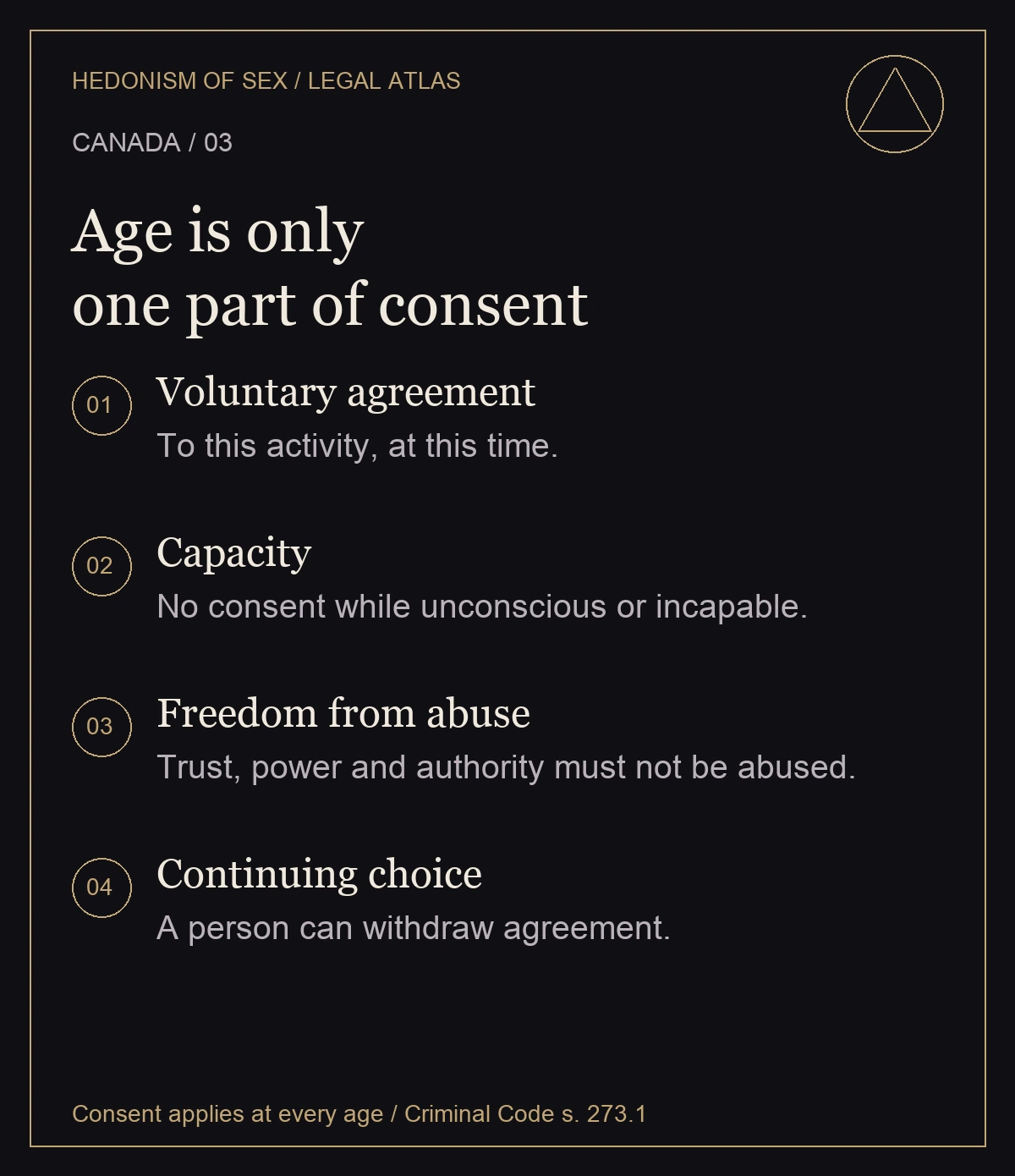
A prior relationship or earlier agreement is not a substitute for present agreement. Under section 273.2, a claimed belief in consent is restricted: self-induced intoxication, recklessness, wilful blindness and failure to take reasonable steps can defeat that defence. The provision also addresses the absence of evidence of affirmative words or active conduct.
Four separate legal questions the number 16 does not answer
Sexual images involving anyone under 18
Section 163.1 defines child sexual abuse and exploitation material and creates offences involving its creation, distribution, possession and access. Its definition includes specified sexual depictions of actual or depicted under-18s. The age-of-consent rule does not itself authorise making or sharing such images. Specific legal defences and case law are beyond this guide; do not infer an image-sharing exemption from an age table.
Payment or other consideration
Section 286.1 prohibits obtaining sexual services for consideration or communicating for that purpose. Subsection (2) creates a specific offence involving a person under 18. Eighteen is therefore not a general permission threshold for purchasing services either.
Marriage
The Civil Marriage Act, section 2.2, prohibits marriage below 16. That minimum is a different legal question from consent to sexual activity; eligibility and marriage procedures require their own assessment. A marriage rule should not be used as a shortcut around the Criminal Code’s protections.
Conduct outside Canada
Criminal Code section 7(4.1) gives Canada jurisdiction over specified child sexual offences committed abroad by Canadian citizens or permanent residents. A destination’s lower threshold does not settle Canadian criminal exposure. Justice Canada also explains the overseas application of these protections.
Practical questions
Can parental permission override the rules?
The close-in-age defences listed in section 150.1 do not provide a parental-permission exception. Consent under section 273.1 must come from the person concerned; someone else’s agreement cannot replace it. Section 273.1(2)(a).
Is believing someone is older enough?
No automatic defence follows from that belief. Subsections 150.1(4)–(6) restrict mistake-of-age defences and require all reasonable steps to ascertain age. The applicable test and evidence need case-specific assessment.
Should I use this guide to decide a live legal situation?
Use it to identify the questions and source provisions, then obtain advice from a lawyer qualified in the relevant jurisdiction. Bring the exact dates, ages, relationship roles and location. For a past event, identify the event date before selecting the version of the law. Avoid circulating intimate material while seeking help.
Official sources and review record
Primary legislation takes priority over simplified summaries. The Justice Canada overview was cross-checked with the statutory provisions and the RCMP’s consent guidance. Where a short public summary omits the words “less than”, the precise statutory wording controls.
- Criminal Code, s. 150.1 — consent defences, age gaps, historical transitions and mistake of age.
- Criminal Code, s. 153 — exploitation and relationships of trust, authority or dependency.
- Criminal Code, s. 273.1 and s. 273.2 — consent and limits on mistaken belief.
- Criminal Code, s. 163.1; s. 286.1; s. 7(4.1) — separate image, payment and overseas offences.
- Civil Marriage Act, s. 2.2 — marriage minimum; this source copy showed a 30 September 2026 consolidation cut-off.
Continue with the Law & Rights collection or explore relationships and communication.