Age of Consent in Czechia: 15, the 2025 Reform and Separate Image Rules
Why the ages 12, 15 and 18 refer to different protections, how peer cases fit into the framework, and what changed in 2025 and 2026.
The general age of sexual consent in Czechia, also called the Czech Republic, is 15. Section 187 of the Criminal Code addresses intercourse and other sexual abuse involving a child below 15. It contains no express numerical close-in-age exemption. The separate under-12 helplessness rule does not lower that threshold, and several protections continue to 18. Criminal Code, sections 119a, 126 and 187.
A single age is a poor guide to the whole legal position. This article separates age-based protection from a person’s will and ability to decide, abuse of dependence or position, payment, and images. It also distinguishes the age of a protected child from the age at which the person acting can be criminally responsible.
The ages 12, 15 and 18 describe different legal boundaries
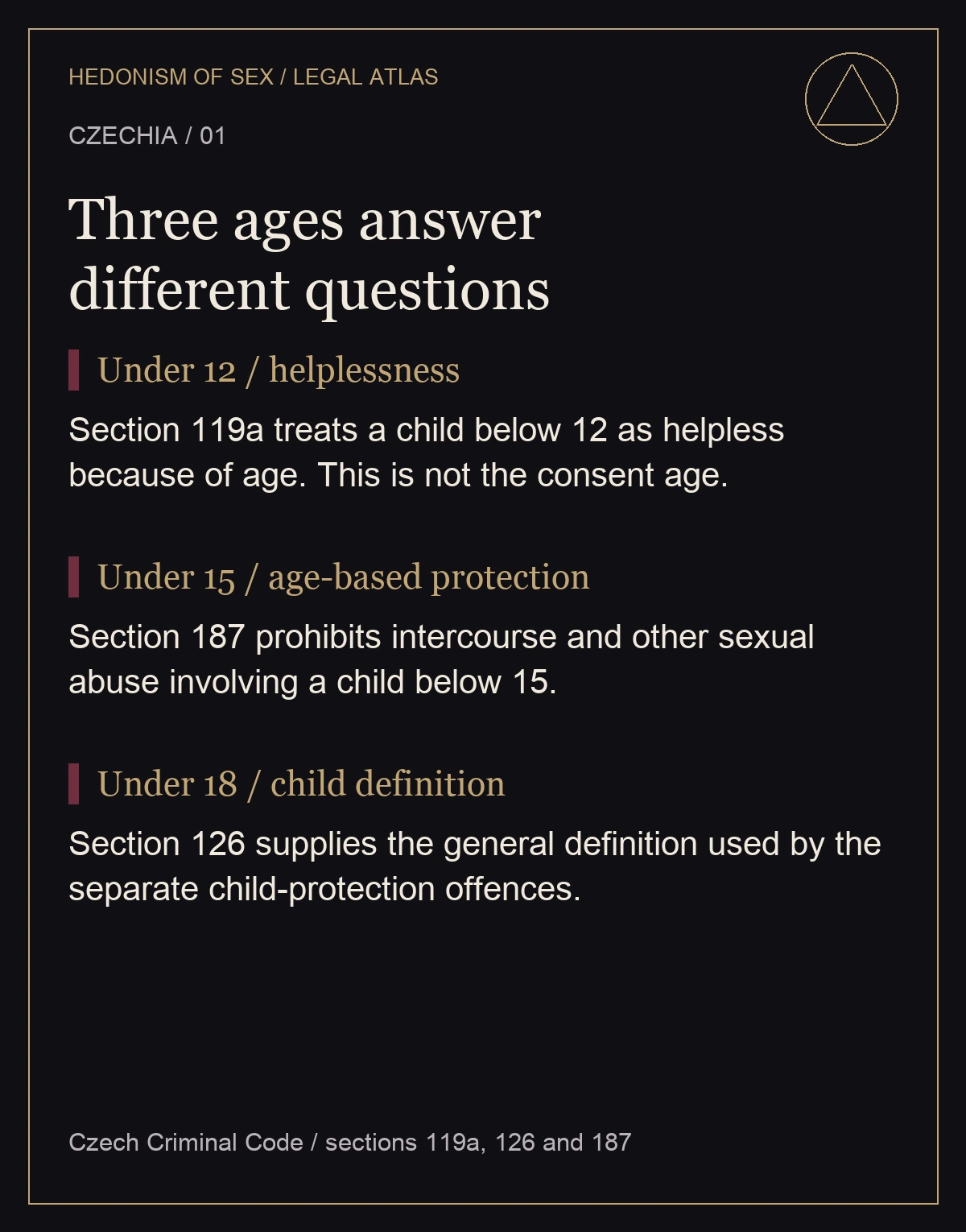
Section 187(1) prohibits intercourse with a child below 15 and other sexual abuse of that child. Its wording is not restricted to an adult perpetrator or to opposite-sex conduct. Reaching 15 removes that particular below-15 age condition; it does not establish that every sexual situation is lawful. Section 187.
Section 119a(2), introduced by the reform effective on 1 January 2025, treats a child below 12 as helpless because of low age. This matters to the helplessness routes in the rape and sexual-assault offences. It is a classification rule, not permission for sexual conduct at 12–14. The nature of the conduct and the other elements of the applicable offence still have to be assessed. Act 166/2024, Article I point 3; sections 119a, 185, 185a and 187.
Section 126 generally defines a child as someone below 18 unless the criminal legislation provides otherwise. Consequently, a provision referring simply to a child can protect a 15-, 16- or 17-year-old. That distinction is important for images, paid sexual activity and the aggravated forms of coercive offences. Sections 126, 186, 192 and 202.
| Age or circumstance | Relevant distinction |
|---|---|
| Below 12 | Always considered helpless because of age under section 119a(2). |
| Below 15 | The age-based sexual-abuse provision in section 187 remains relevant. |
| 15–17 | Still a child under section 126; separate child-protection offences remain applicable. |
| Any age | Recognisable will, helplessness and abuse of dependence or position require their own assessment. |
No express close-in-age clause appears in section 187
Section 187 gives no fixed number of years that makes below-15 conduct exempt. Describing people as classmates, partners or similar in maturity does not establish a statutory age-gap permission under that section. The absence of an express clause must also be distinguished from the general principles and procedures that affect a particular case. Section 187.
Section 25 says that someone who has not reached 15 at the time of the act is not criminally responsible. This is a rule about the person acting. It does not change the age of the child protected by section 187, nor does it establish that harmful conduct by a younger child must be ignored. A situation involving children needs an assessment of the applicable child-protection and youth-justice routes, rather than an assumption that adult prosecution is the only possible response. Section 25.
Section 12(2) separately limits criminal responsibility and its consequences to socially harmful cases in which responsibility under another legal provision is insufficient. This principle of subsidiarity is not a numerical peer exception. A reader cannot safely turn it into “a two-year difference is allowed” or another guaranteed formula. A Czech lawyer would need the actual ages, conduct and circumstances to assess its relevance. Section 12(2).

The reform effective in 2025 changed the offence framework
Act 166/2024 reworked the sexual offences from 1 January 2025. Current section 185 addresses intercourse and comparably performed sexual acts against a person’s recognisable will, compelling the specified acts with another person, and exploiting helplessness for such an act. Section 185a separately addresses other sexual acts and the specified compelled sexual behaviour. The distinction between those offences depends on the conduct, not on calling the situation a relationship. Act 166/2024, Article I points 4–5 and Article IV.
The statutory phrase concerning recognisable will should not be rewritten as a requirement that a victim physically fight back. The Ministry of Justice explains that disagreement may be expressed understandably through words, crying, physical resistance and other outward manifestations. It also identifies freezing under severe paralysing stress as a reason why a person may be unable to resist. Ministry of Justice: changes for 2025.
Section 119a(1) addresses a person’s inability to form or express their will, or a substantial reduction in that ability, for the listed reasons. These include unconsciousness, sleep, the effects of addictive substances, illness, disability, mental disorder, severe paralysing stress, age, surprise and comparable reasons. It is the relevant condition and its exploitation that matter. The provision does not mean that every person with a disability lacks the ability to decide. Section 119a.
For example, in a hypothetical situation involving someone who is asleep, the fact that both people are above 15 does not resolve the issue. Similarly, a previous agreement or relationship cannot answer what the person’s will or ability was during the activity in question.
Dependence and influence remain relevant beyond 15
Section 186(1) addresses inducing the specified sexual activity or comparable behaviour by abusing another person’s distress, dependence, or the perpetrator’s position and the trustworthiness or influence arising from it. Its basic rule is not confined to a person below 18. Committing the basic offence against a child is a separately specified aggravated form. Section 186(1)–(2).
In a hypothetical teacher, coach, supervisor or support-provider situation, the useful questions concern the relationship, influence and abuse actually involved. The ordinary threshold does not cancel these questions. Conversely, the statutory test should not be replaced by a blanket claim that a particular job title automatically proves every element of section 186.
Section 188 separately prohibits intercourse between direct-line relatives or siblings. Its wording is not limited to children below 15. That restriction must be considered independently of the ordinary age threshold and the person’s expressed agreement. Section 188.
Meetings and benefits have their own child-protection rules
Section 193b concerns proposing a meeting to a child below 15 with the intention of committing the listed offences or another sexually motivated offence. Its wording is not confined to online communication, and it does not require the proposed meeting to have taken place. The relevant criminal intention remains an element; a neutral arrangement to meet is not, by itself, the complete offence. Section 193b.
Section 202(1) covers offering, promising or providing payment, an advantage or a benefit to a child or another person in return for the specified sexual activity involving the child. Subsection (2) also addresses participating in the specified conduct where such consideration has been offered, promised or provided. Because the general child definition is below 18, this is not only a rule about under-15s. A benefit must be connected to the specified exchange; the existence of an ordinary gift alone should not replace that requirement. Sections 126 and 202.
Section 203 expressly protects the child who requests or accepts the consideration for the conduct described there from punishment for that act, including as an instigator or helper. This protection for the child does not create permission for the other person’s conduct. Section 203.
Images: a separate under-18 framework
Section 192(1) addresses possession of a pornographic work depicting or otherwise using a child or a person appearing to be a child. Subsection (2) separately covers obtaining access through information or communications technology. Subsection (3) covers production, the listed supply and circulation activities, and profiting from such a work. Neither the ordinary contact threshold nor a private relationship supplies an express exemption in these provisions. Sections 126 and 192.
Section 193 separately addresses inducing, recruiting and otherwise involving a child in producing a pornographic work, and profiting from that participation. Section 193a concerns attendance at the specified pornographic performance involving a child. Section 191(2) also restricts offering or making pornographic works available to children, or exposing them in places accessible to children. These provisions answer different questions from whether two people have reached 15. Sections 191(2), 193 and 193a.
The classification of the material matters: these offences concern the content and conduct stated in the law, not every ordinary photograph of a minor. Czech police guidance on self-generated content warns that voluntary production or sending an image to just one person does not remove the legal and redistribution risks. It also advises responding calmly and without blaming a child when a problem is discovered. Police of the Czech Republic: self-generated content.
A separate identity provision took effect in 2026
Section 191a, inserted by Act 270/2025, addresses the specified production and supply activities involving a pornographic work depicting or otherwise using a person whom the perpetrator knows did not consent to that depiction or use. The provision is not limited to a child. Its commencement follows the Act’s general 1 January 2026 date; the delayed dates for other listed parts of that Act should not be applied to this insertion. Act 270/2025, Article I point 73 and Article XLV; current section 191a.
That offence has its own knowledge and content requirements. Do not assume every manipulated or private image necessarily falls within the same provision, or that the absence of one particular offence settles all other privacy or civil-law issues. A real image-related case needs advice on the actual material and the conduct, without forwarding it around for informal opinions.

National scope, source currency and commencement
We checked the official e-Sbírka entry and downloaded its current Criminal Code text on 6 November 2026. The entry labels the current version as effective from 1 January 2026, naming Acts 268/2024, 220/2025, 250/2025 and 270/2025 for that version. The consolidated download is labelled an informative text of the official system; it should be read with the legally binding amending Acts. Official Criminal Code entry and download options.
We checked the original wording and commencement of Act 166/2024 for the 2025 reform, and the legally binding published text of Act 270/2025 for section 191a and its commencement. The latter Act has delayed commencement for several other provisions, including dates in July 2026 and January 2027. An amendment’s headline date therefore cannot be applied indiscriminately to every part of it. Act 166/2024; Act 270/2025.
The national territorial starting point is section 4. Prague and other Czech cities do not have separate consent ages under this Code. Sections 5–9 address additional jurisdictional situations, including Czech-registered vessels and aircraft, conduct abroad by Czech citizens and certain other cases. Crossing a border requires a separate jurisdictional assessment. Older events also require section 2’s rules on the applicable law and subsequent more favourable legislation. Sections 2 and 4–9.
Practical questions
Did the reform make 12 the age of consent?
No. The under-12 rule concerns statutory helplessness. Section 187 still protects children below 15 through the age-based sexual-abuse offence.
Is there a fixed age gap that makes peer conduct exempt?
Section 187 states no numerical close-in-age exception. The age of criminal responsibility and the general principle of subsidiarity are different questions, not an automatic permission formula.
What information is needed for a real legal assessment?
The dates and exact ages, the location, conduct, expressed will and capacity, relationships of dependence or influence, any exchange of benefits, and any recording, possession, access or sharing. These facts determine which provisions need examination.
Official sources and verification
- Criminal Code, Act 40/2009: current official-system informative version from 1 January 2026; full downloaded text examined.
- Act 166/2024: sexual-offence reform and 1 January 2025 commencement.
- Act 270/2025: original published text, section 191a insertion and staggered commencement.
- Ministry of Justice: changes for 2025: official explanation of recognisable disagreement and helplessness.
- Czech police: self-generated content: public guidance concerning young people’s images.
For a neighbouring jurisdiction, consult the separately researched Polish guide or Austrian guide. The country collection helps locate the relevant legal system; an exception in one country should not be transferred to another.