Estonia’s ordinary age of sexual consent is 16. Penal Code § 145(1) addresses an adult engaging in intercourse or another act of a sexual nature with a person below 16. It contains an exception where the younger person has reached 14 but is still below 16 and the age difference is no greater than five years. That exception does not remove the separate rules on force, inability to comprehend, dependency, abuse of trust, payment or images. Current authentic Code, § 145; Ministry of Justice and Digital Affairs explanation.
A country-chart number leaves several questions unanswered. The ages of both people matter, but so do the relationship, voluntary participation, capacity, any payment or benefit and whether the conduct involves a file, a performance or a proposed meeting. This guide separates those questions and explains the November 2022 reform using the current law checked in November 2026.
The national threshold and the adult-offender condition
The framework is national. Section 6(1) applies Estonia’s penal law to acts committed within Estonian territory. Conduct in Tallinn, Tartu, Narva and the islands is governed by the same national Penal Code. Visitors should not substitute their home country’s rules for the applicable Estonian law; cross-border conduct can raise additional jurisdictional questions. Code § 6.
Section 145(1) expressly refers to an adult. This matters when describing conduct between two minors: it is inaccurate to say that this paragraph automatically criminalises every sexual act involving anyone below 16 regardless of the other participant’s age. Equally, absence of the adult element does not establish that all other conduct is lawful. Other offences must still be examined. § 145(1).
Criminal responsibility and the protected age are different questions. Section 33 addresses capacity for guilt, including a minimum age of 14 together with mental capacity. That is not a replacement age of consent and is not permission for an adult to act against someone below 14. Code § 33.
| Situation | Provision | What to check |
|---|---|---|
| An adult and a person below 16 | § 145(1) | Basic age offence and the limited age-difference exception |
| A person below 14 | § 145(1¹) | The five-year exception does not extend below 14 |
| Abuse of dependency, influence or trust involving a minor | § 143² | Separate under-18 protection |
| Sexual material depicting a minor | § 178 | Content, conduct and the exception’s own cumulative conditions |

The five-year exception: check both conditions
For the exception within § 145(1), the younger person must be at least 14 and below 16, and the age difference between that person and the adult must be no greater than five years. A difference of exactly five years is within the numerical wording. A difference greater than five years is not. The exception does not supply an age-gap permission for an adult and a child below 14. 2022 amending Act, § 1(1)–(2).
Use full dates of birth and the event date. Rounded ages can be misleading: describing a difference as “five years” may hide additional months or days. Both statutory conditions need to be established; meeting one does not compensate for failing the other.
Hypothetical boundary comparison: a precise difference of five years satisfies the age-gap limb, while five years and one month does not. Neither statement alone answers the younger person’s age band, whether participation was voluntary or whether trust, dependency or payment brings a different offence into consideration.
The exception qualifies a particular age-based offence. It should not be described as blanket clearance for an adult to pursue a young person. The ministry’s guidance also stresses voluntary participation and protection against harmful or exploitative relationships. Official age-threshold guidance.
The wording also differs from the Slovenian peer provision, which uses comparable age and maturity rather than a fixed numerical gap. Do not transfer one country’s test into another country’s law.

Protection against force, dependency and exploitation
Voluntary participation and capacity
In the current Code, § 141 addresses intercourse against a person’s will using force or taking advantage of an inability to resist or comprehend. Section 141¹ addresses the other sexual acts specified there. An age threshold is not proof of willingness, and a close age difference does not remove these provisions. The precise legal elements must be read in the current text rather than replaced with a slogan about consent. Code §§ 141 and 141¹.
Section 147 additionally deems a person below ten incapable of comprehending for the sexual offences in that subchapter. This is a distinct rule about comprehension; it does not mean that all children ten or older fall outside legal protection. § 147.
Dependency, influence and family
Section 143 addresses the specified conduct against a person’s will through exploitation of dependency outside the force or incapacity situations. Section 143² separately concerns an adult’s sexual conduct with someone below 18 through exploitation of dependency or abuse of influence or confidence, again with its own conditions. A person aged 16 or 17 can therefore remain protected even though the ordinary age threshold has been reached. §§ 143 and 143².
Assess the actual relationship and abuse, not merely whether someone has a particular job title. Family relationships also require their own check: § 144 addresses sexual conduct by a parent, a person holding parental rights or a grandparent with their child or grandchild. Do not treat the ordinary threshold as eliminating that offence. § 144.
Payment and benefits
Section 145¹ addresses sexual intercourse or another sexual act with a person below 18 for money or another benefit. Its under-18 protection is separate from the age of 16 and the five-year contact exception. Something described as a gift may still need assessment as a benefit in context; a label alone does not settle the legal classification. § 145¹.
Images have their own conditions
Section 178(1) covers the specified manufacture, acquisition, storage, handing over, display or other making available of works or reproductions depicting a person below 18 in a pornographic situation, or a person below 14 in a pornographic or erotic situation. The distinction between the two content categories and age bands matters. It should not be paraphrased as “every nude image of anyone below 18 is automatically the same offence.” Code § 178(1).
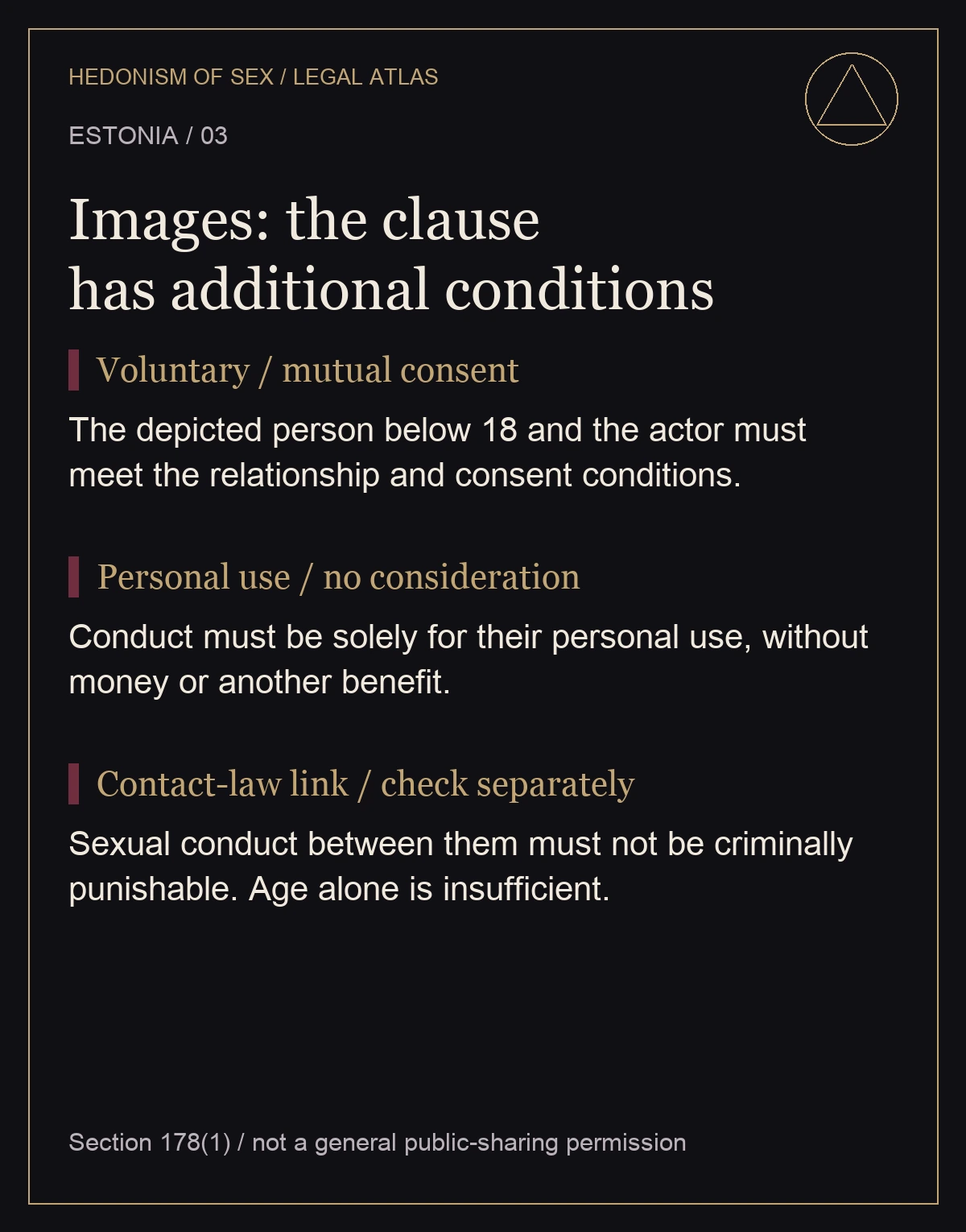
The 2022 Act added a separate exception with cumulative conditions. The conduct must occur voluntarily in a relationship based on mutual consent between the depicted person below 18 and the person carrying out the act; it must be solely for their personal use; no money or other consideration may be given for it; and sexual intercourse or another sexual act between them must not be punishable as a criminal offence. 2022 amending Act, § 1(7).
- Mutual consent and voluntariness: do not infer agreement from a relationship label or earlier conduct.
- Personal use: public posting or forwarding to an outside group cannot simply be treated as the participants’ exclusive personal use.
- No payment or consideration: this is an independent condition.
- The contact-law link: the exception expressly requires that sexual conduct between those people would not be criminally punishable.
This wording is not restricted in its text to a pair of minors. It should therefore not be rewritten as a blanket prohibition on every adult recipient, nor as a blanket permission for an adult recipient. The participants, the legality of sexual conduct between them and every other condition require assessment. An age-gap condition alone does not settle the image question.
Hypothetical example: two people originally agree to keep material solely for their own use. Later publication to an outside audience is a different act. Their original agreement does not establish that this later distribution satisfies § 178’s exception. This example explains the personal-use condition; it is not a finding that any particular file was lawful to create or possess.
Performances, exposure and proposed meetings
Section 175¹ addresses the specified knowing requests for access to child pornography and watching pornographic performances involving someone below 18, or pornographic or erotic performances involving someone below 14. It has its own exception concerning voluntariness in a mutually consensual relationship, absence of payment or other benefits and the legality of sexual conduct between the people. Read that provision separately: its wording is not identical to the personal-use wording in § 178. Code § 175¹; 2022 Act, § 1(6).
Section 178¹ concerns a proposal or agreement to meet a person below 16, or the specified person below 18 unable to comprehend, together with an act preparing the meeting and the purpose of committing one of the listed sexual offences. Purpose and preparatory conduct matter. Ordinary communication is not automatically equivalent to this complete offence, while an online request involving exploitation may engage other provisions before any meeting occurs. § 178¹.
Section 179 separately addresses the listed ways of exposing or sexually enticing a person below 16, including making pornography accessible. It also contains a qualification where sexual conduct between the younger person and the actor is not criminally punishable. Do not omit that qualification, or assume it displaces every other image, exploitation or coercion offence. 2022 Act, § 1(9); current § 179.
The 2022 reform and the current text
The reform was adopted on 18 May 2022 and published as RT I, 8 June 2022, 1. Its § 4 expressly set commencement at 1 November 2022. That is when the ordinary threshold increased from 14 to 16 and the associated exceptions entered into force; the adoption and publication dates are not substitutes for commencement. Original amending Act; ministry’s commencement announcement.
For this guide’s check on 6 November 2026, the authentic consolidation is RT I, 9 July 2026, 28, in force from 1 October through 31 December 2026. The matching English translation was published on 26 October 2026. The wording of §§ 145, 175¹, 178, 178¹ and 179 examined here retains the relevant 2022 amendment annotations. Later incidents require checking the edition applicable to their dates.
Common questions
Does the five-year exception extend below age 14?
No. The exception in § 145(1) concerns a younger person who has reached 14 but is still below 16. Section 145(1¹) separately addresses conduct against a person below 14.
Is an exact five-year difference inside the numerical boundary?
Yes. “Not more than five years” includes exactly five years. Other conditions and offences still require independent assessment; rounded ages are insufficient.
Does meeting the contact exception automatically make sexual images lawful?
No. Section 178 adds its own requirements involving mutual consent, voluntariness, personal use, no money or other consideration, and the legality of sexual conduct between the people.
Sources and practical next steps
- Authentic Estonian Penal Code, RT I, 9 July 2026, 28. Current consolidation for 1 October–31 December 2026, including §§ 6, 33, 141–145¹ and 175¹–179.
- Government-hosted English Penal Code translation. Edition downloaded and examined: translation published 26 October 2026, matching the above validity interval. The link opens the current translation and may change as editions are updated.
- Original 2022 amendment on sexual self-determination and marriage. Section 1 amends the relevant criminal provisions; § 4 fixes commencement at 1 November 2022.
- Ministry guidance on the age threshold and 1 November 2022 commencement announcement. Official explanation corroborating the reform and the age-difference qualification.
For a real incident, preserve the exact event date, dates of birth, relationship, conduct and any payment or handling of material. A qualified Estonian lawyer can apply those facts to the appropriate edition. For other jurisdictions, use the country library; each country’s exceptions need separate research.