Greece’s ordinary age of sexual consent is 15. Article 339(1) of the Criminal Code addresses a sexual act with a person below 15, or inducing that person through deception to perform or undergo such an act. Article 339(2) contains a separate rule for sexual acts between minors who are both below 15. Protection against abuse of entrusted care and exploitation can continue below 18. Law 4855/2021, Articles 74 and 76, reproducing Code Articles 339 and 342.
This guide explains why a country-chart number is only a starting point. The relevant questions include the ages of both people, the particular act, whether someone has been entrusted with a young person’s care, whether participation is voluntary and whether images or a live performance are involved. A rule about physical contact does not establish permission for pornography.
What the age of 15 means
This is a national Criminal Code framework. Article 5(1) applies Greek criminal law to acts committed within Greek territory, including acts by foreign nationals. A visitor should not substitute the rules of their home country for the law governing conduct in Greece. Cross-border conduct can raise additional jurisdictional questions. Code Article 5(1).
Article 339(1) sets the basic protected age at below 15. The provision does not make the offender’s adulthood a condition of its basic wording. It must be read together with paragraph (2), the applicable juvenile rules and the other sexual offences. Nor does the basic age offence require proof that the younger person was forced before its age protection can apply. Law 4855/2021, Article 74.
The Code uses a defined concept of a sexual act. Article 336(2) identifies intercourse and acts of equivalent gravity. Do not assume that every remark, message, gesture or touch is classified under Article 339: other provisions, including Article 337, address different forms of interference with sexual dignity. The legal classification depends on what actually happened. Law 4855/2021, Articles 71–74.
Reaching 15 removes the simple “below 15” element from Article 339(1). It does not remove the need for voluntary participation, or protections linked to care, vulnerability, payment and images. The number is a threshold within a wider criminal-law framework.
| Situation | Question to examine | Code provision |
|---|---|---|
| A person below 15 | Basic age-based sexual offence | Article 339(1) |
| Both minors below 15 | Specific non-punishment and measures rule | Article 339(2) |
| Adult entrusted with a minor | Protection against abuse of supervision or care | Article 342 |
| Images or performances involving a minor | Separate content and conduct offences | Articles 348A and 348Γ |

The specific rule for two minors below 15
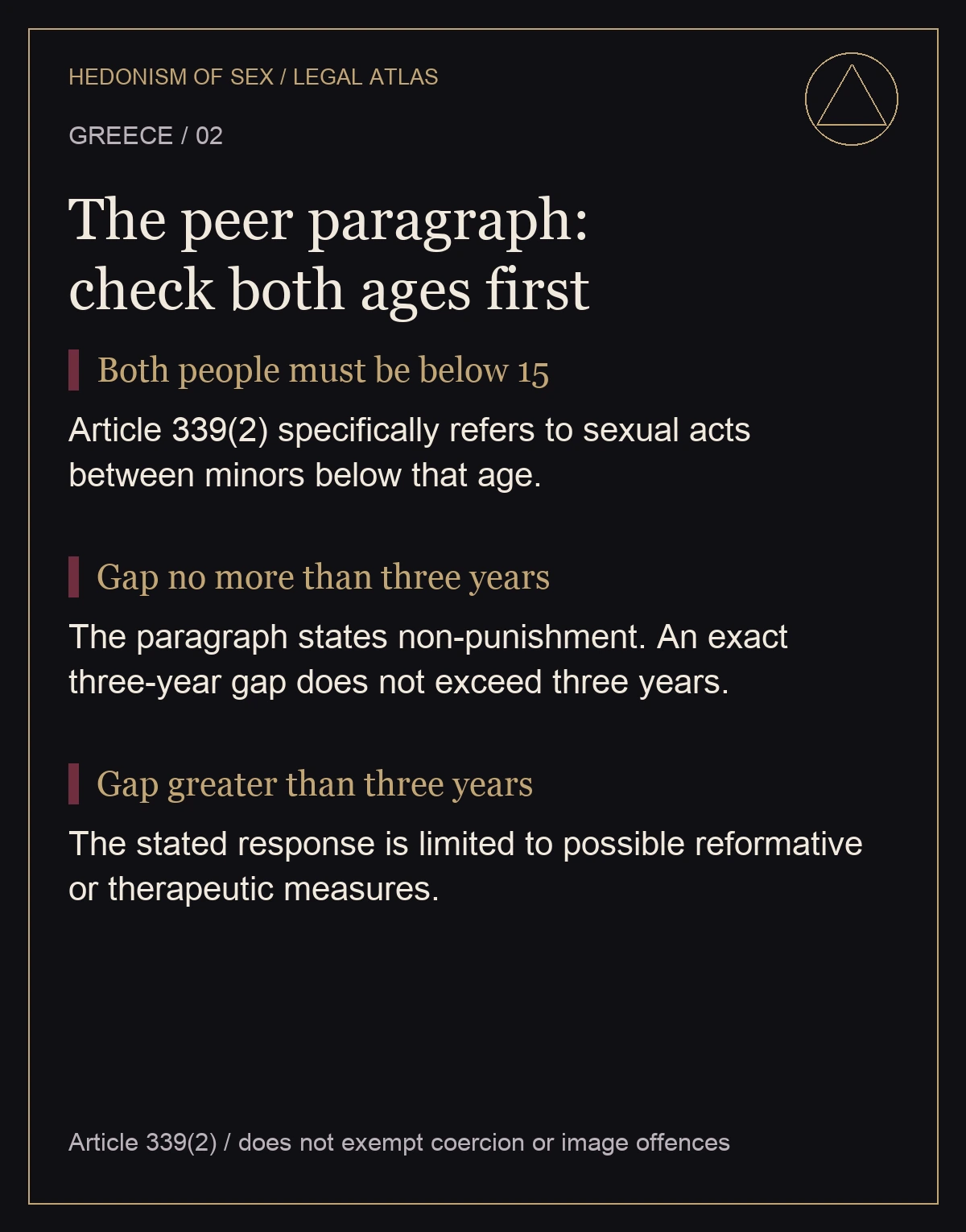
Article 339(2) says that sexual acts between minors below 15 are not punished, except where the difference in their ages is greater than three years; in that latter situation, only reformative or therapeutic measures may be imposed. The wording therefore needs two separate checks: both people must be below 15, and the precise age difference determines the stated consequence. Article 339(2), reproduced by Law 4855/2021, Article 74.
The statute says greater than three years. An exact three-year difference does not cross that numerical condition. Check complete dates of birth and the date of the event rather than subtracting rounded ages.
Hypothetical example: two people who are both below 15 and whose age difference is no more than three years fall within the specific non-punishment wording for Article 339(2). If both are below 15 but the difference exceeds three years, the paragraph refers to reformative or therapeutic measures. That is not the same statutory consequence as ordinary adult punishment.
A different hypothetical example: a person aged 16 and a person aged 14 are not both below 15. A two-year difference alone therefore does not satisfy paragraph (2)’s condition. Other juvenile-law provisions and all the facts still require assessment. A guide should not turn this paragraph into a universal “three-year exception” that applies to any two people.
This explanation concerns the age-based provision. It is not clearance for coercion, abuse, exploitation or images, and it does not predict the outcome of a real case.
Care, coercion and exploitation
Entrusted supervision and care
Article 342 addresses an adult performing sexual acts with a minor entrusted to that adult for supervision or care, even temporarily. Because the protected person is a minor, a person aged 15, 16 or 17 can remain within this provision. The ordinary threshold does not answer whether the adult has that entrusted role. Law 4855/2021, Article 76, reproducing Code Article 342.
The provision also lists circumstances that increase seriousness, including specified family or household connections, teaching, spiritual guidance and professional care. These references should be read with the offence’s conditions; a list of job titles alone is not a substitute for establishing the relationship and conduct.
Article 343 separately addresses compelling sexual acts through abuse of employment dependence, exploitation of a person’s position while seeking work, and specified abuse of a position in custodial, educational or treatment institutions. Its protection is not restricted to someone below the ordinary consent age. Law 4855/2021, Article 77.
Non-consensual conduct and inability to resist
Article 336 addresses rape, including its distinct provision for a sexual act without consent outside the force-or-threat form. Article 338 separately addresses abusing another person’s disability or inability to resist. Being old enough for the ordinary age threshold does not resolve either issue. Law 4855/2021, Articles 71 and 73.
A previous relationship or agreement does not settle participation in a later act. If someone cannot freely choose or communicate, stop. A statutory age does not create consent on someone else’s behalf.
Payment and family relationships
Article 351A separately addresses an adult’s sexual act with a minor in return for payment or other material consideration, and the adult-induced situations specified there. Do not use the age of 15 as permission to purchase sexual activity involving a minor. Law 4855/2021, Article 82, reproducing Code Article 351A.
Article 345 addresses sexual acts between specified direct-line relatives by blood or adoption and between full or half siblings. It also contains a possible exemption from punishment for a descendant or sibling who was below 18 at the time; this does not create a general exemption for an adult relative. Law 4855/2021, Article 79.
Images, performances and online contact
The physical-contact threshold does not govern images
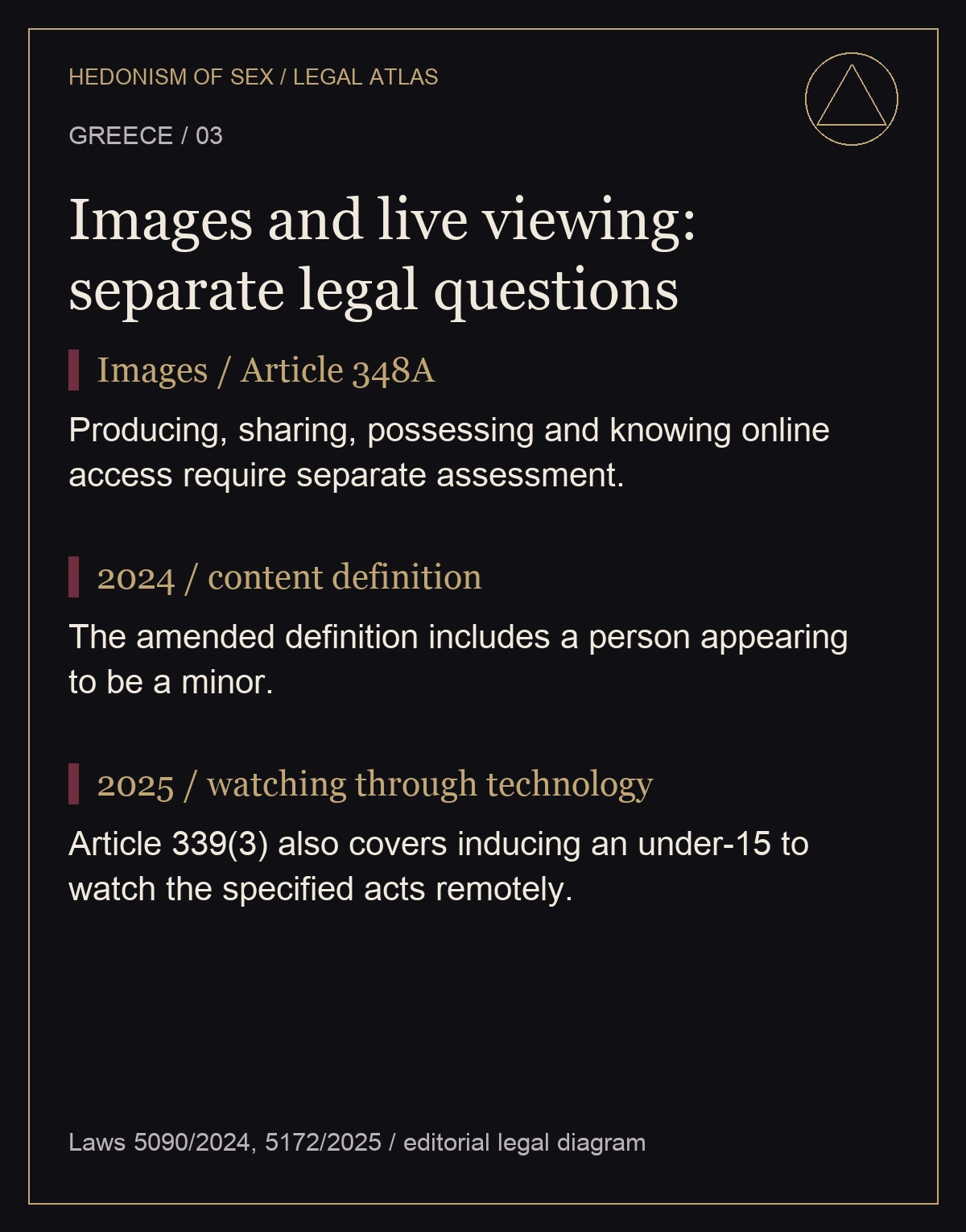
Article 348A addresses the intentional production, distribution, publication, offering, acquisition and possession of the prohibited material, with separate provisions concerning information systems. Paragraph (6) also covers knowingly obtaining access through information systems. The definition and the particular conduct need separate analysis. Original Code, Article 348A; Law 4855/2021, Article 80.
Law 5090/2024 amended the definition in Article 348A(3) to include a person appearing to be a minor. The definition concerns the specified real or virtual depictions and their sexual character. It should not be paraphrased as a prohibition on every image containing nudity. Equally, an image should not be assumed lawful merely because the depicted person is above 15. Law 5090/2024, Article 50.
The physical-act rule in Article 339(2) does not say that it also exempts images. Article 348A’s text must be checked on its own; the provisions examined do not state a corresponding general private-peer image permission.
Article 346 separately criminalises the unauthorised disclosure to a third person or public posting of the specified real, altered or drawn images or audiovisual material depicting another person’s non-public sexual life. Threatening such disclosure is also covered. An earlier agreement to make an image does not automatically establish a right to disclose it. Law 4947/2022, Article 38, introducing Code Article 346.
Live performances and watching online
Article 348Γ addresses inducing a minor to participate in a pornographic performance and organising such a performance. The 2024 amendment removed payment as an element of the specified knowing-viewing offence. A live performance involving minors therefore cannot be assumed outside the law simply because access is free. Law 5090/2024, Article 51.
Law 5172/2025 added watching through information and communication technology to Article 339(3). This paragraph addresses inducing or drawing a person below 15 into watching sexual acts between others without participating. It is distinct from the physical-contact offence and from the pornography provisions. Law 5172/2025, Article 30.
Article 348B separately addresses an intentional proposal, through information systems, for a person below 15 to meet the proposer or a third person for the listed sexual offences, where further acts towards that meeting follow. Purpose and the additional conduct are part of the offence; ordinary online communication is not automatically the same thing. Original Code, Article 348B.
What to check before drawing a conclusion
- Record both exact ages and the event date. The special peer paragraph requires both people to be below 15.
- Identify the conduct. Physical acts, sexualised communications, images and performances have different provisions.
- Check the relationship. Entrusted supervision or care, dependency and professional roles can change the assessment.
- Check willingness and capacity. The ordinary age threshold does not settle consent or an inability to resist.
- Check exploitation independently. Payment and image offences have protections extending beyond the basic contact threshold.
For an actual incident, a qualified Greek lawyer needs the chronology and the precise acts, not just two rounded ages. For comparisons, consult the country library and read the separate Bulgaria guide: its 2026 threshold and peer-responsibility framework differ from Greece’s.
Common questions
Does a three-year age gap always make contact lawful?
No. Article 339(2) specifically concerns minors who are both below 15. Its numerical condition and its distinction between non-punishment and possible measures should not be extended to situations outside its wording. Law 4855/2021, Article 74.
Does reaching 15 remove all under-18 protections?
No. Entrusted-care, commercial-exploitation, image and performance provisions need separate assessment. Article 342, for example, addresses an adult and a minor entrusted to that adult for supervision or care. Article 342.
Can the peer rule be used as permission to exchange sexual images?
The contact paragraph does not supply that permission. Images require an assessment under Article 348A, including its definition, the depicted person and the specific act of producing, acquiring, possessing or sharing.
Sources and review record
- Law 4619/2019, Gazette A 95 of 11 June 2019. Original Criminal Code; its second ratification article set commencement at 1 July 2019. Original text requires later amendments.
- Law 4855/2021, Gazette A 215 of 12 November 2021. Articles 71–80 and 82 reproduce or amend the principal sexual-offence provisions; Article 203 sets the general commencement rule.
- Law 5090/2024, Gazette A 30 of 23 February 2024. Articles 50–51 amend images and performances; Article 138 sets different commencement dates. These two provisions fall under the general 1 May 2024 rule.
- Law 5172/2025, Gazette A 10 of 29 January 2025. Article 30 amends Code Article 339(3); Article 98 generally starts the Act on publication, subject to individual provisions.
- Law 4947/2022, Gazette A 124 of 23 June 2022. Article 38 introduces Code Article 346 on intimate-image disclosure.
- Later currency checks: 5039/2023 parliamentary adopted text; 5151/2024 parliamentary adopted text; 5224/2025 Gazette; 5326/2026 Gazette. Their code amendments concern different provisions; the 2026 amendment to Article 349(3) does not replace Article 339.