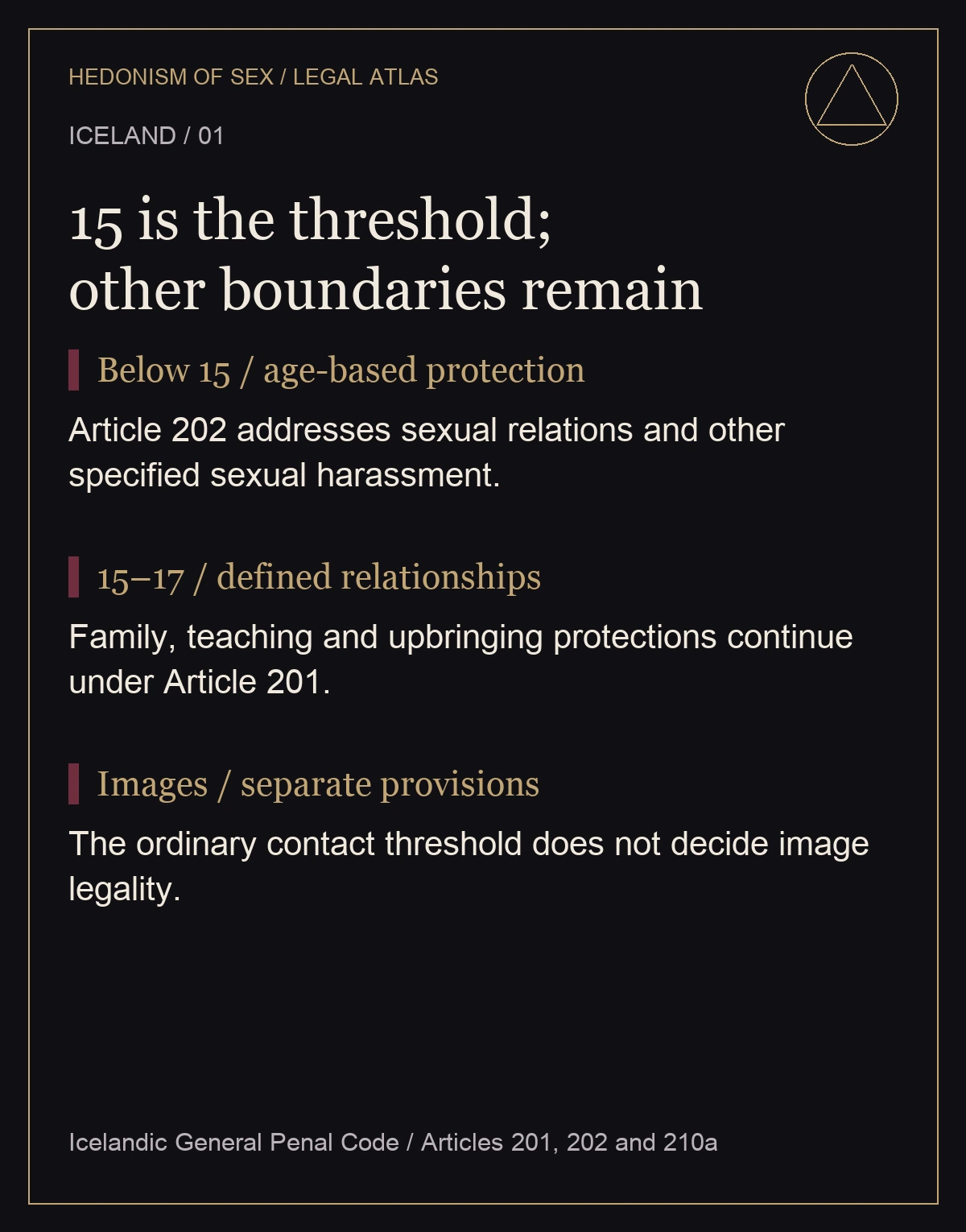
The general age of sexual consent in Iceland is 15. Article 202(1) allows punishment to be reduced or waived where the people involved are of similar age and development. It does not specify a fixed difference in years. Separate rules protect people aged 15–17 in defined family and teaching relationships, while the image provisions have their own conditions. General Penal Code, Articles 201, 202 and 210a.
This guide distinguishes the age-based offence from voluntary consent, a provision concerning punishment, and the separate image exceptions. Those distinctions matter: reaching 15 does not resolve every relationship, compensation or digital-content question.
15 is the ordinary threshold, not a complete permission rule
Article 202(1) addresses intercourse or other sexual relations with a child below 15. Its second paragraph separately addresses other sexual harassment involving the child. The classification and nature of the conduct matter; the provision should not be reduced to a rule about intercourse alone. Apparent agreement below 15 does not by itself remove the age-based offence. General Penal Code, Article 202(1)–(2).
The age wording is not limited to opposite-sex relationships. At 15 or older, consent and the other applicable restrictions remain separate legal questions. Iceland’s 112 public information service also explains the ordinary under-15 protection and the need for freely given consent. Articles 194 and 202; 112: Consent.
| Circumstance | Relevant distinction |
|---|---|
| Below 15 | Article 202 provides age-based protection. Its first paragraph contains a limited punishment provision for people of similar age and development. |
| 15–17 | Defined family, teaching and upbringing relationships remain subject to Article 201; enticement below 18 has a separate rule. |
| Institutional or dependent relationship | Articles 197–198 must be assessed independently of the ordinary age threshold. |
| Sexual images | Article 210a has specific exceptions; the contact-law punishment provision cannot be substituted for them. |
The Penal Code applies nationally. Article 4 covers offences committed within Iceland, subject to its stated jurisdictional qualifications. Articles 5–6 also provide routes for Icelandic law to apply abroad, including specific sexual-offence situations. A foreign location therefore requires its own jurisdictional assessment, rather than an assumption that only the destination’s consent age matters. Articles 4–6.
The similar-age provision concerns reducing or waiving punishment
The final sentence of Article 202(1) permits punishment to be reduced or waived where the perpetrator and the person concerned are of similar age and development. This is a provision about the criminal-law consequence. Its wording does not turn every such case into an automatically lawful relationship. Article 202(1).
There is no universal two-, three- or five-year allowance in the text. Both age and development matter. The provision does not express its test simply as both participants being below 18, so a birthday alone does not settle whether it can apply. Equally, it cannot be assumed merely because two people are in the same school year.
The sentence sits within the first paragraph of Article 202. It should not be presented as an exemption covering every sexual offence in the Code, the separate image offences, or any conduct involving coercion. Article 194 remains the distinct consent-based rape provision. Articles 194 and 202.
Hypothetical example: relatively close birth dates are only part of the information needed to assess a peer case. They do not establish similar development, voluntary consent or how a court would exercise the statutory power concerning punishment. A numerical age-gap calculator cannot determine the outcome.

Protection continues in family, teaching and dependency relationships
Family, teaching and upbringing
Article 201 concerns intercourse or other sexual relations with a 15-, 16- or 17-year-old in the listed relationships. These include an adopted child, stepchild, foster child, a cohabiting partner’s child, the specified direct-line family relationship, and a child entrusted to the person for teaching or upbringing. The article separately addresses other sexual harassment. Passing the ordinary threshold does not remove these relationship protections. Article 201.
Article 200 separately addresses a person’s own child or other descendant and sibling sexual relations. Its descendant prohibition is not confined to people below 18. The sibling paragraph contains a specific possibility of waiving punishment concerning a sibling who was below 18; that should not be confused with the Article 202 peer provision. Article 200.
Institutional care and serious abuse of dependency
Article 197 addresses the specified sexual relations between staff or a supervisor and a resident of the listed institutions, including correctional, police, child-protection and certain care institutions. Article 198 concerns serious abuse of financial, employment or confidential client dependency to obtain sexual relations. These provisions are not limited to people below the ordinary age of consent; Article 198 separately increases the penalty ceiling where the person is below 18. Articles 197–198.
A job title, a relationship label or an age alone cannot replace the statutory facts. Identify what responsibility, supervision or dependency actually existed and whether the relevant provision requires abuse of that position.
Consent must be freely expressed; age mistakes are a separate issue
Article 194 concerns intercourse or other sexual relations without consent. Consent must be expressed freely; it is absent where violence, threats or other unlawful coercion are used. The article also addresses deception, exploitation of a person’s mistaken understanding of the circumstances, and specified exploitation of mental disability or an inability to resist or understand the act. Article 194.
The practical question is whether the person freely agrees to the particular activity now. Prior agreement, flirting or being in a relationship is not a substitute. Consent can be withdrawn. If willingness is unclear, stop and establish what the other person wants. 112’s explanation emphasises continuing choice and the limits of silence or uncertainty as indicators of consent. 112: giving and obtaining consent.
Mistakes about age require a different analysis. Article 204 provides for a proportionately lighter punishment where an offence under Article 201 or 202 was committed negligently as to the person’s age, subject to the statutory imprisonment minimum. Negligence is therefore not an automatic route to avoiding liability. Do not extend Article 204 indiscriminately to other provisions that it does not name. Article 204.
Enticement, arranged meetings and compensation have separate rules
Article 202(3) concerns enticing a child below 18 into intercourse or other sexual relations through deception, gifts or other means. The existence of a gift is not a substitute for assessing the statutory enticement requirement. The ordinary threshold of 15 does not remove this under-18 protection. Article 202(3).
Article 202(4) addresses arranging a meeting with a child below 15, through online or other communications, with the purpose of the specified sexual relations or sexual harassment. Its wording does not require waiting for the intended sexual act to occur. The communications, arrangement and purpose must be examined, alongside any other applicable offences. Article 202(4).
Article 206 separately prohibits paying or promising payment or other consideration for prostitution, with a specific paragraph concerning a child below 18. The general purchase prohibition also concerns adults. Age 15 is therefore not a permission rule for compensated arrangements. Article 206(1)–(2).
The image law has two different, limited exceptions
Article 210a covers specified production, import, acquisition, distribution and possession of material depicting child sexual abuse or showing a child sexually. A separate paragraph covers viewing through the internet or other communications technology. The article also regulates the listed depictions involving adults presented as children and simulated children. These are content-specific provisions, not a prohibition on ordinary photographs of minors. Article 210a.
Making, viewing or possessing specified material of a 15–17-year-old
The first sentence of Article 210a(3) excludes the first two paragraphs for a person who makes, views or possesses material showing a 15-, 16- or 17-year-old sexually, where the child has consented and both people are of similar age and development. These conditions must be read together. The sentence does not provide a general onward-distribution exemption for a recipient or someone depicted alongside the child. Act 29/2022, Article 3, replacing Article 210a.
A 15–17-year-old’s distribution of material showing themselves
The next sentence separately excludes the first two paragraphs for a 15-, 16- or 17-year-old who distributes material showing themselves. It does not give another person a corresponding right to redistribute it. Nor does it settle the rights of anyone else depicted or make coercion lawful. These are two distinct statutory routes, not one universal “sexting exception.” Article 210a(3).
Other provisions remain important. Article 199a separately concerns the listed making, acquisition, distribution or publication of another person’s nude or sexual material without consent, including falsified material; it also addresses specified threats and negligent conduct. Consent to one use should not be treated as consent to every later use. For an individual case, describe the material to a qualified lawyer without circulating potentially unlawful images. Article 199a.

Current law, commencement and pending proposals
Checked on 6 November 2026, Alþingi’s current Code page identifies its consolidation as edition 158a, dated 1 October 2026. It records Act 43/2026 as effective on 16 May 2026 and separately flags Act 78/2026, concerning security measures, for 1 April 2027. That future amendment is not a new current age-of-consent rule. Current Code and amendment notes; Act 78/2026, Article 7.
The consent wording in Article 194 comes from Act 16/2018, listed in the consolidation as effective on 13 April 2018. The current image exceptions come from Act 29/2022, listed as effective on 22 June 2022. The original amendments and their commencement clauses were read alongside those dates; a bill’s approval date, an Act’s date and its effective date should not be assumed to be the same. Act 16/2018; Act 29/2022; commencement annotations.
An October 2026 government bill proposes changes to the purchase provisions in Article 206. Its parliamentary record showed referral to committee on 3 November 2026, rather than an enacted amendment, when checked. This guide follows the current statutory text. Earlier proposals to raise the ordinary age must likewise not be substituted for Article 202’s current threshold. Parliamentary case 282/158; Article 202.
Practical questions
Does a small age gap guarantee that no offence exists?
No. Article 202(1) permits reducing or waiving punishment where age and development are similar. It gives no fixed gap in years and does not replace consent or the separate relationship and image provisions.
Can a recipient forward an image because the person is 16?
The first Article 210a(3) exception lists making, viewing and possession, with consent and similar-age-and-development conditions. It does not provide a general forwarding exemption. The separate self-distribution sentence concerns the 15–17-year-old’s own conduct.
What information should a lawyer receive?
Exact birth dates, the date and location, the nature of the conduct, communications about agreement or pressure, family or teaching relationships, dependency, gifts or payment and any image issue. Do not forward potentially unlawful material to explain the situation.
For another jurisdiction, use its own legislation and exceptions. Continue with the Law & Rights library and separate guides to Norway and Finland.
Official sources and verification
- Alþingi: General Penal Code, Act 19/1940, current edition 158a; Articles 4–6, 194–206 and 210a. Icelandic text is the statutory source; English explanations here are editorial summaries.
- Act 61/2007, particularly the Article 202 amendment; Act 37/2013 for family and teaching protections.
- Act 16/2018 for consent; Act 29/2022 for the current image framework; Act 78/2026 for its future commencement.
- Case 282/158. Used to distinguish a pending proposal from enacted law.
- 112: Consent. Public-service explanation of consent and the under-15 protection, checked against the Code.