Age of Consent in Kazakhstan: 16, Peer Cases and Protection Under 18
The 2026 Supreme Court explanation, juvenile peer cases, paid services, online conduct and separate image protections.
Kazakhstan’s ordinary age threshold is 16, but its law distinguishes contact with a 14- or 15-year-old, offences involving younger children, paid sexual services involving under-18s, online conduct and images. The Supreme Court issued a new binding explanation in 2026. Reading that explanation alongside the Criminal Code avoids several misleading shortcuts, including an invented numerical peer exception or the assumption that turning 16 makes paid services or sexual images lawful.
Start with 16, then identify the conduct and the younger person’s age
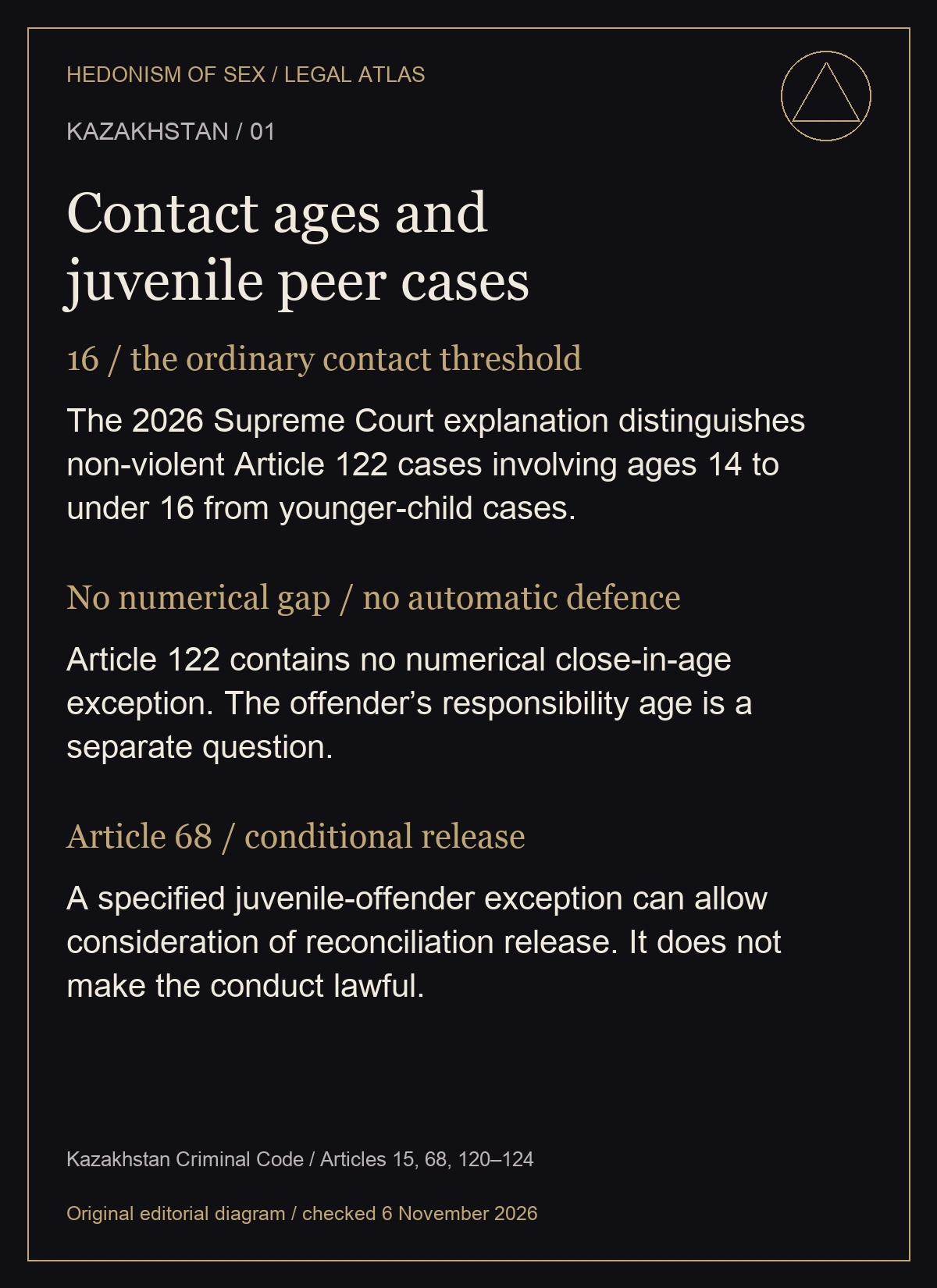
Criminal Code Article 122(1) addresses intercourse and the other specified sexual acts with someone known to be under 16. Paragraph 13 of the Supreme Court’s 2026 resolution explains this as non-violent conduct, without threats of violence or exploitation of a helpless condition, involving a person aged 14 but under 16. The provision is not limited to different-sex relationships. The court also states that liability requires awareness of the affected person’s age before the offence; appearance must be assessed with other evidence of that awareness. Criminal Code, Article 122; Supreme Court Resolution No. 1 of 26 February 2026, paragraph 13.
The ordinary Article 122(1) sanction provides restriction of liberty for up to five years or imprisonment for the same period, with the stated lifetime prohibition on specified positions or activities. Aggravated cases have different ranges. The general sentencing rules, including the special rules for juvenile offenders, still matter; the ordinary adult sanction is not a prediction of every case’s outcome. Article 122(1), (3)–(4).
Under 14 must not be treated as a lower alternative consent age. Paragraph 5 of the resolution identifies children under 14 as young children in its discussion of helplessness. The court directs the relevant contact offences involving them to Articles 120 or 121; paragraph 16 separately explains non-contact indecent conduct under Article 124. Classifying the act matters, not merely attaching the ordinary Article 122 label to every under-16 case. Resolution, paragraphs 5, 13–16.
There is no numerical age-gap defence in Article 122
The checked Article 122 does not provide a two-, three- or five-year close-in-age exception. It also does not expressly limit its ordinary offence to an offender aged 18. Article 15 generally sets criminal responsibility at 16, with responsibility from 14 for listed offences including rape and violent sexual acts. The offender’s responsibility age and the affected person’s protected age answer different questions. Articles 15 and 122.
Hypothetical example: a 16-year-old’s non-violent sexual conduct with a 15-year-old cannot be declared exempt simply because the difference is one year. The conduct, awareness of age and other elements still require assessment. A genuine peer relationship does not insert an exception that is absent from the offence’s wording.
Conditional release is different from lawful conduct
Article 68 concerns release from criminal responsibility following reconciliation and making good the harm, subject to its conditions and exclusions. Article 68(4)(2) generally excludes offences against minors’ sexual inviolability, but contains an exception where the offender was under 18 and the affected minor was aged 14 to under 18. This exception removes that particular bar to considering Article 68; it does not automatically grant release or rewrite the age of consent. Article 68(1)–(4).
That distinction matters in a peer case: satisfying an offence, being eligible for a release mechanism and actually receiving release are separate legal questions. An adult cannot rely on the juvenile-offender exception. Nor does the exception extend its protected age band down to children under 14.
Force, helplessness and dependency do not disappear at 16
Articles 120 and 121 address the specified sexual acts involving violence, threats of violence or exploitation of a helpless condition. The Supreme Court explains that sufficiently severe intoxication can establish helplessness where it prevents understanding the nature and significance of the acts or resisting them. This is a factual assessment, not a rule that every consumption of alcohol automatically produces the same legal result. Articles 120–121; Resolution, paragraphs 1 and 5.
Article 123 separately concerns compulsion through blackmail, threats to destroy, damage or take property, or exploitation of material or other dependency. Paragraph 15 explains that the offence is complete when the relevant demand is expressed, regardless of agreement, refusal or whether the sexual act actually occurs. A demand backed by control over housing, for example, requires examining the dependency and the demand rather than asking only whether physical force occurred. This is a hypothetical illustration, not a statement that every unequal relationship satisfies the offence. Article 123; Resolution, paragraph 15.
Specified parents, stepparents, teachers and other people with legally assigned upbringing duties attract aggravated provisions under Articles 122(3) and 124(2). Paragraph 18 requires the authority handling the case to identify the law imposing those duties. An informal description such as “someone influential” does not replace that legal requirement. Other coercion or exploitation provisions can still matter. Articles 122 and 124; Resolution, paragraph 18.
Paid sexual services have a separate under-18 protection
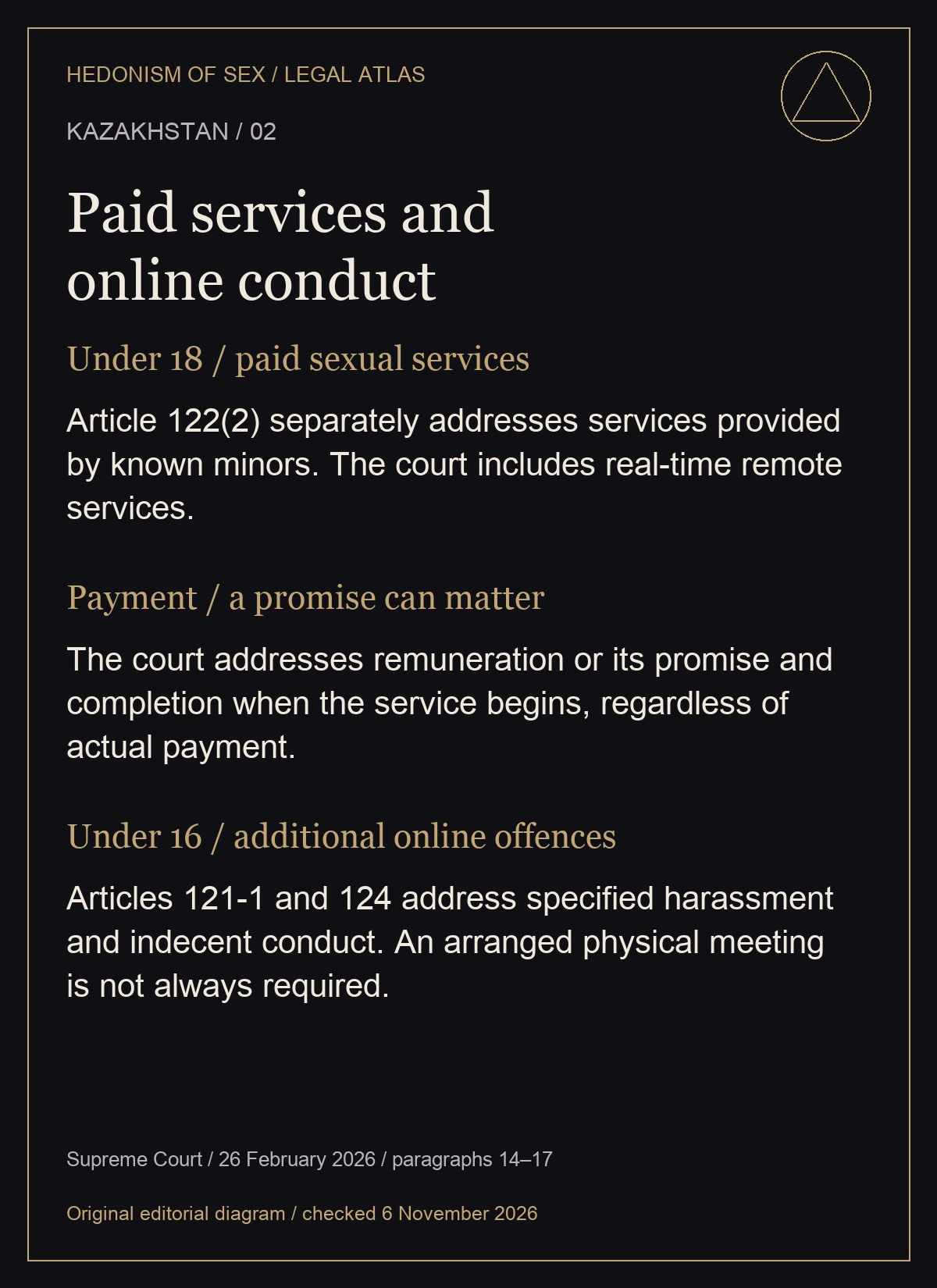
Article 122(2) concerns obtaining prostitution or another sexual service provided by someone known to be a minor. Paragraph 14 of the resolution explains this in relation to 14- to 17-year-olds and monetary or other remuneration, material benefits, property advantages or a promise of such consideration to the minor or a third person. The ordinary contact threshold of 16 does not make this transaction lawful at 16 or 17. The statutory imprisonment range is three to six years, with the stated lifetime occupational prohibition. Article 122(2) and note; Resolution, paragraph 14.
The court expressly includes real-time remote services through telecommunications, including the internet. It treats the offence as complete when the service begins, regardless of whether payment has actually been made. For an under-14, paragraph 14 directs contact cases to Articles 120 or 121 and the specified remote, non-contact cases to Article 124. A webcam does not remove the legal issue, and an unfulfilled promise of payment is not automatically a defence.
Hypothetical example: paying a 17-year-old for a live sexual performance raises the separate service provision even though 17 is above the ordinary contact threshold. Whether a particular exchange qualifies depends on its purpose, the promised consideration, conduct and knowledge; ordinary gifts in a relationship should not automatically be relabelled as payment for a sexual service.
Online conduct does not always require an arranged meeting
Article 121-1 concerns specified indecent sexual conduct towards someone known to be under 16, associated with sexual proposals or touching, including through telecommunications. Paragraph 17 explains direct and remote forms. Article 124 and paragraph 16 separately address indecent conduct with the stated sexual purposes, including certain sexual correspondence, showing pornography or requesting intimate images. These offences must be distinguished by their actual elements. Articles 121-1 and 124; Resolution, paragraphs 16–17.
Neither provision should be described as requiring a meeting proposal followed by practical steps before any offence can exist. Conversely, the court’s discussion of sexual purpose and the nature of the conduct must not be reduced to a claim that every educational discussion of sexuality is criminal.
Images, erotic products and privacy each need a separate check
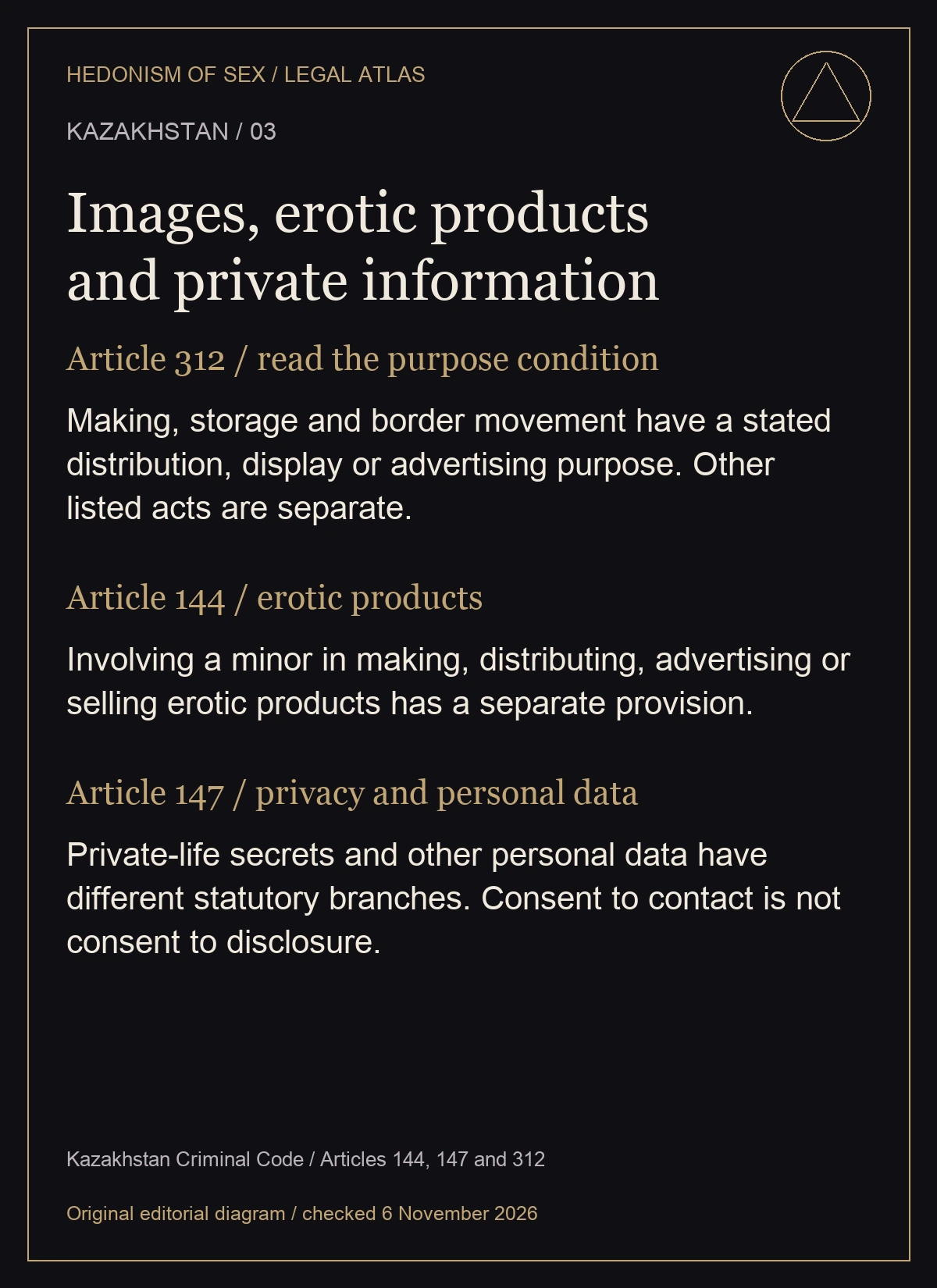
Article 312(1) addresses making, storing or moving material depicting minors pornographically across the state border for distribution, public display or advertising, as well as distribution, public display or advertising itself. Keep the stated purpose attached to the relevant making, storage and border-movement acts. This paragraph should not be paraphrased as an express ban on every instance of private possession or viewing. That textual distinction is not a general permission to produce or exchange such material. Article 312(1).
Article 312(2) separately addresses an adult involving minors as models or actors in producing pornographic material or as performers in pornographic events. Aggravating circumstances appear in paragraph 3. No general private peer-image exception is expressly written into the checked article. The family code defines a child as under 18; turning 16 does not remove the separate protections applicable to minors. Article 312(2)–(3); Marriage and Family Code, Article 1(1)(8).
Article 144 also addresses involving a minor in making, distributing, advertising or selling erotic products. A claim that material is “erotic rather than pornographic” therefore does not end the inquiry. Different offences use different conduct and classification tests; the presence of an ordinary photograph alone does not establish either offence. Article 144.
Article 147 provides a separate privacy framework. It distinguishes unlawful collection of personal or family secrets without consent, specified unlawful processing of other personal data involving substantial harm, and disclosure or public dissemination. Consent to a relationship does not itself authorise disclosing private sexual information. Assess the relevant branch of the provision rather than assuming every privacy offence has an identical harm requirement. Article 147(2)–(5).
Marriage and territorial jurisdiction are different questions
Marriage and Family Code Article 10 sets marriage at 18 for men and women. The registering authority can reduce that age by no more than two years for pregnancy or the birth of a common child, with the stated application and consent requirements, including written parental or guardian consent for an underage party. This is a marriage procedure, not a numerical peer exception in Article 122. The Supreme Court also states that marriage or cohabitation does not determine whether sexual offences are committed. Article 10; Resolution, paragraph 2.
This guide concerns Kazakhstan’s national Criminal Code. Article 7 addresses territorial offences, while Article 8 addresses specified cases abroad. Cross-border conduct can involve more than one legal system. Baikonur additionally has treaty-based jurisdiction arrangements: lease clause 6.12 addresses Russian personnel and their families and refers jurisdiction and law-enforcement interaction to a separate agreement. The 2011 ratified protocol amended that clause and records entry into force on 9 August 2011. The city’s name alone does not establish which country’s law governs a particular person and act. A Baikonur case needs a specific treaty and jurisdiction assessment; this guide does not give a universal Russian or Kazakh threshold for every such case. Articles 7–8; Baikonur lease, clause 6.12; ratified protocol.
Dates, sources and verification limits
Research checked 6 November 2026. Sources include the official current Criminal Code, Marriage and Family Code, the Supreme Court resolution and original amending laws. The resolution was adopted on 26 February 2026; the state register records publication on 12 March 2026, and paragraph 25 makes it operative from first official publication. Paragraph 24 repeals the earlier 2007 resolution and listed amendments. An older court explanation should not be presented as the current one. State register publication record; Resolution, paragraphs 24–25.
The current code generally commenced on 1 January 2015, subject to Article 467. The research checked the original 2024 laws introducing Article 121-1, expanding Article 124 and replacing Article 122, plus relevant 2025 changes and a bounded review of the five 2026 amending laws linked in the code. Their commencement and transitional clauses matter: not every provision printed in a consolidated document is already operative. The 2024 laws use sixty-calendar-day commencement rules for the relevant criminal changes, with stated exceptions elsewhere in the legislation. Article 467 and amendment notes; Law 72-VIII; Law 111-VIII.
This is an English editorial explanation, not an official translation. No independent lawyer review or exhaustive litigation survey is claimed. Before applying the framework, record exact ages and dates, the conduct, knowledge of age, force or dependency, any payment, institutional duties, messages and images, and the jurisdiction. Compare those facts with the relevant provision. Continue through the Law & Rights library or consult the separate Russian framework where jurisdiction makes it relevant.