The general age of sexual consent in Norway is 16. Section 308 allows punishment for specified offences to be waived where the people involved are approximately equal in age and development. It sets no fixed age gap in years and is not an automatic permission rule. Additional protections concern exploitation, care relationships, compensation and images. Penal Code, sections 299–311 and 314.
This guide helps distinguish four questions: the age-based offence, whether participation was voluntary, whether a limited peer provision applies, and whether separate conduct involving money or images is involved. The 2025 consent reform and the 2026 correction to the peer provision make the date and version of a source particularly important.
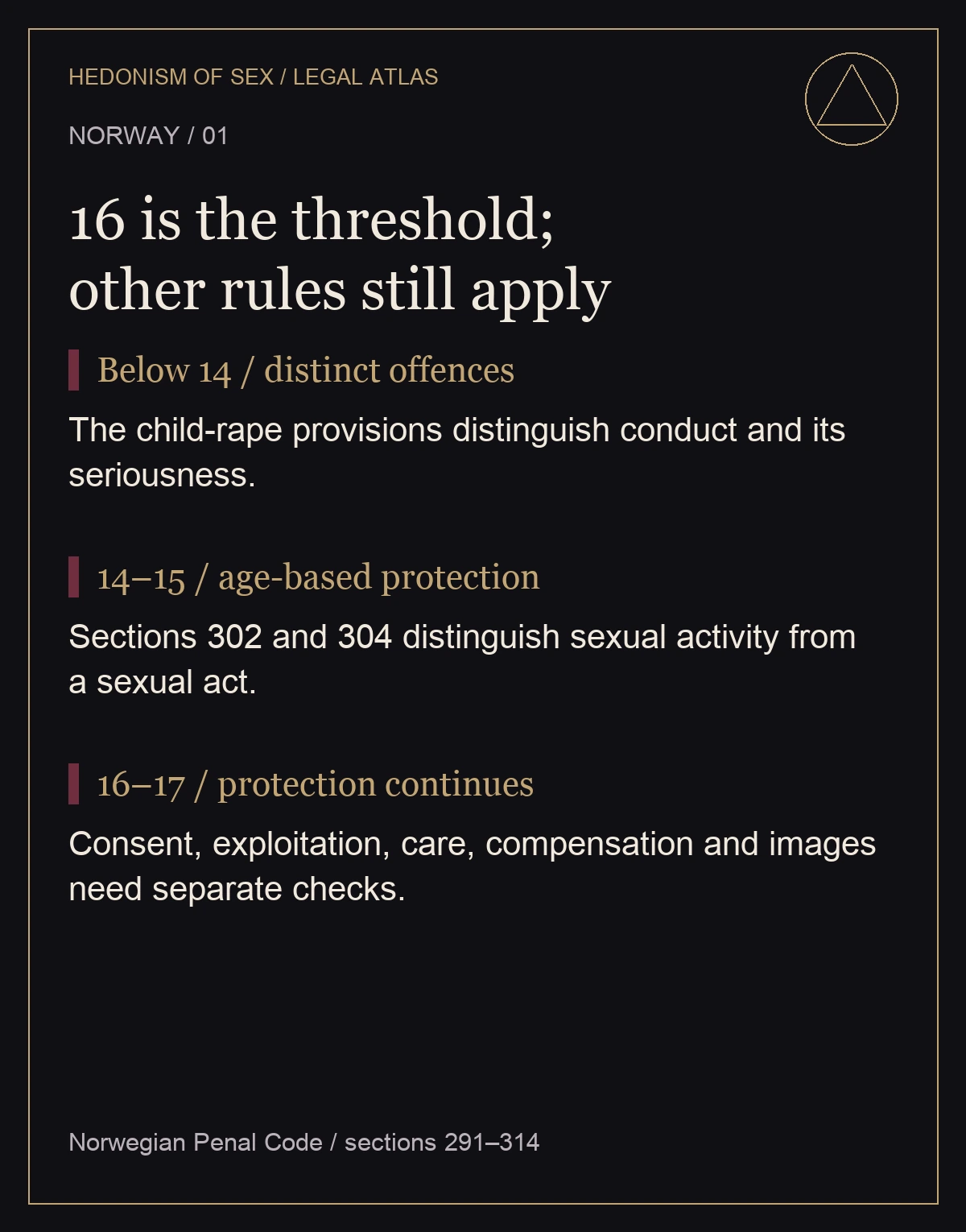
16 is the general threshold; below 14 is a distinct category
Section 299 concerns sexual activity with a child below 14 and specified related conduct. Section 302 concerns sexual activity with a child who has reached 14 but is below 16, including inducing the child to perform acts equivalent to sexual activity on themselves. Section 304 separately addresses a sexual act involving a child below 16 where section 299 does not apply. Norwegian law distinguishes seksuell omgang from seksuell handling; the nature and legal classification of the conduct matter. Sections 299, 302 and 304.
The police describe Norway’s ordinary age threshold as 16. Apparent agreement below that age does not, on its own, remove the age-based offence. Reaching 16, meanwhile, does not establish consent or remove the other statutory protections. The statutory age provisions do not depend on an opposite-sex relationship. Police explanation; Penal Code, sections 291 and 299–304.
| Situation | Relevant distinction |
|---|---|
| Below 14 | Child-rape provisions, with different classifications according to the conduct. |
| 14–15 | Section 302 applies to sexual activity; section 304 addresses sexual acts. |
| Specified peer cases below 16 | Section 308 allows punishment to be waived; it does not change the general threshold. |
| 16–17 | Consent, exploitation, care, compensation and image protections still require attention. |
The territorial framework is national. Section 4 expressly includes Svalbard, Jan Mayen and Norway’s dependencies within the application of Norwegian criminal legislation. This is not a system of separate county ages of consent. Section 5 also provides routes for Norwegian law to apply to conduct abroad, including specified sexual offences committed by Norwegian citizens or residents. A foreign location is therefore not enough to establish that Norwegian law is irrelevant. Sections 4–5.
Section 308 concerns punishment, not a universal lawful age gap
The current wording allows punishment under sections 299–304, the second alternative of section 305(b), and section 306 to be waived if those involved are approximately equal in both age and development. The specified alternative in section 305(b) concerns inducing the child, rather than its separate coercion alternative. The provision does not list every sexual offence, and it does not displace the general consent offence or the separate authority and care provisions. Section 308 and the provisions it identifies.
No universal two-, three- or five-year allowance appears in section 308. Approximate equality is a legal assessment involving the people concerned, not merely subtraction of their ages. Nor does the wording state that the provision is limited to two people who are both below 18. An adult’s birthday is therefore not a substitute for the statutory assessment in either direction.
In HR-2023-2298-U, the Supreme Court’s Appeals Selection Committee distinguished satisfaction of the age-and-development condition from the question whether punishment should actually be waived. It explained that special circumstances are needed to impose punishment once the condition is met, and emphasised actual equality, maturity and the risk of exploitation. The judgment set aside the relevant part of the appeal judgment because its reasoning was inadequate; it did not announce an automatic exemption for a particular age gap. Judgment of 6 December 2023, paragraphs 12–20.
Hypothetical example: two teenagers’ birth dates may show a relatively small age difference. That fact alone cannot establish comparable development or decide whether the circumstances justify waiving punishment. Present the full facts to a qualified lawyer rather than treating a rounded age difference as legal clearance.

Since 1 July 2025, the rape provision expressly addresses absence of consent
Section 291(1) concerns sexual activity with someone who has consented neither in words nor in actions. Its second paragraph separately covers violence or threatening conduct, a person expressing unwillingness in words or actions, inability to resist, and the specified coercion of sexual activity involving another person or acts on oneself. The general age threshold does not answer any of these consent questions. Section 291.
The government’s commencement explanation says that passivity cannot be interpreted as consent without concrete indications supporting that interpretation. In practice, establish whether the other person wants the particular activity and stop if they express unwillingness or their wishes are unclear. A prior relationship is not a replacement for present agreement. Ministry of Justice explanation, 1 July 2025.
Section 297 separately concerns a sexual act without consent. Section 294 addresses grossly negligent violation of section 291’s second paragraph; its wording should not be extended to every aspect of section 291 without distinguishing the paragraphs. The police also explain that sleep, unconsciousness and sufficiently severe intoxication can prevent a person from resisting. Sections 294 and 297; police guidance.
Turning 16 does not remove authority and care protections
Section 295 addresses obtaining the specified sexual activity through abuse of a position, dependency or trust, exploitation of a mental disorder or intellectual disability where section 291 does not apply, or exploitation of someone below 18 in a particularly vulnerable situation. The position, dependency and trust route is not confined to people below 18. The existence of a job title or diagnosis alone should not replace the provision’s abuse or exploitation requirements. Section 295.
Section 296 separately concerns people in specified correctional, police or child-welfare institutions who are under the actor’s authority or supervision. Section 314 concerns sexual activity with a foster child or stepchild, or a person below 18 under the actor’s care, authority or supervision, and specified self-directed activity. The under-18 qualifier is attached to that last category; it should not be casually applied to the foster-child and stepchild categories. The Code also contains distinct descendant and sibling provisions. Sections 296 and 312–314.
Compensation, meeting arrangements and knowledge of age
Section 309 addresses obtaining specified sexual activity or a sexual act involving a person below 18 by providing or agreeing compensation. It also covers compensation supplied or agreed by someone else and the specified self-directed activity. Consent at 16 or 17 does not remove that rule. Section 316 separately criminalises specified purchases involving adults, so turning 18 does not make every paid arrangement lawful. Sections 309 and 316.
Norway’s section 306 requires an agreed meeting with a child below 16, intent to commit one of the listed sexual offences, and arrival at the meeting place or somewhere from which it can be observed. This particular completed offence therefore requires more than merely proposing a meeting. That does not mean earlier messages or other online conduct cannot fall under other provisions. Sections 305–306.
Section 307 imposes a demanding age-related diligence rule for sections 299–306: ignorance does not exclude liability if the defendant can be blamed at any point for that ignorance. It separately addresses age under section 295(c) and sections 309–310. A claim that someone appeared older cannot itself settle the issue; the specific offence and the relevant statutory standard must be identified. Section 307.
The image provision uses 18 and has its own narrow peer clause
Section 311 concerns depictions of sexual abuse of children or depictions that sexualise children. It covers specified production, distribution, acquisition, possession and intentional access, among other conduct. For this provision, a child is a person who is or appears to be below 18. It is not a ban on every ordinary photograph of someone below 18. The content and conduct must be assessed under the provision. Section 311(1)–(3).
Section 311(4) allows punishment to be waived for someone who takes and possesses an image of a person who has reached 16 but is below 18, where that person consented and the two are approximately equal in age and development. This clause does not borrow section 308’s contact framework. It does not extend below 16, and it does not provide an exemption for forwarding or publishing an image. Consent to making an image should never be treated as permission to distribute it.
The final paragraph excludes depictions that must be regarded as defensible for an artistic, scientific, informative or similar purpose. A label such as “art” is not a substitute for that legal assessment. For an individual image issue, describe the facts to a lawyer without forwarding potentially unlawful material. Section 311(4)–(5).

The 2025 reform and the 2026 correction have different dates
Checked on 5 November 2026, the consolidated Code identified Act 23 June 2026 no. 71, effective 1 July 2026, as its latest amendment. The sections used here were read with the original amendments and commencement decisions.
- 1 July 2025: the relevant substantive changes under Act 20 June 2025 no. 86 took effect, including section 291 and the revised section 295(c). The same commencement decision deferred the amendment to section 91 until 1 January 2026; it is inaccurate to say every change commenced in July. Amending Act; commencement decision no. 1123.
- 10 April 2026: amendments to sections 293–294 changed the aggravated-rape and gross-negligence framework. A summary of the 2025 reform alone is not the current version of those provisions. Act no. 13; commencement decision no. 567.
- 1 July 2026: section 308’s obsolete reference to reducing punishment below the former section 300 minimum was removed. The government explained this as a correction following abolition of that minimum in 2025. The approximately-equal-age-and-development condition remains. Act no. 71; commencement decision no. 1238; explanatory memorandum, section 308.
For earlier conduct, establish the applicable historical version and the Code’s rules on application over time. A current guide is not a substitute for that analysis. Section 3.
Practical questions
Does a gap of less than three years guarantee exemption?
No. Section 308 contains no universal numerical gap. Approximate equality in age and development and the circumstances of the case require assessment; the provision concerns specified offences and the possibility of waiving punishment.
Can the same peer rule be used for images below 16?
No. Section 311(4) has its own conditions, including that the person depicted has reached 16 but is below 18, consent and approximate equality. Its taking-and-possession clause does not cover forwarding or publication.
What facts should be given to a lawyer?
Exact birth dates, the date and place, the nature of the conduct, communications about willingness or pressure, any care or dependency relationship, compensation and whether images or meeting arrangements were involved. Do not circulate potentially unlawful images.
Explore the Law & Rights library and separate guides to Sweden and Denmark. Their peer provisions and image rules are not interchangeable with Norway’s.
Official sources and verification
- Lovdata: Penal Code, Chapter 26, with section-by-section amendment annotations; Chapter 1 for time and territorial application. Norwegian statutory text; English descriptions here are editorial summaries.
- Original amending Acts 2025 no. 86, 2026 no. 13 and 2026 no. 71, with the commencement decisions linked above.
- Supreme Court Appeals Selection Committee: HR-2023-2298-U, 6 December 2023, particularly paragraphs 12–20. Read for its legal reasoning; its quotation of the former minimum-sentence clause is historical.
- Norwegian police: What is rape?; Ministry of Justice: consent reform commencement; Prop. 57 L, explanation of the section 308 correction. Guidance and legislative history were checked against enacted provisions.