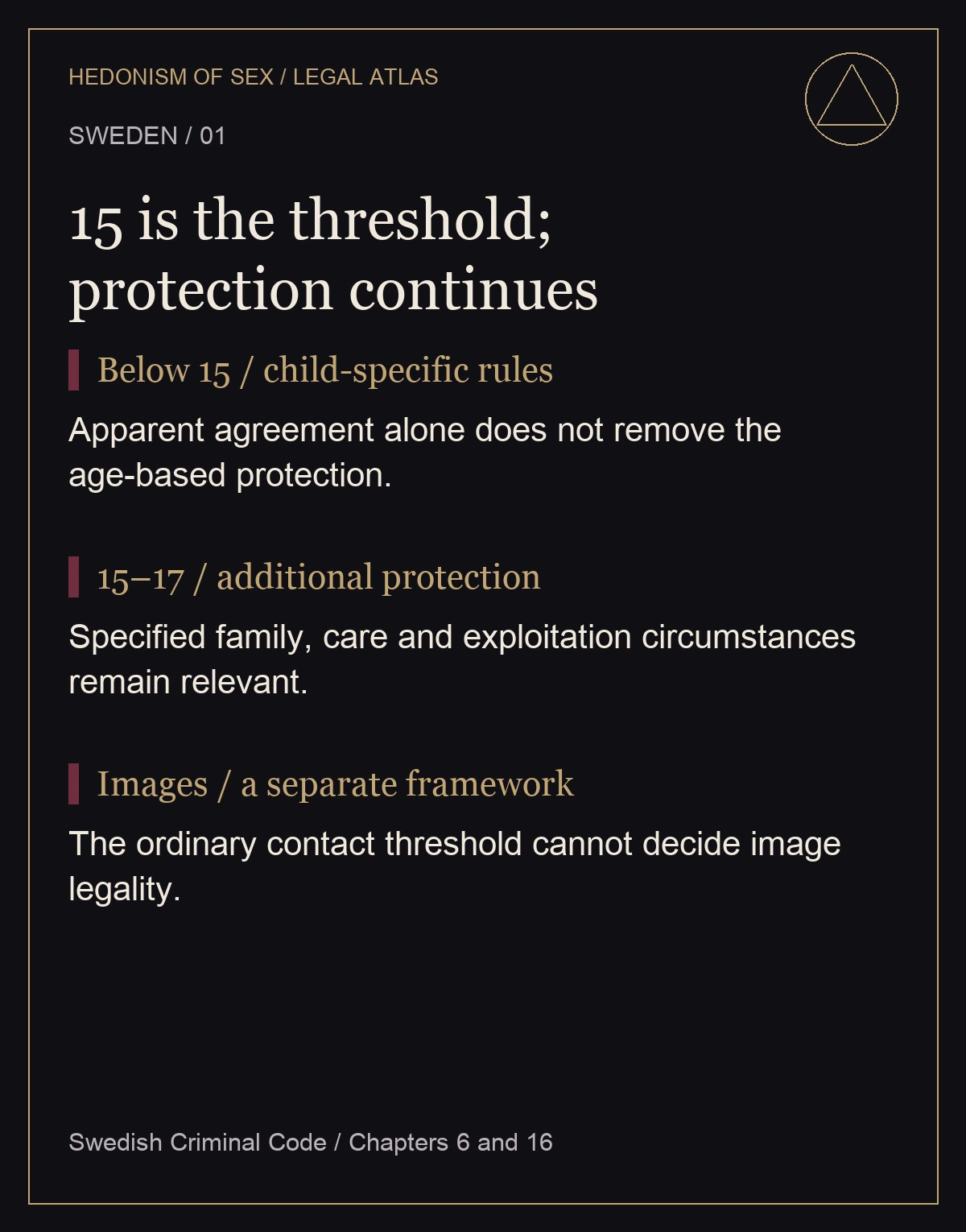
The general age of sexual consent in Sweden is 15. Below 15, a narrowly defined exception can exclude criminal responsibility for certain offences, but the law sets no universal age gap in years. Protection also continues for people below 18 in specified family, care and exploitation circumstances. Criminal Code, Chapter 6, sections 4, 6 and 14.
A single age does not answer every legal question. This guide separates the age threshold from voluntary participation, the limited peer exception, compensation and images. It concerns the Swedish national criminal-law framework; a cross-border situation can require advice on more than one country’s law.
15 is the ordinary threshold, not a complete permission rule
Chapter 6, section 4 addresses vaginal, anal or oral intercourse, and sexual acts comparable in seriousness, involving a child below 15. Section 6 addresses other sexual acts. The provisions also cover improperly inducing a child to perform or submit to the relevant act. Other conduct, including sexual touching, has its own provisions. The classification of an act matters; these offences are not interchangeable. Chapter 6, sections 4–6 and 10.
For a child below 15, apparent agreement does not by itself remove the age-based protection. Conversely, reaching 15 does not establish voluntary participation, remove the specific under-18 protections or decide whether an image is lawful. The statutory language is not based on an opposite-sex relationship; the same age framework must be considered regardless of the participants’ sexes. Chapter 6, sections 1–6.
| Circumstance | Relevant check |
|---|---|
| Below 15 | Child-specific offences; section 14 excludes liability only in its narrowly specified cases. |
| 15–17 | Voluntary participation plus the family, upbringing, care and exploitation protections in section 4(2). |
| Compensated sexual act below 18 | Section 9 applies independently of the ordinary threshold of 15. |
| Images or sexual posing | Separate offences and definitions; the contact threshold cannot be substituted for them. |
The peer exception has no fixed two-year or three-year limit
Section 14 requires it to be obvious that the act involved no abuse, taking account of the small difference in both age and development and the other circumstances. It does not provide a numerical formula. Sharing a school year or having a particular age gap cannot establish the exception on its own. Chapter 6, section 14.
The first paragraph concerns an act involving a child below 15 classified under section 5 or the less serious form in section 6(2), or conduct covered by section 8(1) or the first sentence of section 10(1). Section 5 is itself a less serious classification of conduct within section 4. The exception therefore does not extend automatically to every offence involving a child, and it does not provide a defence to the more serious classifications. Chapter 6, sections 5, 6 and 14.
The Prosecutor Authority’s guidance describes restrictive application, principally concerning voluntary contact between teenagers around the threshold of 15. It stresses the parties’ ages and development, their relationship and the circumstances of the act. This supports reading the exception as an assessment of a specific case, rather than a general licence for a relationship. Sexualbrott, Part 1, section 5.3.3, pages 49–50.
Hypothetical example: a small difference between two teenagers’ birthdays answers only one factual question. It does not establish similar development, voluntariness, the absence of abuse or the required offence classification. An age calculator cannot decide this exception.

Two routes extend child-specific protection to ages 15–17
Family, upbringing and responsibility for care
Section 4(2)(1) covers a 15-, 16- or 17-year-old who is the other person’s descendant, is being brought up by that person or has a similar relationship, or whose care or supervision that person is responsible for under a public authority’s decision. This is a defined relationship protection. The additional exploitation test in the next route is not a condition that must also be proved for this route. Section 6 extends the framework to other sexual acts. Chapter 6, sections 4(2)(1) and 6.
Improper exploitation of reduced ability to protect sexual integrity
In other circumstances, section 4(2)(2) addresses improper exploitation of a child’s reduced ability to safeguard their sexual integrity because of mental ill health, disability, substance abuse, the other person’s authority or other circumstances. The route requires the statutory connection between reduced ability and improper exploitation. A diagnosis alone is not a substitute for that assessment. Nor should every professional title be treated as automatically satisfying the provision. Chapter 6, sections 4(2)(2) and 6.
This expanded protection took effect on 1 July 2025. A summary written before that reform may omit an important part of the current framework. The below-15 peer exception must not be imported into these under-18 relationship and exploitation cases. SFS 2025:586, amended sections 4 and 6 and commencement clause; section 14.
Voluntary participation remains necessary
Section 1 makes lack of voluntary participation central to the rape offence. Words, actions or other expressions of willingness must be considered. Participation cannot be regarded as voluntary where the statutory circumstances involve violence or specified threats, improper exploitation of a particularly vulnerable situation, or serious abuse of dependency. The vulnerable situations listed include unconsciousness, sleep, severe fear, intoxication, illness and injury. Chapter 6, section 1.
The practical question is willingness to take part in the particular activity, rather than a person’s relationship status or their earlier willingness. If participation is unclear, stop and establish whether it is voluntary. Reaching the ordinary age threshold never resolves that question.
Mistakes about age are a separate issue. Section 13 allows liability for an age-based offence where a person lacked intent about the relevant age but was negligent about it. Simply saying that someone looked older does not settle liability. Sections 1a and 3 address a different issue: gross negligence concerning the absence of voluntary participation. These standards should not be confused. Chapter 6, sections 1a, 3 and 13.
Payment, sexual posing and proposed meetings have separate rules
Section 9 concerns inducing someone below 18 to perform or submit to a sexual act for compensation. It also applies where another person promises or provides that compensation. The ordinary threshold of 15 does not remove this protection. Section 11 separately criminalises specified purchases of sexual acts outside the earlier offences; turning 18 does not make every compensated arrangement lawful. Chapter 6, sections 9 and 11.
Section 8 addresses promoting or exploiting sexual posing involving a child below 15, and also a 15–17-year-old where the posing is apt to harm health or development. Its analysis is distinct from whether a particular image falls within the image offence. Chapter 6, section 8.
Section 10a concerns proposing or arranging a meeting with a child below 15 with the purpose of committing one of the specified sexual offences. The text does not require the meeting actually to happen. Section 14(2) provides only a tightly linked exception where the intended act would meet its first-paragraph non-abuse conditions if completed. It is not a general exception for online communication. Chapter 6, sections 10a and 14(2).
The contact threshold of 15 does not decide image legality
Chapter 16, section 10a addresses pornographic depictions of children. The listed conduct includes making, distributing, supplying, acquiring and possessing such images, and viewing images to which the viewer has procured access. Its definition concerns a person whose pubertal development is incomplete or who is below 18. This is not a prohibition on every ordinary photograph of a minor: the provision concerns pornographic images. Chapter 16, section 10a.
There is a further statutory distinction: for a fully developed person, liability for the conduct listed in section 10a(1)(2)–(5) requires it to be apparent from the image and surrounding circumstances that the person depicted is below 18. The making offence has its own rule extending liability to negligence about the person being below 18. These qualifications should not be replaced with a blanket claim that appearance decides all image offences.
Section 10b(1) narrowly excludes the making and possession prohibitions for the person who makes the image where the age and development difference is small and the other circumstances do not call for liability. It is not a general exemption for a recipient, and it does not exempt distribution. Section 10b also contains separate provisions for specified hand-made images not intended to be made available to others and for acts justifiable in the circumstances. Neither the ordinary consent age nor the contact-law peer exception replaces these image-specific rules. Chapter 16, sections 10a–10b.

Which effective versions were checked?
This guide was checked on 5 November 2026 against the Riksdag’s Criminal Code page, displaying amendments through SFS 2026:1656. A consolidated page can contain future provisions; a recent header date alone does not establish that every provision is already in force.
The original SFS 2025:586 confirms commencement on 1 July 2025 for the relevant reform. SFS 2026:1318, which amends Chapter 6 sections 1, 4 and 10a, commenced on 1 August 2026. Both dates precede this check. Historical conduct requires the law applicable to that date and consideration of the relevant transitional rules. 2025 amendment, commencement clause; 2026 amendment, commencement and transitional provisions.
Practical questions
Does Sweden have a fixed three-year peer exception?
No universal number appears in Chapter 6, section 14. It requires a small difference in age and development, the other circumstances and an obvious absence of abuse, within specified offence classifications.
Is agreement enough when a person is 16?
No. Voluntary participation matters, but so do the defined family, upbringing and care relationships, improper exploitation, compensation and any separate image offences.
What should be collected before seeking legal advice?
Exact birth dates, the date and location of the conduct, its nature, relevant communications and any care, dependency, authority or compensation arrangements. Describe any image issue without forwarding potentially unlawful material.
For a situation involving another country, use its own sources rather than Sweden’s exception. Continue with the Law & Rights library or the separate guides to Denmark and its distinct territorial codes and Germany.
Official sources and verification
- Riksdag: Brottsbalk (1962:700). Chapter 6, sections 1–14; Chapter 16, sections 10a–10b. Swedish statutory text; English explanations here are editorial summaries.
- Svensk författningssamling: SFS 2025:586. Original amendment and 1 July 2025 commencement.
- Svensk författningssamling: SFS 2026:1318. Original amendment; relevant Chapter 6 provisions and 1 August 2026 commencement.
- Swedish Prosecutor Authority: Sexualbrott, Part 1, RäV 2024:9, updated October 2025. Used for the restrictive peer-exception explanation; later statutory amendments were checked separately.