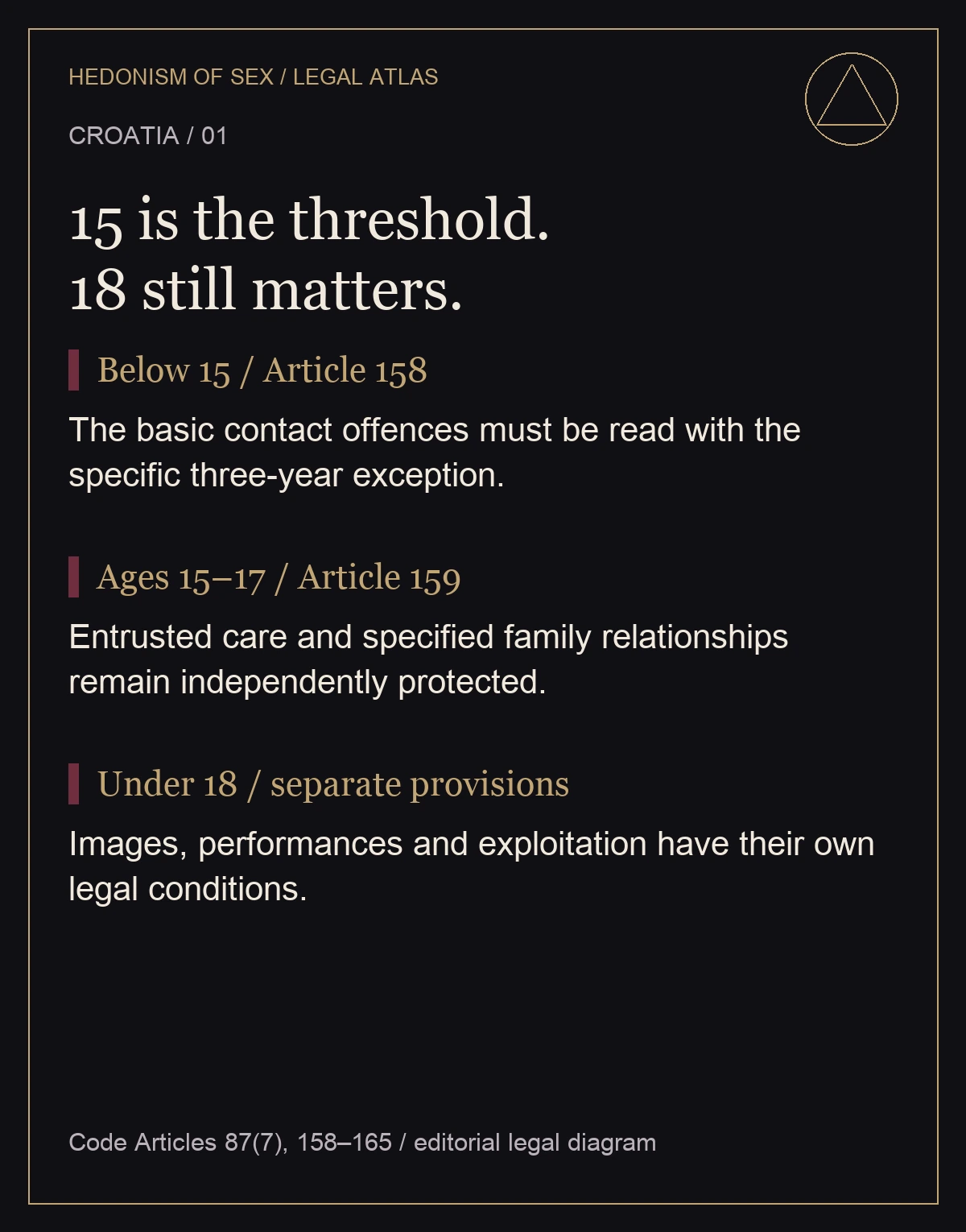
Croatia’s ordinary age of sexual consent is 15. Criminal Code Article 158 protects children below 15 through its basic sexual-contact offences. Paragraph (3) excludes the offences in paragraphs (1) and (2) where the age difference between the people involved is no greater than three years. This exception does not remove the separate offences involving coercion, entrusted care, exploitation or images. Code Article 158, read with NN 36/2024, Article 23.
The practical task is to identify which provision governs the situation. A consensual relationship between young people, an adult’s care responsibilities, a request for an image and the redistribution of an existing image raise different legal questions. This guide explains those distinctions without treating one country-chart number as blanket permission.
The national threshold and what counts as a child
The framework is national. Article 10 applies Croatian criminal law to everyone committing an offence within Croatian territory; a visitor is not exempt because their home country has different rules. The same Code governs conduct in Zagreb, Split, Dubrovnik and the islands. The 2025 amendment added a separate paragraph on legal persons without removing the existing territorial rule. Cross-border conduct may require further jurisdictional analysis. Code Article 10; NN 136/2025, Article 1.
For this Code, a child is a person who has not reached 18: Article 87(7). The age of 15 therefore does not mean that a person stops being a child for the other offences. Article 158’s basic offences concern intercourse or equivalent sexual acts and the additional sexual conduct described in paragraph (2), involving a child below 15. The conduct needs legal classification; a message, an image and a physical act are not interchangeable. Articles 87(7) and 158(1)–(2).
| Question | Relevant provision | Why it matters |
|---|---|---|
| Contact with someone below 15 | 158(1)–(2) | Basic age-based offences |
| Age difference no greater than three years | 158(3) | Exception specifically to those basic offences |
| A child aged 15–17 entrusted to another person | 159 | Separate care and family protections |
| Producing or possessing sexual images | 163 | Separate offence and narrow private-use clause |
How the three-year exception works
Article 158(3) says that the offences in paragraphs (1) and (2) do not exist where the age difference between the people carrying out the specified sexual acts is not greater than three years. The text does not impose Greece’s separate requirement that both participants must be below 15. It is nevertheless a provision tied to particular offences, not a general exemption from the Criminal Code. Article 158(3); compare the independently explained Greek framework.
The boundary includes an exact three-year difference. “Not greater than” is different from “less than.” Calculate from full dates of birth and the date of the event. Two rounded ages can hide a difference exceeding three years.
Hypothetical example: one person is 14 and the other is 16, and their precise age difference is two years and six months. That difference is within paragraph (3)’s numerical boundary. This answers only that part of the basic age-offence assessment; coercion, care relationships or separate image conduct still need their own checks.
Another hypothetical example: two people described as “14 and 17” could be three years and two months apart. Those rounded ages are insufficient to establish the exception. A family’s approval also does not substitute for a statutory condition.
Paragraphs (5) and (6) address conduct involving force or threats, deception, fraud or abuse of authority, hardship or dependency. Paragraph (3) expressly names paragraphs (1) and (2), so it must not be extended to erase those additional offences. The 2012 amendments clarified paragraphs (5) and (6); later changes increased penalties. NN 144/2012, Article 42; NN 36/2024, Article 23.
Criminal responsibility is a different issue again. Article 7 excludes application of criminal legislation to a child below 14. That does not change the protected age in Article 158 or give an older person permission to act against that child. Code Article 7.

Why protection continues after 15
Entrusted care and family relationships
Article 159(1) protects a child who has reached 15 and is entrusted to another person for upbringing, teaching, custody, spiritual care or nursing. It covers the intercourse and equivalent acts specified there, including inducing the child into those acts with another person or upon themselves. The relationship matters: a 15-, 16- or 17-year-old can fall within this protection despite meeting the ordinary threshold. Code Article 159(1).
Paragraph (2) separately addresses direct-line relatives by blood or adoption, stepparents and the specified partners of the child’s parent. The 2015 amendment expanded that list. Do not reduce this provision to “teachers only,” or assume that a close age difference displaces it. NN 56/2015, Article 47.
Consent and exploitation remain independent questions
Article 153(5) describes consent as a voluntary decision to participate where the person was capable of making and expressing that decision. It identifies circumstances inconsistent with consent, including threats, fraud, abuse of a dependent position and exploitation of a state preventing expression of refusal. Meeting an age threshold is not proof of any of those conditions. NN 126/2019, Article 14.
Article 162 separately criminalises the specified involvement in a child’s sexual services, including purchasing the sexual services of a child who has reached 15. Article 106’s trafficking protections are also independent; the 2025 replacement expressly addresses trafficking children for sexual exploitation and states that the victim’s consent to exploitation does not remove the offence. Code Article 162; NN 136/2025, Article 9.
Images: a different exception with different conditions
Article 163 covers child pornography, including specified production, acquisition, sharing, possession and knowing access through communication technology. Its definition includes real children, realistically depicted nonexistent children and people appearing to be children in the specified depictions. The 2019 definition distinguishes sexually explicit depictions from the separately described genital depictions and their artistic, medical or scientific qualification. It should not be summarised as “every nude image is pornography.” Article 163(1)–(2); NN 126/2019, Article 19, replacing paragraph (6).
Article 163(5) contains its own narrow non-punishment clause. It concerns a child’s production and possession of material depicting that child alone or that child with another child, where they themselves produced it, possess it with each person’s consent and keep it exclusively for their personal use. Every condition matters. This is not a blanket permission for adults to acquire the material or for anyone to forward it, publish it or sell it. Article 163(5).
The two exceptions do different work. Article 158(3) concerns particular physical acts and an age difference. Article 163(5) concerns a child, the depicted participants, self-production, consent and exclusive personal use. The three-year contact exception cannot supply missing image conditions.
A separate privacy offence also matters. Article 144.a, introduced in 2021, addresses the specified abuse of trust in making a privately made sexual recording available to a third person without the recorded person’s consent, as well as specified fabricated or altered recordings used as real. Consent to making a recording does not by itself establish consent to sharing it. NN 84/2021, Article 13.

Online requests, viewing and performances
Article 161(1) addresses an adult proposing a meeting with a person below 15, through technology or another means, with the specified criminal purpose and taking steps to bring about the meeting. The 2019 amendment extended the referenced purposes to particular image and performance offences. A proposal’s purpose and the steps towards meeting are relevant elements; do not describe every conversation as this particular offence. Code Article 161; NN 126/2019, Article 18.
Article 164 separately addresses involving children in pornographic performances and viewing the specified performances live or through communication means. Article 165 concerns making pornography available to a child below 15. These provisions do not use the contact exception as a general viewing or distribution permission. Code Articles 164–165; NN 126/2019, Article 20.
What changed, and what is still a proposal
The original Code commenced on 1 January 2013, not its 2011 publication date. The 2019 sexual-offence and image amendments commenced on 1 January 2020. The 2024 amendments were published on 25 March 2024 and commenced on the eighth day after publication, 2 April 2024. Code Article 387; NN 126/2019, final commencement provision; NN 36/2024, final commencement provision.
The 2024 change from “three” to “five” in Article 158(5) concerns punishment. It did not replace the three-year age-difference wording in paragraph (3). Reading the paragraph number is essential when checking an amendment.
NN 136/2025 was published on 5 November 2025 and commenced eight days after publication, 13 November 2025. It includes territorial and trafficking amendments. Separately, Parliament’s record for P.Z.E. 343 reports acceptance at first reading on 21 October 2026 and referral for preparation of a final proposal. That record is not evidence of a newly commenced criminal rule. This guide distinguishes that proposal from the enacted provisions above. NN 136/2025; official parliamentary procedure record.
Common questions
Is an exact three-year difference within the contact exception?
Yes, its numerical wording is “not greater than three years.” The exception is specifically to Article 158(1) and (2); other offence conditions remain separate.
Does the private-image clause allow forwarding an image?
It describes self-production and possession with each participant’s consent exclusively for personal use. It does not supply a general distribution permission or protection for an adult recipient.
Does parental permission replace the law?
No. A parent’s approval cannot remove the conditions of the Criminal Code or establish another person’s voluntary consent. Entrusted-care and family provisions need their own assessment.
Before drawing a conclusion about an actual event, record both dates of birth, the event date, the precise conduct, any entrusted-care or dependent relationship, and what happened to any images. Use the country library for comparisons, and a qualified Croatian lawyer for individual advice.
Sources and review record
- Criminal Code, NN 125/2011. Original Articles 7, 10, 87, 158–165 and 387, compared with the amendments below.
- NN 144/2012 and NN 56/2015. Clarifications to Article 158 and the Article 159 family list.
- NN 118/2018 and NN 126/2019. Penalty changes, rape reform, online purposes and image/performance definitions.
- NN 84/2021. Intimate-image privacy offence and related updates.
- NN 36/2024 and NN 136/2025. Later penalty, territorial and trafficking changes.