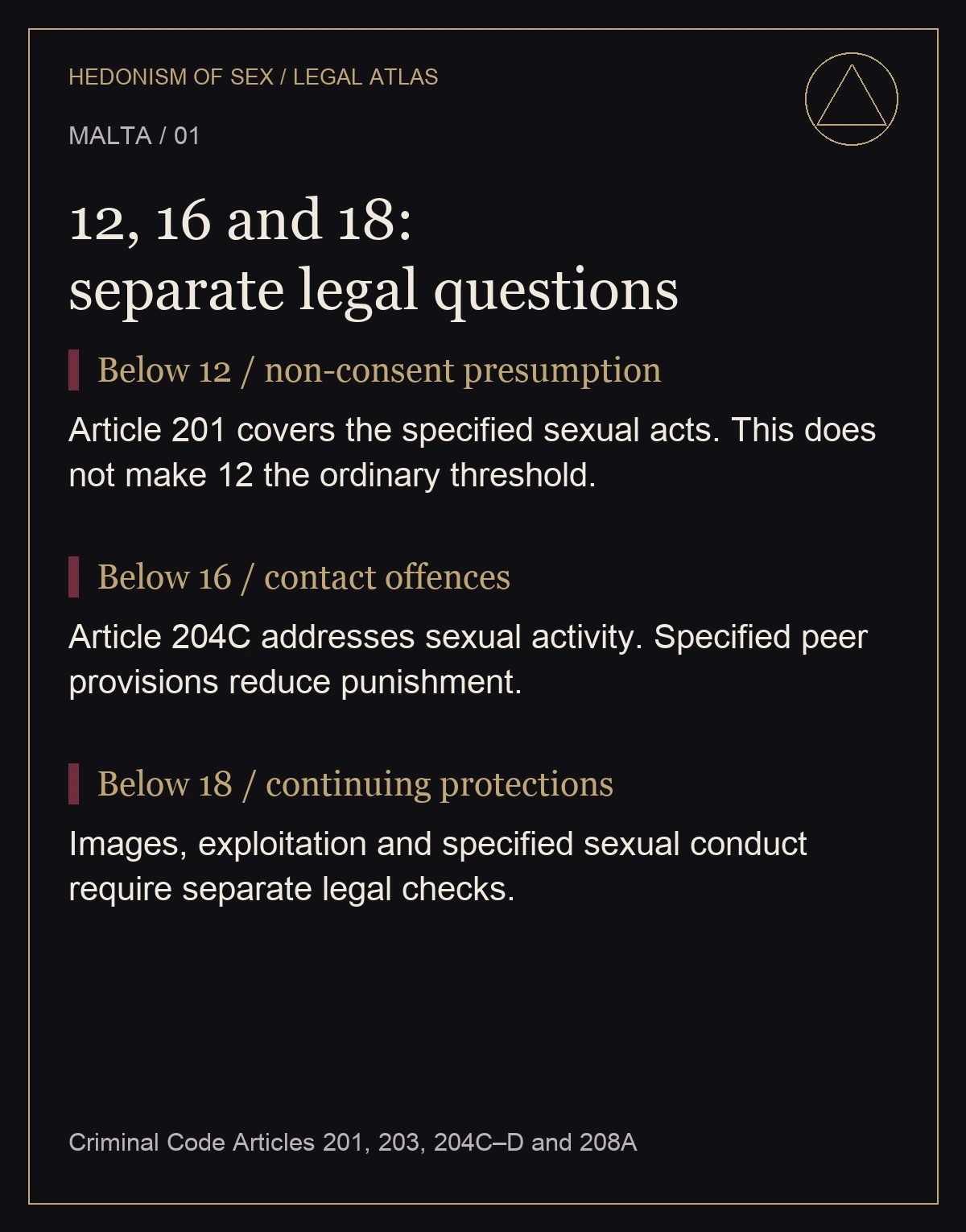
Malta’s ordinary age of sexual consent is 16. Criminal Code Article 204C(1) criminalises taking part in sexual activities with a person who has not reached 16. Paragraph 3 provides a reduction of punishment by one or two degrees for consensual acts between peers close in age and level of development, without physical or psychological abuse. A sentencing reduction is not the same as conduct being lawful. The provision states no fixed two-, three- or four-year gap. Criminal Code, Article 204C(1) and (3).
The ordinary contact threshold and minority are different
Article 204C(1) concerns sexual activities with a person below 16. Its basic wording does not require the other participant to be an adult. Article 203 separately addresses what the code calls defilement through lewd acts involving a person below 16. The proper classification depends on the conduct and applicable offence; those provisions should not be reduced to one interchangeable label. Articles 203 and 204C.
A person aged 16 or 17 is still a minor. Civil Code Article 157 defines a minor as a person who has not reached 18, and Article 188(1) fixes majority at completion of the eighteenth year. The Criminal Code continues to protect people under age through provisions addressing exploitation, pornographic performances, sexual images and other specified conduct. Reaching the contact threshold does not remove those protections. Civil Code, Articles 157 and 188; Criminal Code, Articles 204–204D and 208A.
| Age or situation | Relevant distinction |
|---|---|
| Below 12 | Article 201(a) supplies a presumption of non-consent for the acts it covers. Other below-16 offences also require assessment. |
| Below 16 | Article 204C’s sexual-activity offence and Article 203’s separate offence; specified peer provisions reduce punishment. |
| Peers close in age and development | Consent and absence of physical or psychological abuse are required for the stated reductions. No numerical gap is given. |
| 16–17 | Minor protections concerning exploitation, images and specified sexual conduct remain separate. |
The peer provisions change punishment, not the offence’s existence
Article 204C(3) requires consensual conduct between peers who are close both in age and in their level of development, without physical or psychological abuse. Its stated consequence is that punishment must be decreased by one or two degrees. It does not say that the conduct is not an offence or that the people are exempt from prosecution. Article 204C(3).
Article 203(1A) contains the same form of reduction for the offence in that article. Article 203A, addressing instigation, encouragement or facilitation of defilement, also contains a peer reduction in its second proviso. These provisions were introduced by Articles 7, 8 and 12 of Act LXIV of 2021. They must be read with their specific offences rather than treated as a general exception to all sexual-offence law. 2021 amending Act, Articles 7, 8 and 12; current Articles 203, 203A and 204C.
Hypothetical example: if one participant is 15 and the other 16, a one-year difference alone does not make Article 204C irrelevant. The offence’s below-16 condition and the separate criteria for a peer reduction still need examination. This example does not decide whether particular people qualify as peers or how a court would sentence them.
There is no statutory number of years in these clauses that a reader can use as an automatic clearance. Nor should “one or two degrees” be translated into subtracting one or two years: the code uses degrees as a legal sentencing mechanism. A lawyer must assess the applicable offence, any aggravating circumstances and the sentencing rules on the actual facts. Articles 203(1A), 203A and 204C(3).

Free agreement must be assessed in its circumstances
Article 198 addresses the specified forms of non-consensual penetration. Its paragraph 3 states that the acts are deemed non-consensual unless consent was given voluntarily as a result of the person’s free will, assessed in the surrounding circumstances and the person’s state at the time, including their emotional and psychological state. Article 207 separately addresses non-consensual sexual acts not constituting one of the preceding completed or attempted offences. Articles 198(1)–(3) and 207.
Article 201 presumes non-consent for unlawful carnal knowledge and other indecent assault in its listed situations: conduct involving someone below 12, and specified circumstances where the person was unable to resist because of infirmity, another cause independent of the offender’s act or the offender’s fraudulent device. It is a distinct provision, not the basis for saying that the ordinary threshold is 12. Article 201(a)–(b).
A claim that conduct was consensual cannot displace the separate age offence. Equally, being 16 or older does not supply consent to a particular act. The circumstances at the time, capacity, pressure and the specific conduct still matter.
Authority matters within the particular offence
For Article 203, its proviso identifies aggravating circumstances including specified family and care relationships. Paragraph (c) covers an ascendant, adoptive parent, tutor or someone charged, even temporarily, with the younger person’s care, education, instruction, control or custody. Paragraph (d) contains a different formulation concerning recognised trust, authority, influence or listed professional duties together with one of the additional circumstances specified there. Do not omit those additional conditions when summarising that paragraph. Article 203(1), proviso (c)–(d).
Article 204C(2) also specifies aggravating circumstances concerning violence, payment and its particular authority or professional conditions. Other provisions, including Articles 202 and 208AC, address aggravation of the offences within their scope. The correct question is which offence and which aggravating conditions are established; the code should not be condensed into a claim that every professional relationship automatically has one identical age threshold. Articles 202, 204C(2) and 208AC.
For people aged 16 or 17, protections against exploitation remain important. Article 204D includes coercing a person under age into sexual activities, specified sexual-purpose involvement in witnessing or performing sexual conduct, recourse to child prostitution and knowingly attending a pornographic performance involving a person under age. Articles 204A and 204B separately address specified prostitution and pornographic-performance exploitation. Ordinary contact consent is not permission for those activities. Articles 204A–204D.
A proposed meeting can matter before a meeting occurs
Article 208AA concerns a person aged 18 or older who has met or communicated with someone below 16 on one or more occasions and intentionally meets, proposes by any means to meet, or arranges to meet that person, with the specified intention to commit one of the listed offences during or after the meeting. The provision also includes its express reasonable-belief condition concerning the younger person’s age. All of those elements need to be read together. Article 208AA(1).
The current wording is not confined to a completed meeting: proposing or arranging one is expressly included. It is also not accurate to say that every ordinary conversation necessarily constitutes this offence. Age, previous contact, the meeting-related conduct, the stated belief condition and criminal intent must be considered. The 2021 Act replaced paragraph 1, so older summaries may describe different wording. Act LXIV of 2021, Article 15.
The image offence has its own scope and defences
Article 208A(1) addresses making, producing and the specified distribution, supply, transmission, availability and procurement of indecent material involving or showing people under age. Paragraph 1B separately covers acquisition, knowingly obtaining access through information and communication technologies, and possession of the specified material. A distribution purpose is not stated as a general requirement for possession under paragraph 1B. Article 208A(1) and (1B).
The definition in paragraph 7 extends beyond documentary photographs. It includes the listed audio or video recordings, digitally created images, drawings, cartoons, text and simulated or realistic representations, including specified material involving an apparent or nonexistent child. The content still has to meet the offence’s legal description; ordinary photographs of a minor are not automatically indecent material. Article 208A(2) and (7).
Article 208A(4) contains a defence provision, including a legitimate reason or its specified lack-of-knowledge conditions. Its exact wording refers to charges of distributing, showing or possessing material under paragraph 1. That cross-reference should not be silently rewritten into an unrestricted defence to every act in paragraph 1B. Its application in a case requires legal interpretation. No general private-couple or numerical age-gap permission is written into these provisions. Article 208A(1), (1B) and (4).
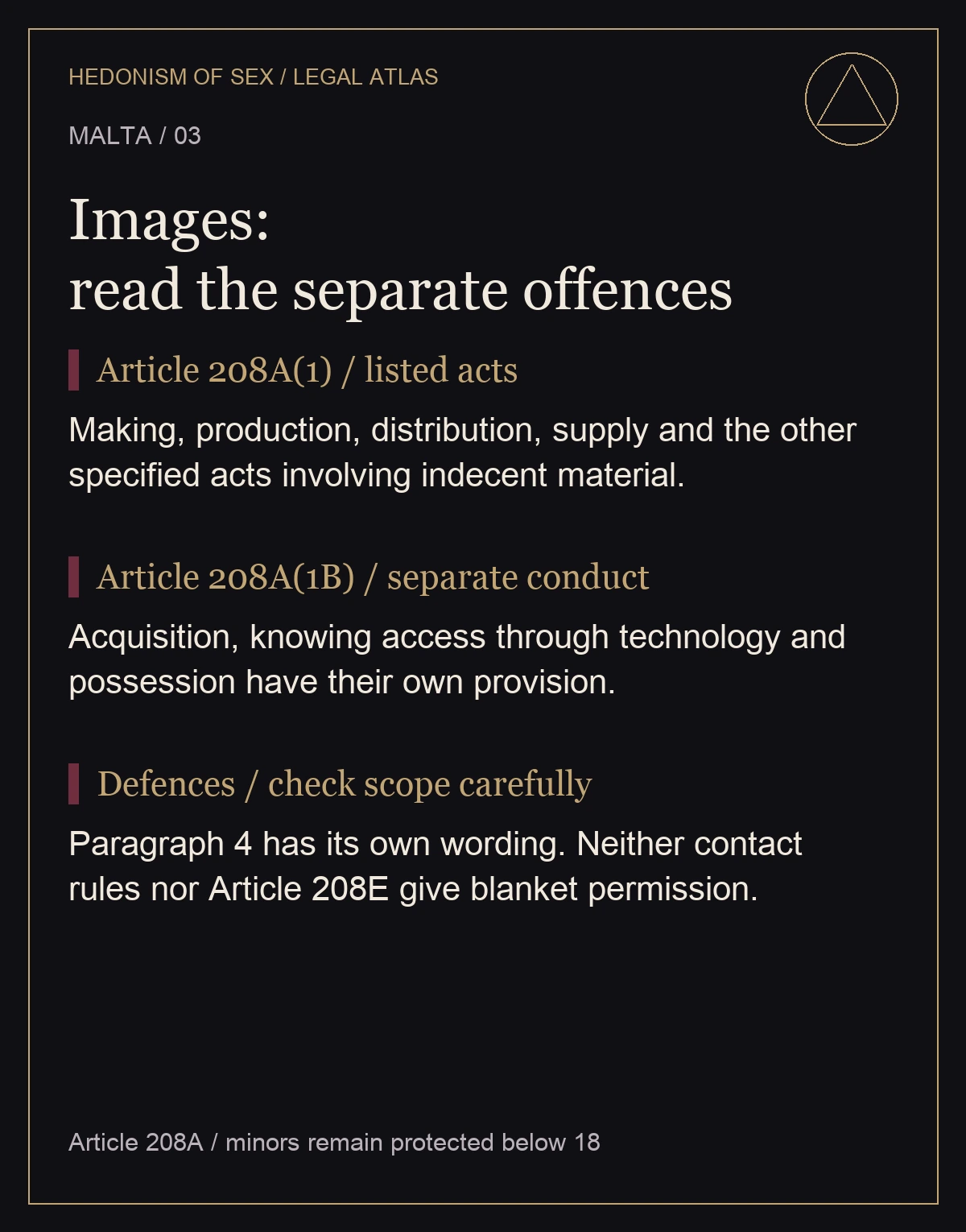
There is another distinction with Article 208E, concerning taking or disclosing private sexual photographs or films without consent and with the intent to cause the specified harm. Its paragraph 2 contains its own exclusions, including a carefully worded situation involving disclosure solely to the depicted people. That is a provision about the Article 208E offence; it should not be represented as cancelling Article 208A’s separate protection of people under age. Articles 208A and 208E(1)–(2).
Separate publication, commencement and consolidation dates
Act XIII of 2018 was published on 30 April 2018. Its Article 24(r) substituted Article 204C with the below-16 sexual-activity offence. Legal Notice 154 of 2018 expressly appointed 14 May 2018 as the date when all the Act’s provisions came into force. The notice itself was published on 15 May. The parliamentary vote date, Act publication and appointed commencement date are different facts. Act XIII of 2018, Article 24(r); Legal Notice 154 of 2018.
The peer punishment reductions appear in Act LXIV of 2021, published on 14 December 2021, and remain in the current code. This guide checked the current official Criminal Code version with portal publication date 1 October 2026. That date is the code edition’s publication date, not a claim that the consent threshold changed in October 2026. 2021 Act, Articles 7, 8 and 12; current code record.
For historical events or international situations, a current age table alone is insufficient. Article 208B(5) supplies additional jurisdiction grounds for its specified offences, including particular connections to Malta, Maltese nationals or permanent residents and computer systems accessed from Malta. A case involving travel or online activity can require those rules as well as the law where people were physically located. Article 208B(1) and (5)–(7).
Common questions
Does Malta have a three-year close-in-age exemption?
The provisions checked give no numerical three-year permission. Articles 203(1A), 203A and 204C(3) provide punishment reductions for consensual peers close in age and development without the specified abuse. They do not state that the conduct ceases to be an offence. Current peer provisions.
Does turning 16 make sexual images lawful?
It does not create a general permission. A 16- or 17-year-old remains a minor, and Article 208A must be assessed separately from the contact threshold. Civil Code, Article 157; Criminal Code, Article 208A.
Must a grooming meeting actually occur?
Not in every form covered by the current wording. Article 208AA expressly includes proposing or arranging a meeting, subject to its other elements. It is not a rule criminalising every conversation without those elements. Article 208AA(1).
Sources and practical next steps
For a concrete concern, establish the full birth dates, event dates, conduct, whether agreement was voluntary, any authority or dependency, and whether images, payments or proposed meetings were involved. A qualified Maltese criminal-law professional can assess the offence and sentencing provisions. Ask how evidence should be preserved before copying or forwarding intimate material.
- Criminal Code, Chapter 9, official current English text — portal publication 1 October 2026; relevant Articles 198–204D and 207–208E checked in the 425-page PDF.
- Gender-Based Violence and Domestic Violence Act, XIII of 2018 — original Act, Article 24 and especially paragraph (r); publication 30 April 2018.
- Legal Notice 154 of 2018 — original commencement notice appointing 14 May 2018.
- Act LXIV of 2021 — peer reductions in Articles 7, 8 and 12; image and grooming amendments in Articles 14–15.
- Civil Code, Chapter 16, official current English text — Articles 157 and 188 on minority and majority.