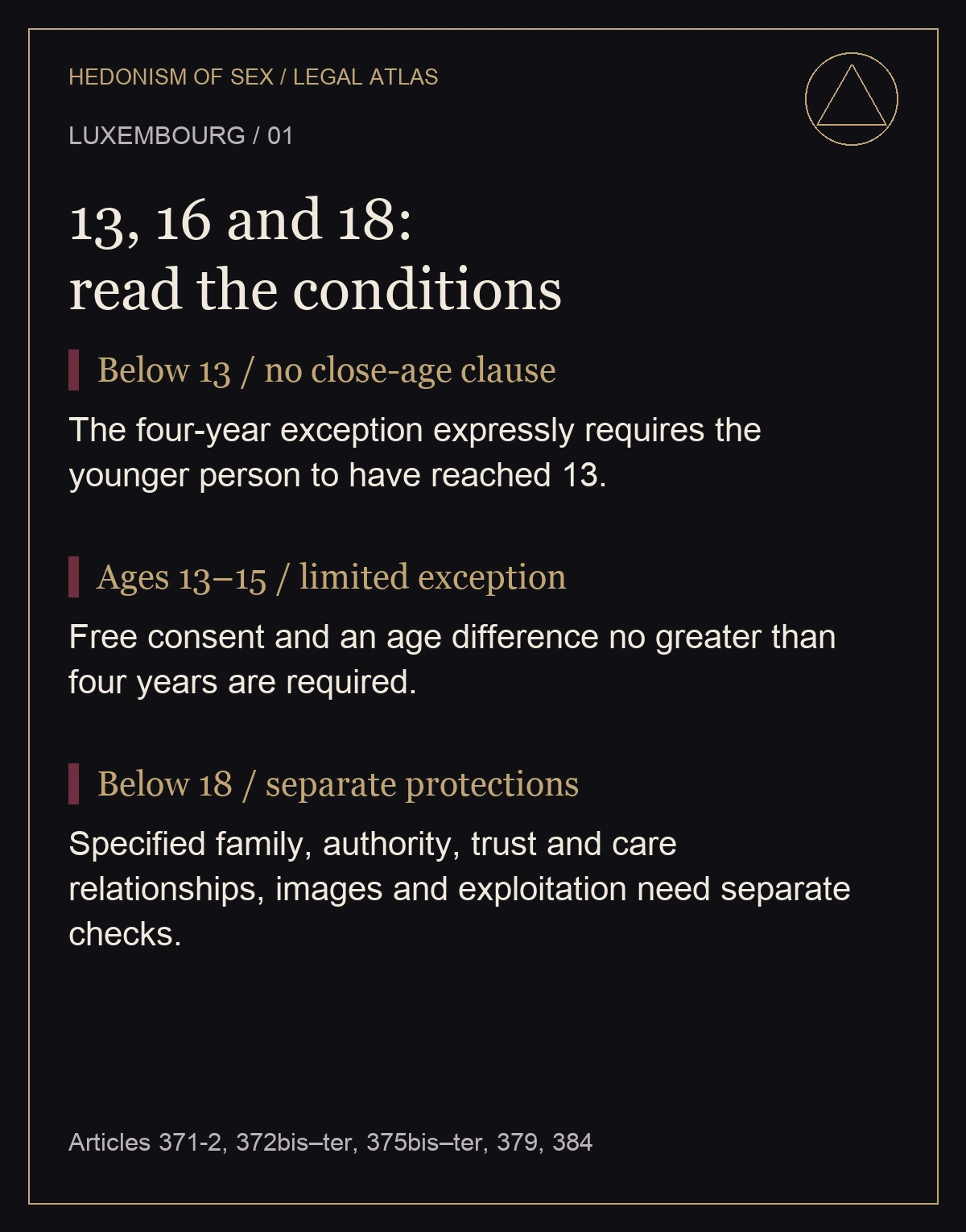
The ordinary age of sexual consent in Luxembourg is 16. For the age-based offences in Articles 372bis and 375bis, a person below 16 is deemed unable to consent. The exception requires the younger person to have reached 13 and still be below 16, to consent freely, and to have an age difference with the other person no greater than four years. It does not remove the separate prohibitions concerning specified family, authority, trust and care relationships. Criminal Code, Articles 371-2, 372bis, 372ter, 375bis and 375ter.
Different ages answer different questions
Article 372bis addresses sexual acts affecting sexual integrity involving a person below 16, including the forms of participation specified in the provision. Article 375bis separately addresses sexual penetration involving a person below 16. Both contain the four-year exception for a freely consenting person who has reached 13 but not 16. Their basic age-based wording does not require the other participant to be an adult. Articles 372bis and 375bis.
| Younger person’s age | What the law requires you to check |
|---|---|
| Below 13 | The four-year exception does not apply. The below-16 offences and other applicable protections remain relevant. |
| 13–15 | Free consent and an exact age difference no greater than four years for the exception; separate offences and relationship prohibitions must still be checked. |
| 16–17 | The ordinary below-16 rule no longer applies on age alone. Protections concerning specified family, authority, trust and care relationships, images and exploitation continue. |
| 18 or above | Consent remains necessary. Reaching adulthood does not authorise non-consensual sexual conduct. |
The table is not a clearance tool for a relationship. It separates the ordinary threshold from the exceptional situation and continuing protections. In particular, Article 371-2 deems a minor unable to consent in the situations covered by Articles 372ter and 375ter, which concern specified family and authority relationships. Articles 371-2, 372ter and 375ter.
The exception has an age floor, a maximum gap and a consent requirement
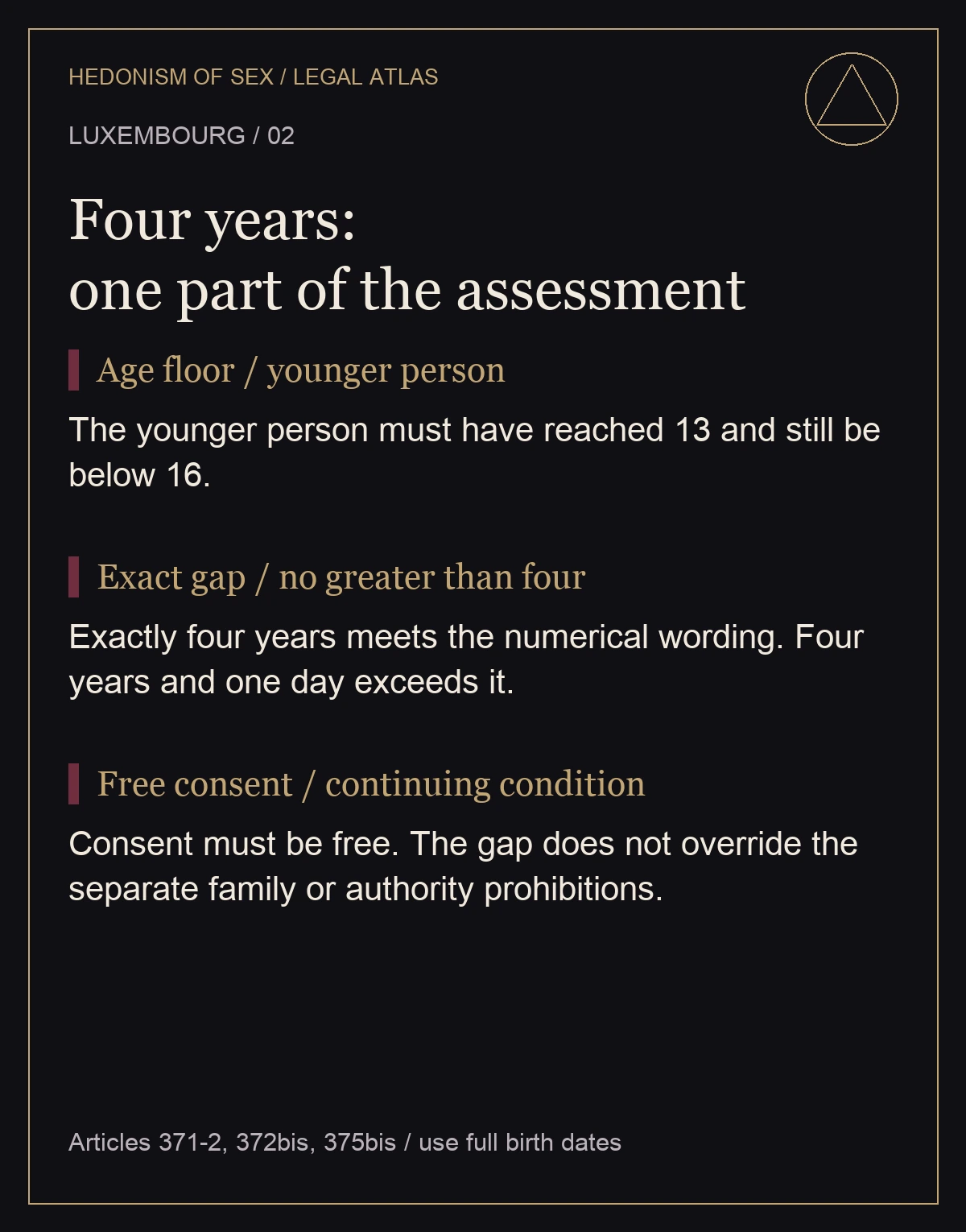
The younger person must have completed their thirteenth year and not reached 16. The difference between the participants’ ages must be no greater than four years. Free consent is an express condition. The provision does not say that the older person must also be a minor, so describing it as exclusively a rule for two minors would add a restriction that its wording does not contain. Articles 371-2, 372bis, final paragraph, and 375bis, second paragraph.
Hypothetical example: people born on the same calendar date four years apart meet the numerical limit exactly. If the younger person is 15, that answers the age-floor and numerical-gap questions; it does not establish free consent or exclude a prohibited authority or family relationship. A gap of four years and an additional day is greater than four years. Use complete dates of birth rather than subtracting rounded ages.
A real judgment demonstrates why the detail matters. In judgment no. 156/2024 of 7 November 2024, the Court of Cassation recorded that the defendant was 19 years and 11 months old and the younger person 15 years and 3 months old at the time. The Court held that the age-difference condition was not satisfied. That decision concerns its particular facts and does not create a different statutory numerical limit. Court of Cassation, CAS-2024-00010, judicial reasons at page 11.
Neither a relationship beginning earlier nor an app’s minimum account age is an exception written into these provisions. For a concrete situation, check the ages on the date of each relevant act and the precise offence involved. The four-year clause does not refer to image offences or electronic sexual propositions.
Consent cannot be inferred from a failure to resist
Article 371-2 requires consent to be assessed in the circumstances of the case. It expressly says that consent cannot be inferred from the victim’s lack of resistance and may be withdrawn at any time before or during the sexual act. These rules apply alongside the statutory limits on a minor’s ability to consent. Article 371-2; 7 August 2023 Act, Article 2.
Article 372 addresses non-consensual sexual acts affecting sexual integrity, and Article 375 addresses non-consensual sexual penetration. Their wording includes acts involving deception, surprise and a person unable to give free consent or resist; it is not confined to proving physical violence. Article 375 also covers the specified conduct where a person is made to perform an act on their own body or another person’s body. Articles 372 and 375.
For the close-age exception, willingness must therefore be real and free. A qualifying birthday difference cannot supply consent that is absent, withdrawn or legally unavailable. A relationship, marriage or past agreement does not change the requirement for the particular sexual act.
The separate family and authority prohibitions protect minors
Articles 372ter and 375ter cover the respective sexual acts involving a minor by specified family members. The list includes a parent, an ascendant, collateral relatives up to the third degree and relatives by marriage up to the third degree. Their paragraph 2 provisions extend to specified people who live or have habitually lived with those relatives, people with authority over the minor, people abusing authority from their functions or a recognised position of trust or influence, and people entrusted with the minor who have responsibility for their care. Articles 372ter(1)–(2) and 375ter(1)–(2).
These are not merely rules for someone below 16. They concern minors, including 16- and 17-year-olds. In those situations Article 371-2 deems the minor unable to consent. The four-year clause for Articles 372bis and 375bis is not an exception to Articles 372ter or 375ter.
A teacher, coach, carer or other professional relationship therefore needs a careful factual assessment. The relevant authority, entrusted care or abuse of a recognised position has to be identified. Avoid treating every job title as an identical automatic offence, but do not rely on the ordinary threshold or age gap to disregard the separate provision. Articles 371-2, 372ter(2) and 375ter(2).
An electronic sexual proposition can be a separate offence
Article 385-2 addresses an adult making sexual propositions through electronic communication to a minor below 16 or a person presenting themselves as such. Its first paragraph does not require a subsequent physical meeting. A following meeting is addressed separately in its second paragraph with a higher penalty. This differs from a rule requiring concrete meeting arrangements before the basic offence is complete. Article 385-2.
The four-year contact exception does not appear in Article 385-2. It should not be assumed that an adult’s sexual messages are lawful simply because the people might satisfy the age conditions of the contact clause. Whether a particular message amounts to a sexual proposition remains a question of the actual content and circumstances.
Contact consent does not authorise pornographic images of a minor
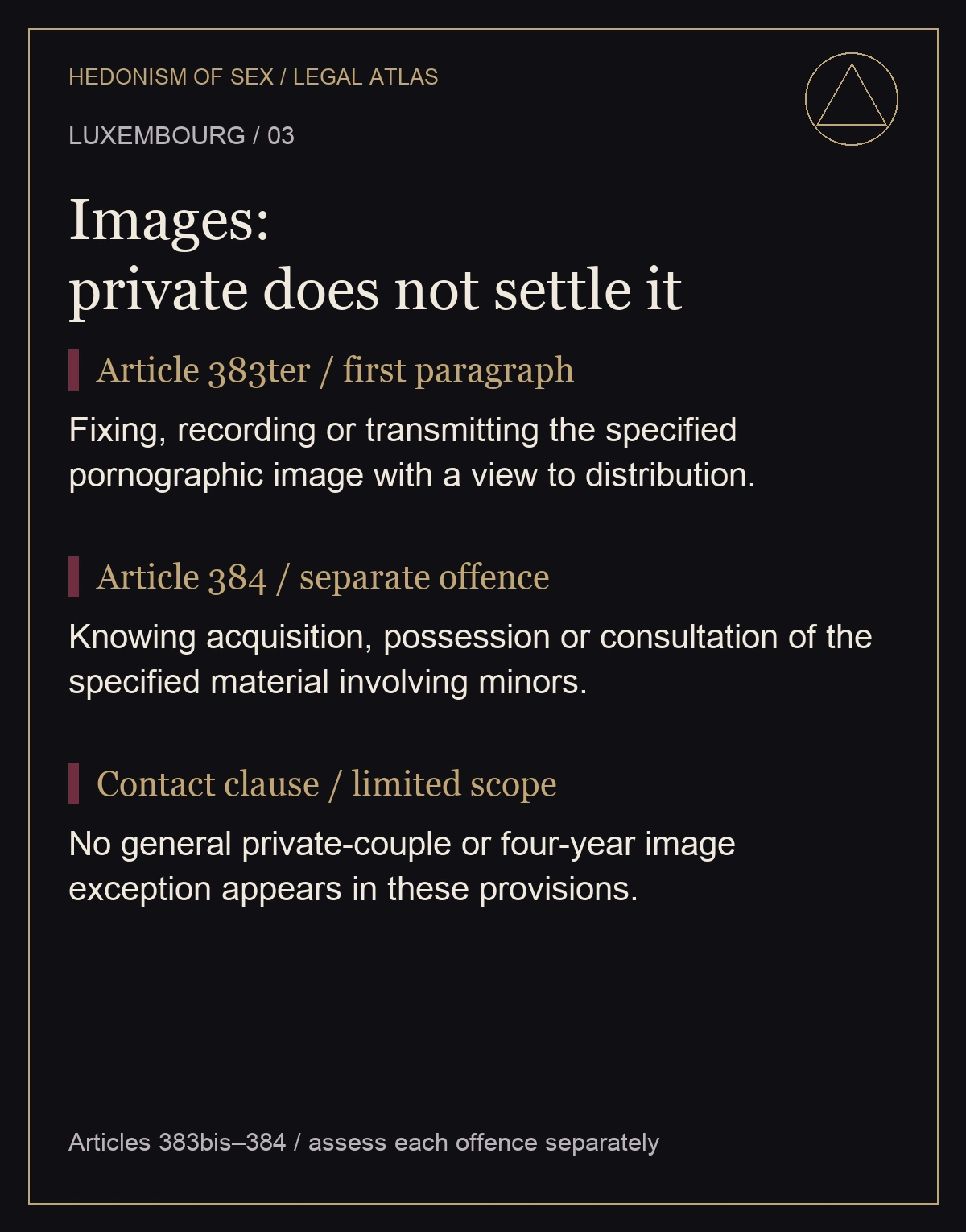
Article 383ter concerns fixing, recording or transmitting a pornographic image or representation of a minor with a view to distribution. It separately addresses offering, making available, distributing, importing or exporting such material and specified attempts. The purpose wording in the first paragraph matters, but it does not mean that material kept privately is generally permitted. Article 383ter.
Article 384 independently criminalises knowingly acquiring, possessing or consulting the specified pornographic material involving or depicting minors. Its wording does not require a purpose of distribution. Articles 383bis and 379 also address the specified production, circulation, exploitation and performances involving minors. A complete assessment therefore cannot stop after reading the first paragraph of Article 383ter. Articles 379, 383bis–384.
No general private-couple or four-year image exception appears in these provisions. A person reaching 16, agreeing to a photograph or intending it for one recipient does not by itself establish that the material is lawful. The content must still meet the relevant statutory description; an ordinary photograph of a child is not automatically pornographic. Articles 383bis–384.
Commercial exploitation has separate protections. Article 379 expressly addresses specified exploitation of people below 18. Article 382-7(1) addresses requesting, accepting or obtaining sexual relations in exchange for payment or a promise of payment from a minor engaged in prostitution, even occasionally. Article 382-8 contains a specific non-prosecution provision connected to disclosure to the authorities; it is not an age-of-consent exception or a general permission for the underlying conduct. Articles 379 and 382-7–382-8.
The 2023 reform took effect on 22 August 2023
The reform was signed on 7 August 2023, published in Mémorial A no. 520 on 18 August and entered into force on 22 August 2023, according to the official record. It introduced Article 371-2 and the relevant new structure of Articles 372–377. Do not use the signature or publication date as though either were the commencement date. 7 August 2023 Act and official information panel.
For older events, Article 13 of the amending Act supplies a transitional rule, with exceptions for its procedural Articles 11 and 12. The Court of Cassation’s 2024 judgment also explains Article 2 of the Criminal Code: comparison with a later, more favourable criminal law is concrete, including both the offence and punishment. It did not treat the entire reform as automatically more favourable in every case. Historical cases need that analysis, rather than the unqualified application of today’s age table. Act, Article 13; Cassation judgment, page 11.
The edition checked here is consolidated to 19 December 2025 and marked currently applicable by Legilux on our check date. The consolidation date is not a new age-of-consent reform date. Article 3 applies Luxembourg law to offences committed in its territory; Article 4 provides that conduct abroad is punishable in Luxembourg in the cases determined by law. Cross-border cases require the relevant jurisdiction rules as well as the local threshold. Current code status and Articles 3–4.
Common questions
Does exactly four years satisfy the age-gap wording?
Yes, the statutory wording is no greater than four years. The younger person must also be 13–15 and consent freely, and separate prohibitions must be assessed. Articles 371-2, 372bis and 375bis.
Does the exception apply below 13?
No. It expressly requires the younger person to have reached 13. A smaller age difference does not remove that condition. Articles 372bis and 375bis.
Does turning 16 make images or authority relationships lawful?
No general permission follows. The separate minor protections in Articles 372ter and 375ter and the image provisions must still be checked. Articles 371-2, 372ter, 375ter and 383bis–384.
Sources and practical next steps
For an actual case, record exact birth dates, the event date, the nature of the acts, whether consent was free and continued, any family or authority relationship, and whether messages, images or payment were involved. A qualified Luxembourg lawyer can assess those facts. Ask how to preserve evidence before downloading or forwarding intimate material.
- Criminal Code, official documentary consolidation to 19 December 2025 — marked currently applicable; full 150-page PDF and the relevant provisions checked. Legilux states that the consolidation has no legal force.
- 7 August 2023 Act, Mémorial A520 — original five-page published legislation, especially Articles 2–8 and 13; official commencement 22 August 2023.
- Court of Cassation, 7 November 2024, no. 156/2024, CAS-2024-00010 — judicial reasons at page 11. The later prosecutor’s conclusions are a separate part of the file.