The ordinary age threshold is 14. Criminal Code Article 180(1) prohibits intercourse or an equivalent act with a child, defined by Article 112(8) as someone below 14. Article 180(4) contains an exception where there is no significant difference in the participants’ mental and physical maturity. It does not specify a fixed age gap. Additional provisions protect people aged 14–17 and regulate other conduct independently. Criminal Code, Articles 112 and 180–185b.
Research scope. Checked against the Official Gazette’s Legal Information System (PIS), the Supreme Court’s consolidation through 94/2024, the original parliamentary amendments of 2024 and 2026, and Supreme Court judgment Kzz 543/2025. This guide concerns the Serbian Criminal Code; Kosovo has a separate criminal-code framework requiring a separate assessment. This is AI-assisted editorial research without independent lawyer review, rather than advice on an individual case.
Do not translate every statutory age term as “child”
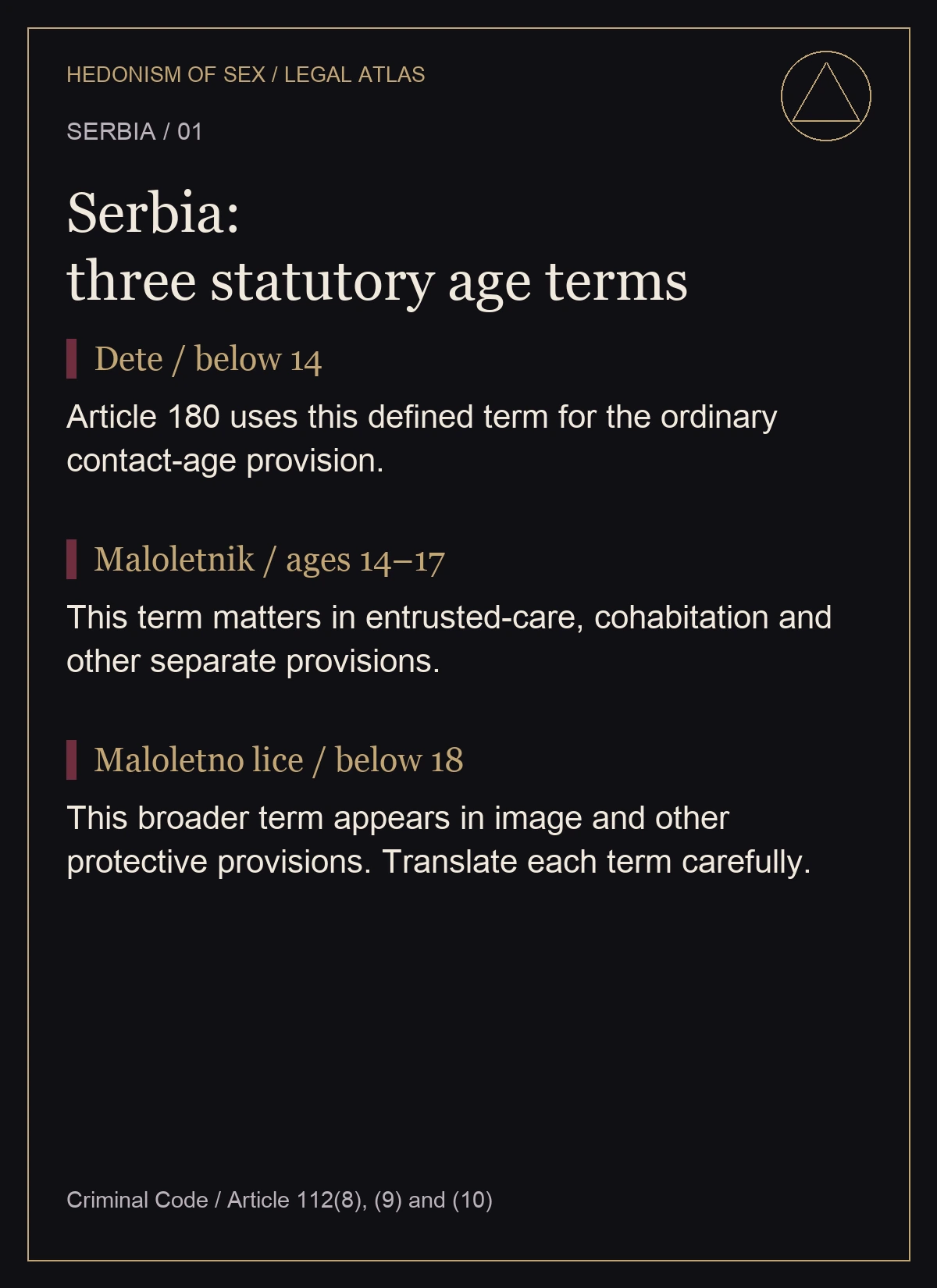
Article 112 distinguishes three terms. A dete is a person below 14. A maloletnik has reached 14 but not 18. A maloletno lice is a person below 18. These definitions affect the scope of individual offences, so a translation that uses “minor” or “child” indiscriminately can change the apparent legal boundary. Article 112(8)–(10).
Article 180(1) uses the first term, making 14 the ordinary threshold for the conduct it describes. It does not generally limit the person alleged to have committed the offence to an adult. Article 182(2) separately covers other sexual acts under its specified cross-references, including the circumstances of Article 180(1). Reaching 14 removes neither authority protections nor the separate image rules. Articles 180–182 and 185.
Age of criminal responsibility answers a different question. Article 4(3) states that criminal sanctions cannot be imposed on a person who was below 14 at the time of the act, while sanctions concerning minors operate under a special law. That provision concerns the alleged offender; it does not change the age of the person protected by Article 180. Article 4(3).
The exception requires mental and physical maturity to be assessed
Article 180(4) says that the person will not be punished for the offence in paragraph 1 if there is no significant difference between that person and the child in their mental and physical maturity. Neither a two-year nor a three-year difference appears in the text. Birthdays can be relevant facts, but subtraction alone does not establish the statutory condition. Article 180(4).
The phrase has an express legal meaning. Article 112(29) states that “will not be punished” means that there is no criminal offence in that case. This is consequently different from a provision merely allowing a lower sentence. Its scope remains limited: Article 180(4) expressly refers to Article 180(1). This guide does not extend it automatically to Article 182 or to authority, image or other offences. Articles 112(29), 180(4) and 182.
A useful illustration comes from Supreme Court judgment Kzz 543/2025, dated 14 May 2025. The court examined an appellate application of the exception involving a 13-year-old and a 26-year-old. It found that the appellate reasoning did not properly account for the age difference and expert evidence of a significant difference in psychological maturity. It identified errors of procedural and substantive law in the accused’s favour. Supreme Court, Kzz 543/2025.
The procedural outcome matters: the Supreme Court made that finding without disturbing the finality of the challenged judgment. It should not be reported as a new conviction or as proof that the court created a fixed numerical age-gap rule. The decision instead illustrates the need to assess the statutory maturity conditions and the evidence rather than rely on a broad assertion of similar intellectual ability. Judgment’s reasoning and disposition.

For a hypothetical pair close in chronological age, the same distinction remains: a small gap is not an automatic exemption. This guide offers no physical-development checklist and does not invite readers to assess someone else’s legal status by appearance.
Authority, force and inability to resist remain separate protections
Article 181(1) addresses inducing intercourse or an equivalent act through abuse of a position where the other person is subordinate or dependent. Paragraph 2 addresses abuse of position or authority by teachers, educators, guardians, adoptive parents, parents, step-parents and other people involving a minor entrusted for education, upbringing, care or nursing. Paragraph 3 separately addresses conduct against a child below 14. Article 181.
A hypothetical relationship involving a 16-year-old and someone responsible for their care therefore cannot be assessed just by comparing 16 with the ordinary threshold. The relationship, entrustment and alleged abuse are material. Nor does a job title alone decide a case: all statutory elements need examination.
Article 178 addresses its specified forms of compulsion through force or threats. Article 179 concerns exploitation of mental illness, delayed mental development, other mental disturbance, helplessness or another condition leaving the person unable to resist. Article 182a separately addresses sexual harassment, with an additional provision where the person affected is below 18. Those protections do not disappear on a birthday above the ordinary contact threshold. Articles 178–179 and 182a.
In practical terms, lawful age is never a replacement for freely choosing to participate. A person can refuse or withdraw agreement regardless of a relationship label. This guide’s headline is not a determination of which offence applies to disputed facts.
Living together has a separate criminal provision
Article 190(1) addresses an adult living in an extramarital union with a maloletnik—the code’s term for a person aged 14–17. Paragraphs 2 and 3 separately concern a parent, adoptive parent or guardian who enables or induces that union, with a further provision concerning financial motives. An ordinary contact threshold of 14 therefore does not automatically authorise living together in the relationship described by Article 190. Article 190(1)–(3).
Paragraph 4 states that, if a marriage is concluded, prosecution will not be initiated or will be discontinued if already initiated. That is a specific provision within Article 190. It must not be presented as a general marriage defence to all sexual offences, or as an explanation of when a marriage can lawfully be concluded. Marriage eligibility is a separate family-law enquiry. Article 190(4).
Family relationships can also engage a separate prohibition. Article 197 addresses its specified adult conduct involving an underage blood relative in the direct line or an underage brother or sister. The general contact threshold is not the complete answer to those relationships. Article 197.
Image offences are separate, and the definition has two limbs
Article 185(4) addresses acquisition for oneself or another, possession, sale, display, public exhibition and making available electronically or otherwise of the specified pornographic material produced through exploitation of an under-18 person. Paragraph 5 separately addresses knowing access using information technology. A general intention to redistribute is not stated as a condition of the possession offence. Article 185(4)–(5).
Its definition needs precise translation. Article 185(6)’s first limb refers to material visually depicting a maloletno lice—someone below 18—engaging in real or simulated sexually explicit conduct. Its further limb refers to depictions of the sexual organs of a dete for sexual purposes, using the separately defined below-14 term. The provision should not be paraphrased as though the two statutory age terms were identical. Articles 112(8)–(10) and 185(6).
This distinction is not permission to create or circulate sexual depictions of a person aged 14–17. The first limb and other applicable offences still require assessment. Equally, an ordinary nonsexual photograph is not automatically material satisfying the statutory definition. The content, conduct, knowledge and applicable provision must be identified.
Article 185(1) separately concerns making the specified pornographic content or a performance available to a minor aged 14–17, while paragraph 3 addresses its commission against a child below 14. Paragraph 2 concerns exploitation of a minor for production or a performance, with paragraph 3 again addressing the younger group. There is no express general private-couple or numerical peer exception in the Article 185 text examined. Article 180(4) should not be copied into it. Article 185(1)–(3).
The online-meeting offence includes appearance at the agreed place
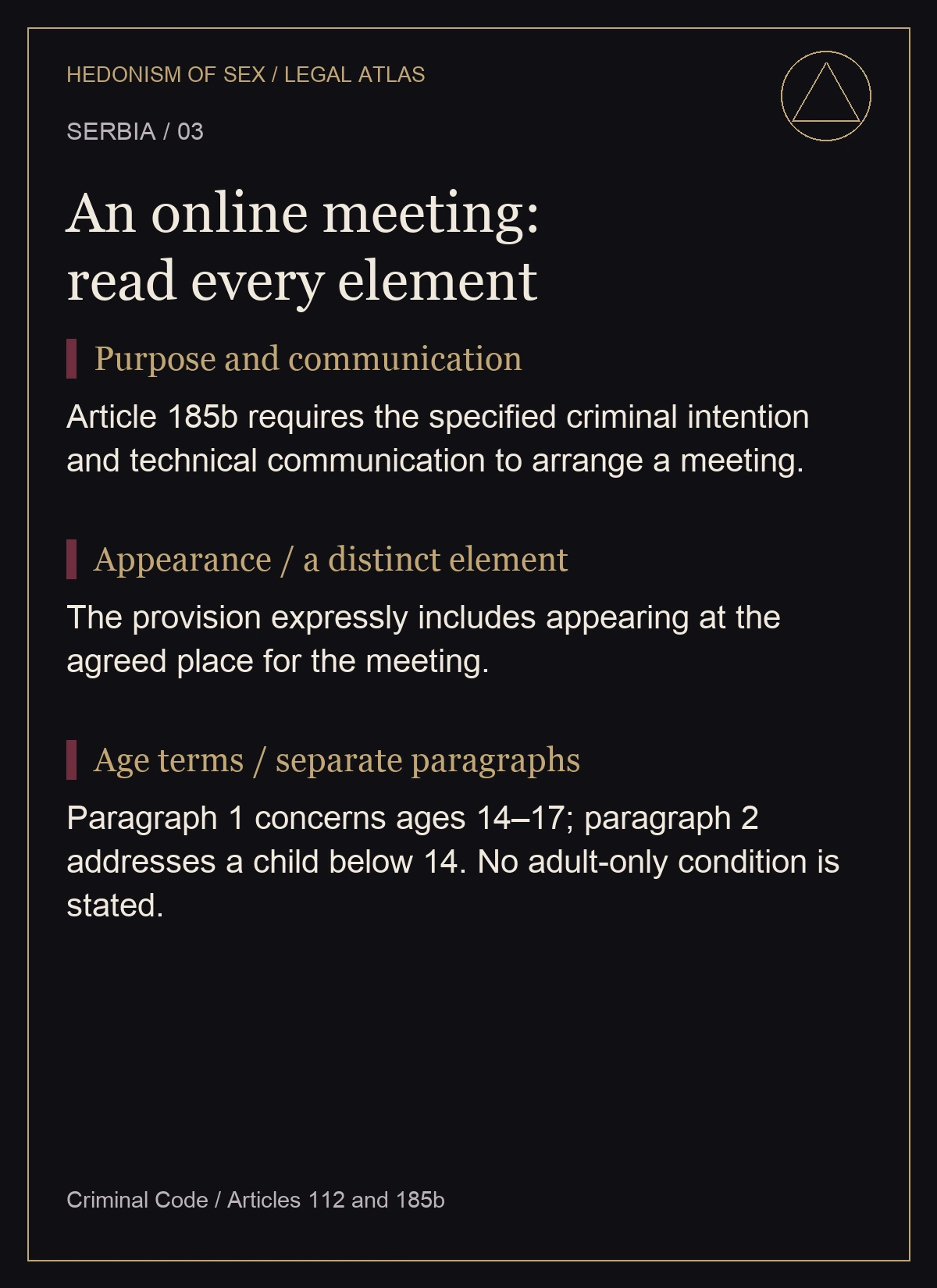
Article 185b concerns use of a computer network or communication through other technical means to agree a meeting with a minor aged 14–17, with the intention of committing one of the listed sexual offences, followed by appearance at the agreed place for that meeting. Paragraph 2 addresses conduct against a child below 14. The text does not state an adult-perpetrator condition. Article 185b.
This differs from a provision satisfied merely by an invitation or by any preparatory step. The Serbian wording expressly includes appearance at the agreed place. That does not mean earlier communications are always lawful: image offences, harassment, attempts or other provisions may require their own examination. Nor does appearance establish every remaining element without evidence of the specified criminal purpose.
Article 185a is another separate offence, concerning inducing a child below 14 to witness the specified sexual acts. Articles 183 and 184 address their listed facilitation and prostitution-related conduct, with provisions protecting under-18 people. A relationship or payment should not be treated as an automatic answer to those restrictions. Articles 183–185a.
The July 2026 amendment does not change these contact-age provisions
The official PIS consolidation lists amendments through Official Gazette 63/2026, published 10 July 2026. The original parliamentary Act changes Article 55a concerning repeat offending and replaces or adds specified firearms offences around Article 348. It does not amend Articles 112 or 178–185b. The November 2024 amendment similarly concerns other offences, including transport consequences and attacks on specified workers. Neither should be described as a 2026 change to the ordinary age of consent. 2026 Act, Articles 1–5; 2024 Act.
Commencement and application also differ. The 2026 Act enters into force eight days after publication, on 18 July 2026, but its Articles 2 and 3 have application deferred for nine months, to 18 April 2027. The official publisher expressly explains that distinction and provides the earlier Article 348 for the intervening period. Those firearms provisions do not establish a later contact-age threshold. PIS publisher’s note; Article 5.
Historical events require a further check under Article 5 of the code: the ordinary rule concerns the law at the time of the act, with the most favourable law applying where subsequent changes meet the provision. A current edition should not simply be applied backwards without that analysis. Article 5.
Identify the legal framework before relying on a country label
This guide describes Serbia’s Criminal Code. Its territorial and cross-border provisions appear in Articles 6–10; nationality, presence, extradition, foreign proceedings and additional prosecution conditions can matter. A foreign destination’s age chart is not a complete jurisdictional assessment. Articles 6–10.
Do not transfer this guide’s 14-year threshold to Kosovo. Kosovo’s Official Gazette publishes a separate Criminal Code, No. 06/L-074, with its own amendments. This article does not determine that code’s thresholds or exceptions; a situation there requires a separate current-law review. This distinction identifies the applicable legal materials without taking a position on political recognition. Kosovo Official Gazette, code record.
Common questions
Is every relationship above 14 lawful?
No. Abuse of position, dependence, coercion, incapacity, cohabitation and other restrictions remain separate questions. Image offences also have their own definitions.
Is there a fixed close-in-age allowance?
Article 180(4) uses mental and physical maturity, without a numerical gap. It expressly concerns Article 180(1), rather than every offence in the code.
Did the Supreme Court create a thirteen-year age-gap limit?
No. Kzz 543/2025 examined the facts and expert evidence in a particular case. Its thirteen-year gap is a fact of that case, not a generally permitted numerical limit.
Did July 2026 raise or lower the age?
The enacted 63/2026 amendment examined concerns other provisions. It does not change the ordinary threshold or the maturity exception discussed here.
Sources and practical next steps
For a concrete situation, establish each person’s age on the relevant date, the conduct involved, any dependence or entrusted-care relationship, whether a union or cohabitation is involved, and whether material or online communications exist. A qualified local lawyer can then assess the correct offence, evidence and law applicable in time.
- Official Legal Information System: Criminal Code. Publisher’s editorial consolidation through 63/2026, including the deferred-application note.
- Supreme Court: Criminal Code through 94/2024. Independent official-hosted baseline checked against the later amendment.
- Supreme Court Kzz 543/2025, 14 May 2025. Maturity assessment and the precise procedural outcome.
- Parliament: original 2024 amendment.
- Parliament: original 2026 amendment.
- Parliament: adopted laws and Gazette references.
- Kosovo Official Gazette: separate code record. Cited only to distinguish the legal framework.
Editorial transparency. Checked 6 November 2026. English explanations are editorial translations and summaries; the original-language legislation governs. No independent lawyer review has been completed. Source copies and correction notes are retained in the editorial registry.
Browse the country law directory or read the separately researched guides to Montenegro, Croatia and Hungary. Similar terminology does not make their exceptions interchangeable.