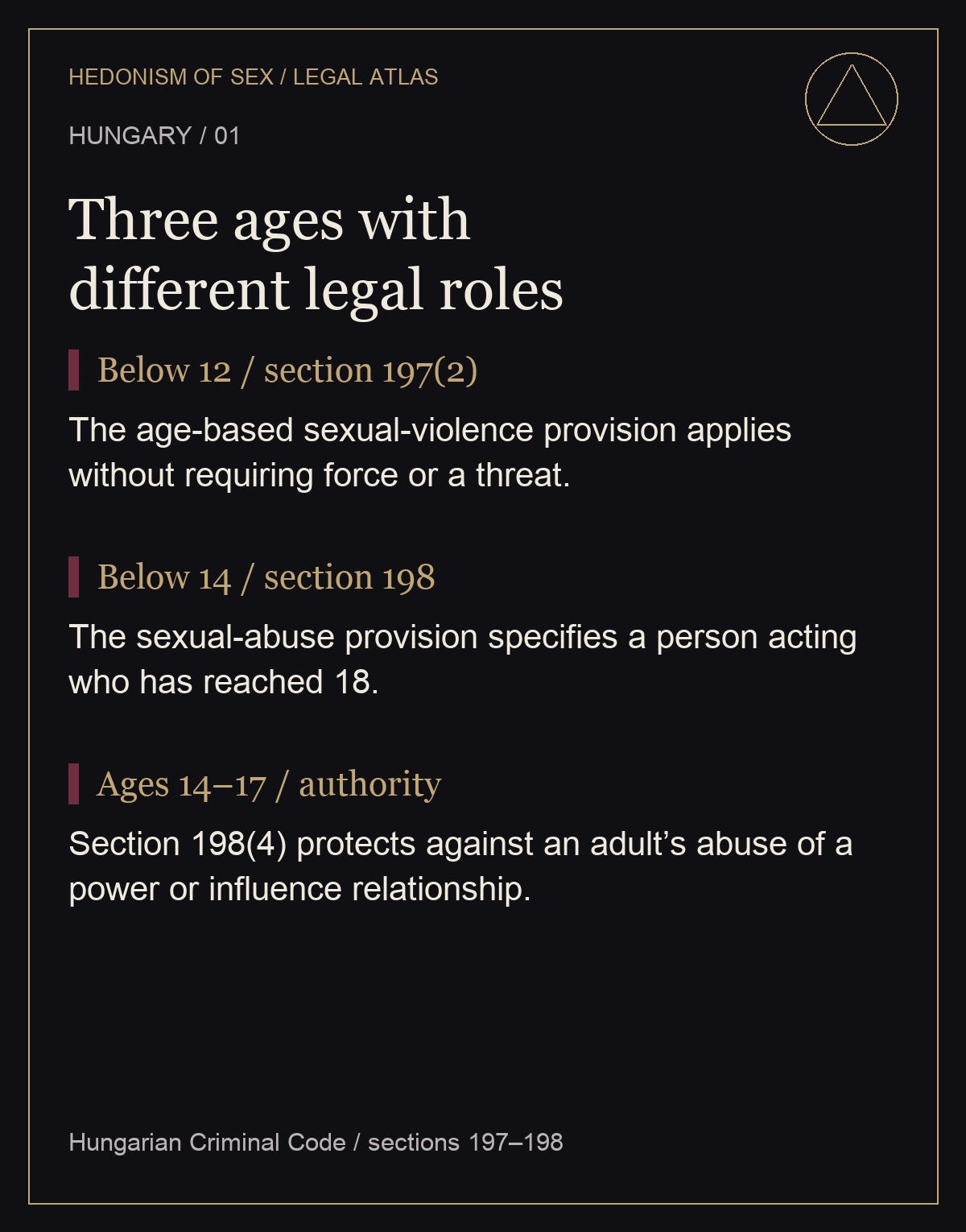
Hungary’s ordinary age of sexual consent is 14. Section 198 of the Criminal Code specifies an offender aged 18 or older for its age-based sexual-abuse offence involving a person below 14. A different provision, section 197(2), protects children below 12 without that adult-offender condition. Protection against an adult’s abuse of power or influence continues at ages 14–17. These are separate statutory conditions, not a general permission for a relationship. Criminal Code, sections 197–198.
This guide explains which questions a single-number country chart leaves out. It covers the national law applicable in Hungary, including Budapest and the other regions. It distinguishes the contact threshold from criminal responsibility, coercion, payment and the creation or sharing of sexual images.
What 12, 14 and 18 mean
Section 198(1) addresses a person who has reached 18 engaging in a sexual act with a person below 14, or inducing such a person to engage in a sexual act with someone else. Subsection (2) separately addresses an adult’s efforts to induce a person below 14 to engage in a sexual act with the adult or another person. The text does not make an actual meeting or completed physical act necessary for every form of the offence. Section 198(1)–(2).
Section 197(2), under the heading sexual violence, separately addresses performing or having a sexual act performed with a person below 12. Its age-based form does not require proof of the violence, direct threat or inability to resist or express a will described in section 197(1). It also does not contain section 198’s requirement that the person acting must be 18 or older. Section 197.
The Kúria, Hungary’s supreme court, has explained the relationship between these offences: the under-12 provision is the specific classification for that age group; the section 198(1) age-based sexual-abuse classification concerns the 12–13 age group. This distinction is not a reason to describe 12 as the ordinary consent age. Kúria, published decision 236, paragraphs 32–40.
| Age or situation | Legal question | Provision |
|---|---|---|
| Below 12 | Specific age-based sexual-violence offence | § 197(2) |
| Below 14 | Adult aged 18 or older: sexual abuse and specified inducement | § 198(1)–(3) |
| 14–17 | Adult abusing a power or influence relationship | § 198(4) |
| Below 18 | Separate exploitation, image and performance offences | §§ 203–204/A |
The table summarises starting points. The full offences, culpability rules and facts still matter. Official Criminal Code.
How the law treats peer cases
Hungary’s framework is sometimes described as a “close-in-age exception”. That can be misleading if it suggests a fixed permitted gap. Section 198 instead uses a condition about the age of the person acting: they must have reached 18. It does not say that a two-year or three-year difference automatically makes conduct lawful.
For a hypothetical situation involving a person below 18 and a person aged 12 or 13, the adult-offender element of section 198 is absent. That conclusion addresses only that element of that offence. It does not remove the need to examine coercion, inability to resist or express a will, exploitation and other applicable provisions. If the younger person is below 12, section 197(2) must be considered separately. Sections 196–198.
Criminal responsibility answers a different question
Section 16 generally excludes punishment where the person acting was below 14. It lists exceptions allowing responsibility from 12 for specified serious offences, subject to the required understanding of the consequences; sections 196–198 are not among those listed exceptions. This is a rule about responsibility for conduct, not a statement that the conduct is acceptable or that safeguarding concerns disappear. Section 16.
Record the ages at the time of the event. A birthday during an ongoing situation can change which statutory conditions apply. Do not use the current ages of the people to assess an event that happened earlier.

Authority, coercion and exploitation
Protection at ages 14–17
Section 198(4) criminalises an adult aged 18 or older engaging in a sexual act with a person who has reached 14 but is below 18 by abusing a relationship of power or influence over that person. For example, a hypothetical situation involving a young person and an adult who supervises or controls important aspects of their life needs an assessment of the actual relationship and its abuse. Being above the ordinary threshold does not settle that question. Section 198(4).
Section 198(3) also increases the seriousness of the under-14 forms in specified family, upbringing, supervision, care, medical-treatment and abuse-of-power circumstances. The precise subsection matters; do not replace these conditions with a claim that every relationship involving a professional title has the same legal outcome.
Coercion and inability to express a will
Section 196 separately criminalises forcing another person to perform or tolerate a sexual act. Section 197(1) addresses specified coercion involving violence or a direct threat to life or physical integrity, and exploiting another person’s inability to resist or express a will for a sexual act. These protections are not limited to children. Sections 196–197.
A prior relationship, silence or a previous agreement should not be treated as permission for a new act. If someone cannot freely decide or communicate, stop. The ordinary age threshold does not answer whether their participation is voluntary or whether their condition is being exploited.
Payment and family relationships
Section 203(2) prohibits providing consideration for a sexual act with a person below 18. Other parts address seeking profit from a minor’s prostitution and related exploitation. An age-of-consent rule is not permission to buy sexual activity from a minor. Section 203.
Section 199 separately addresses sexual acts between direct-line relatives and intercourse between siblings. It excludes punishment of the descendant below 18 for the direct-line offence; this does not exempt the adult relative. Read that provision independently of the ordinary contact threshold. Section 199.
Separate rules for images and performances
Section 204 concerns pornographic recordings depicting a person below 18. It distinguishes obtaining or keeping material, offering or handing it over or making it accessible, and making, commercially circulating or publicly disseminating it. Asking a minor to appear in a covered recording has its own provisions. The contact threshold of 14 does not determine the legality of any of these acts. Section 204(1)–(7).
Lower penalties are not an exemption
For recordings depicting people aged 14–17, section 204(5) provides different penalty ranges for obtaining or keeping and for making material, where the aggravating circumstances listed in subsection (2)(b)–(e) are absent. Subsection (7) similarly addresses invitations to appear. These provisions still define punishable conduct. They should not be presented as a private-image or teenage-peer permission. No express consensual private-peer exemption appears in the text checked.
The statutory definition in section 204(8) concerns depictions of sexuality with the specified explicitness and purpose of arousing sexual desire. It includes realistic depictions of non-existent people. An ordinary photograph of a minor is not automatically a pornographic recording; classification depends on the content and the statutory test. Do not assume that calling material AI-generated or fictional removes the issue. Section 204(8).
Section 204/A separately concerns pornographic performances involving a person below 18, including attendance, involving a minor, organising a performance and specified invitations. It supplies its own definition of a pornographic performance. A livestream or performance needs a separate analysis from a stored image. Section 204/A.
The current image and performance framework was substituted by section 20 of Act LXXIX of 2021. Its ordinary commencement rule was the fifteenth day after promulgation on 23 June 2021, making this change effective on 8 July 2021. We checked the current consolidated provisions rather than relying on an older English summary. Act LXXIX of 2021, sections 20 and 24 and promulgation note.

What to check in an actual situation
Start with a factual timeline, rather than a conclusion that someone was “over the age of consent”. Establish:
- Each person’s date of birth and age on the relevant dates.
- The conduct involved and whether anyone was pressured, threatened or unable to communicate a decision.
- Any family, supervisory, care, treatment, power or influence relationship.
- Any payment or promised consideration.
- Whether images were requested, made, kept, accessed, sent or shared, and the ages of the people depicted.
These facts can engage different offences. A hypothetical voluntary relationship between two 16-year-olds does not have the same age-based section 198 issue as conduct by an adult with a person below 14; creating or sharing a covered sexual image remains a separate question in either situation.
For an actual allegation, seek advice from a Hungarian lawyer about the applicable provisions, the law on the event date and handling evidence. Do not forward sexual material depicting a minor to friends or upload it elsewhere as proof. Record account names, platforms and relevant dates without spreading the material.
Cross-border conduct can involve Hungarian law as well as the law of another country. Section 3 includes Hungarian citizens’ conduct abroad among its jurisdictional rules. For comparison, see our independently researched guides to Slovakia, Austria and Czechia, or browse Law & Rights. Criminal Code, section 3.
Common questions
Is Hungary’s age of consent 14 or 12?
Fourteen is the ordinary threshold in the adult-offender framework of section 198. The under-12 sexual-violence provision and the adult-offender condition must be read separately. Twelve is not a general consent age for relationships with adults.
Is there a fixed close-in-age exception?
The relevant section 198 provisions specify a person acting who has reached 18. They do not set a two- or three-year permitted gap. Other offences and the under-12 rule remain relevant.
Does consent make a sexual image of a 16-year-old lawful?
Consent to contact does not settle image legality. Section 204 has separate offences, including lower penalty provisions for certain conduct involving depictions of people aged 14–17; these are not exemptions.
Can abuse of authority be illegal after 14?
Yes. Section 198(4) addresses an adult’s abuse of a relationship of power or influence to engage in a sexual act with a person aged 14–17.
Sources and review record
- Act C of 2012, Criminal Code: official consolidated Hungarian text. Version displayed: 1 October 2026. Sections 3, 16, 196–199 and 203–204/A are central to this guide.
- Kúria, published decision 236. Independent judicial explanation of the distinction between sections 197(2) and 198(1), especially paragraphs 32–40; the current Code was separately checked.
- Act LXXIX of 2021, original effective version. Sections 19–20, commencement section 24 and promulgation note; relevant image-law change effective 8 July 2021.