Age of Consent in Kyrgyzstan: 16, Adult Offenders and Protection Under 18
The adult-offender condition, non-contact conduct, coercion, marriage and separate protection for images under 18.
Kyrgyzstan’s central age-based sexual-contact provision protects children under 16 against specified acts by a person aged 18 or over. Article 157 applies where the elements of rape, violent sexual acts or coercion under Articles 154–156 are absent. Its stated prison range is eight to ten years. The adult-offender condition is important, but it does not make every encounter involving younger people lawful: non-contact indecent acts, violence, dependency, images and marriage have separate rules. Criminal Code, Articles 154–158.
What the age-16 rule actually says
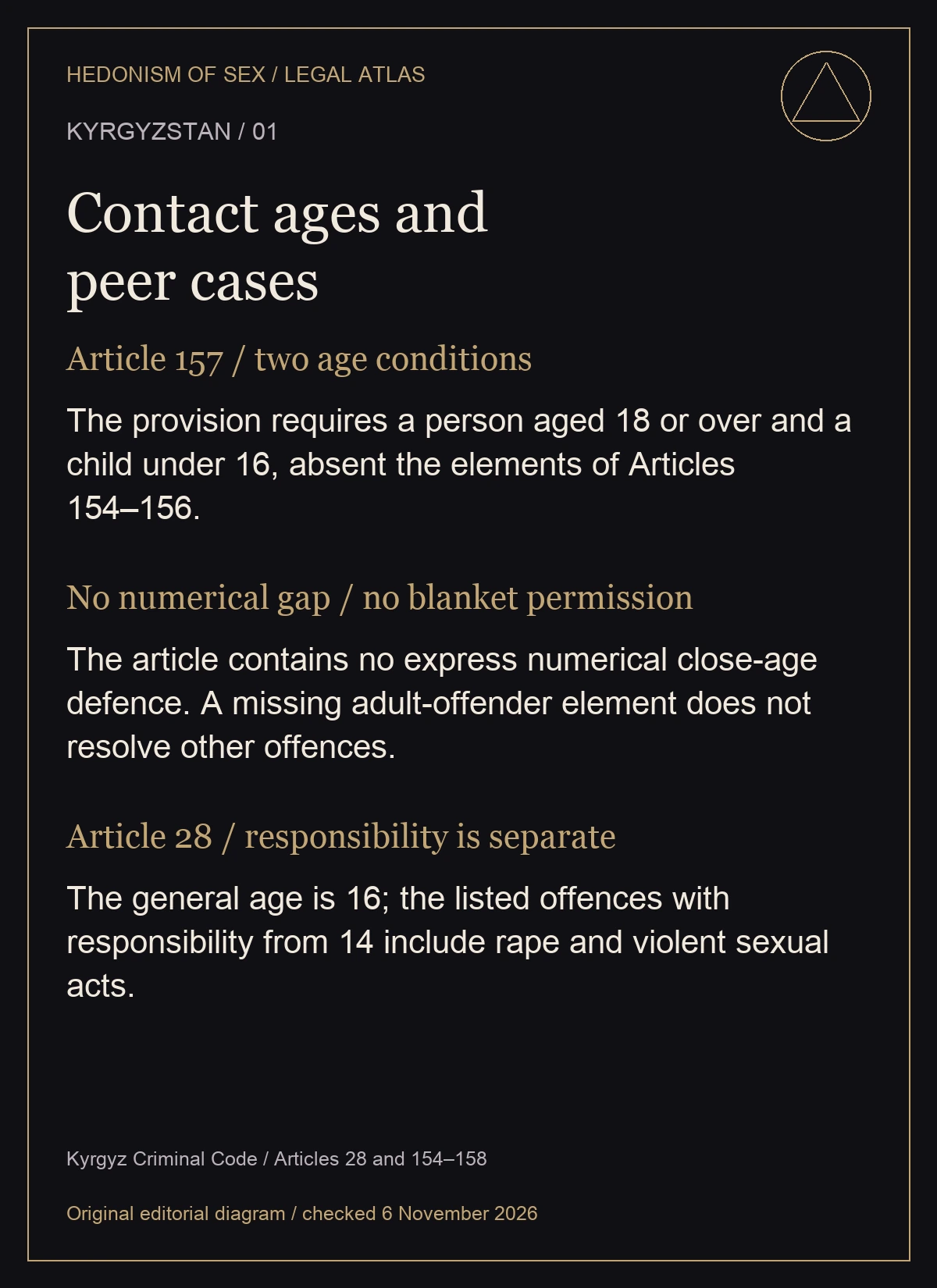
Article 157 is narrower and more useful than a bare country-list entry saying “16”. It addresses sexual intercourse and the other sexual acts listed in the provision, committed by a person who has reached 18 with a child who has not reached 16, provided Articles 154, 155 and 156 do not supply the offence elements. The text includes same-sex acts; the explanation here uses neutral English rather than reproducing the source’s dated terminology. A child’s apparent willingness does not remove the stated age elements. Criminal Code, Article 157.
| Question | Verified statutory distinction |
|---|---|
| Who is protected by Article 157? | A child under 16. |
| Who can commit this particular offence? | The provision expressly requires a person who has reached 18. |
| What if force or coercion is involved? | Check Articles 154–156 first; Article 157 expressly excludes their elements. |
| Does turning 16 remove every protection? | No. Under-18 protections and offences independent of this contact threshold remain relevant. |
The code’s own definitions appendix, point 9, defines a child as a person under 18. That definition matters when another offence says “child” without using Article 157’s lower age limit. It should not be replaced with the age of marriage or an assumed general adulthood rule. Criminal Code, appendix definitions, point 9.
Peers and the offender’s age are a separate question
Article 157 does not contain an express numerical close-in-age exception, such as a permitted two- or three-year gap. Instead, it has an express adult-offender element. Those are different legal structures. Hypothetical example: a 17-year-old does not satisfy Article 157’s requirement that the offender has reached 18. That observation alone does not resolve whether other acts in the situation constitute an offence. Criminal Code, Article 157.
General criminal responsibility begins at 16 under Article 28(1). Article 28(2) sets 14 for an enumerated list that includes rape under Article 154 and violent sexual acts under Article 155. Do not turn the special age of 18 in Article 157 into a general immunity for all younger offenders, or use the general age of responsibility to erase Article 157’s special requirement. Criminal Code, Articles 24 and 28.
Age and conduct are not the only elements of liability. The code requires the elements of the relevant offence and contains general rules on fault and intent. This guide does not assert an automatic mistake-of-age defence or strict liability merely because Article 157 does not use a particular knowledge-of-age phrase. Criminal Code, Articles 23 and 29–30.
Force, helplessness and dependency can change the offence
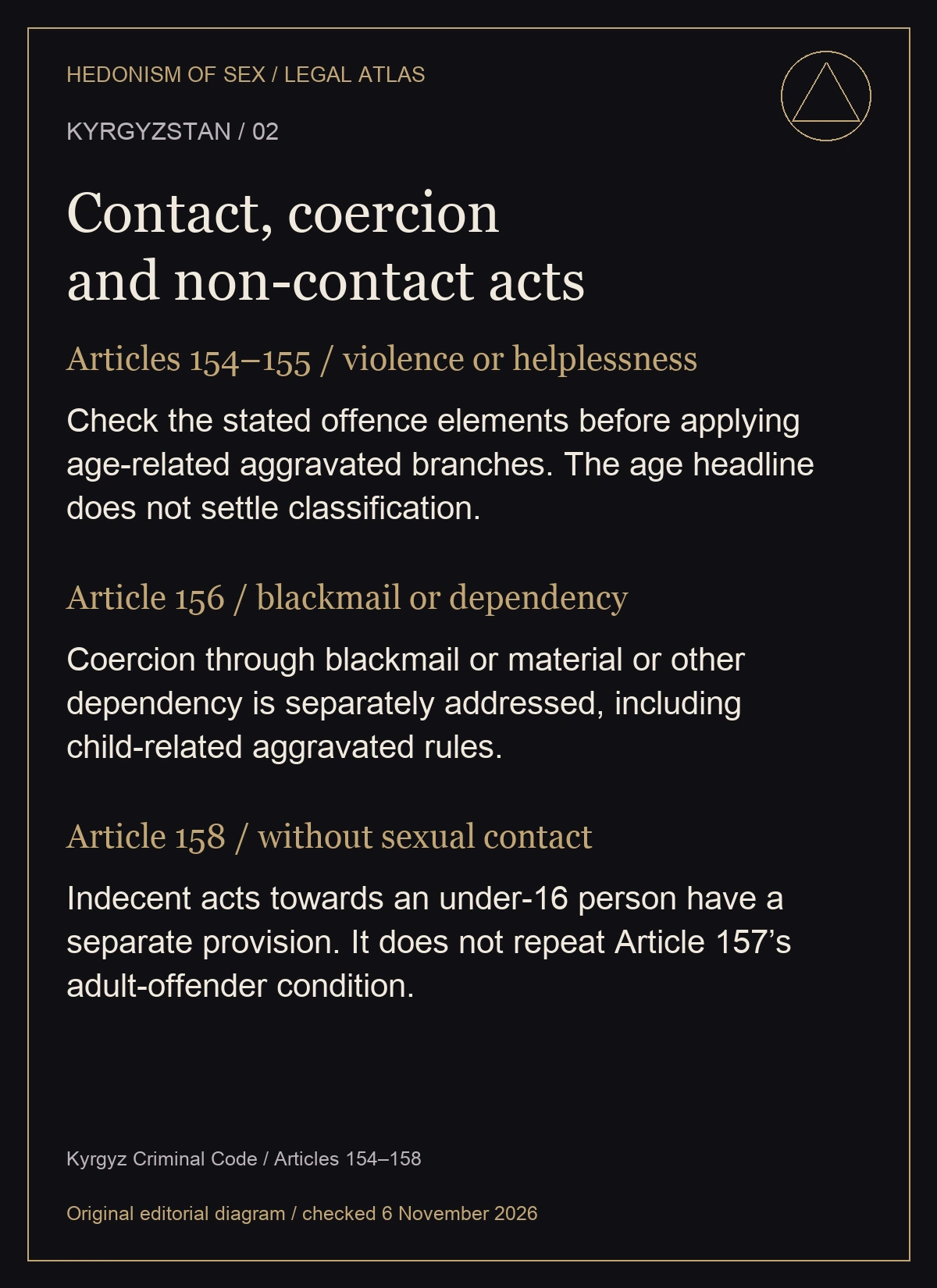
Articles 154 and 155 address the specified sexual acts involving violence, threats of violence or exploitation of a person’s helpless condition. They distinguish the acts covered by the rape provision from the other acts covered by Article 155. Their aggravated branches include victims aged 14 to under 18; further branches concern children under 14 and persons with disabilities. The underlying offence elements must still be examined. This is not a basis for assuming that every case involving a younger child is classified identically without examining the law and facts. Criminal Code, Articles 154–155.
Article 156 separately addresses coercion through blackmail or exploitation of material or other dependency where Articles 154 and 155 do not apply. It contains aggravated rules involving children aged 14 to under 18, specified parents or people with upbringing or supervision duties, and additional protections in part 3. A relationship involving education, care or money therefore needs more analysis than the two ages. Equally, the provision should not be rewritten as a universal age-18 contact rule for every authority relationship: it is a coercion offence with stated elements. Criminal Code, Article 156.
Hypothetical example: threatening to disclose a 17-year-old’s intimate information to obtain sexual acts raises a blackmail/coercion question even though that person is above Article 157’s protected age. The age-16 headline cannot answer it. Which offence is made out depends on the actual conduct and evidence.
Non-contact acts and online situations need their own analysis
Article 158 addresses indecent acts without sexual contact towards a person under 16, where the elements of Articles 154, 155 and 157 are absent. The stated prison range is seven to ten years. Unlike Article 157, this provision does not expressly restrict the offender to a person aged 18 or over; the general responsibility rules must be considered. Its cross-reference list also differs from Article 157’s. Criminal Code, Articles 28 and 158.
This prevents a simple conclusion that “no meeting means no possible offence”. It does not justify declaring every conversation about sex criminal. The statutory text examined here does not provide a comprehensive definition of every online act covered by “indecent acts”, or a detailed educational or peer-message exemption. Messages, exposure, demands for images and any later conduct require classification against the actual offence elements. This guide does not claim a separately verified meeting-arrangement offence from Article 158 alone.
Images, exploitation and privacy: protection can continue to 18
Involving a child in pornographic production or performance
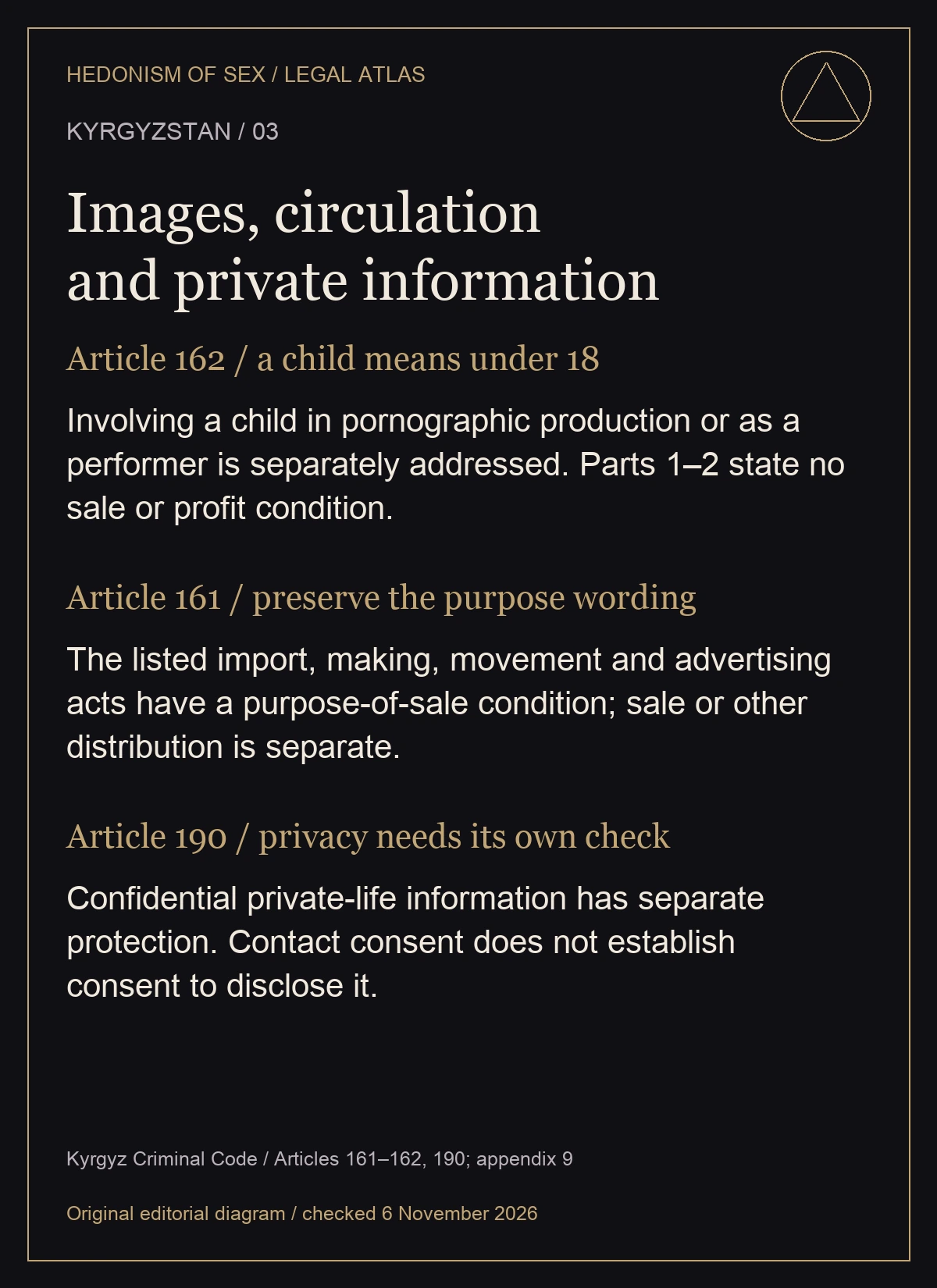
Article 162(1) addresses involving a child in acts connected with making pornographic items or works, or copies. Part 2 separately addresses involving a child as a performer in pornographic events or works. Read “child” with the code’s under-18 definition. The title’s reference to a business does not insert a sale or profit requirement into these clauses: neither clause expressly states one. Further branches address specified coercive methods and aggravating circumstances, including particular care roles and a child under 14. Criminal Code, Article 162 and appendix point 9.
The examined provision contains no express private-couple or close-age image exemption. Nor does this guide infer from it an exhaustive offence of merely viewing or possessing every category of material. Its verified focus is the listed involvement in production and performance. Requests, creation, use and distribution can engage different provisions; being above the contact threshold does not settle those questions.
General circulation rules have their own wording
Article 161 lists importing, making, transporting or otherwise moving, and advertising pornographic works, images or other items for the purpose of sale, and separately sale or other distribution. Preserve that purpose condition instead of presenting the provision as a blanket criminal ban on all private possession. It also means adult distribution cannot be assessed solely by asking whether everyone is over 18. Criminal Code, Article 161.
Privacy and commercial exploitation remain separate
Article 190 addresses unlawful collection, storage, use and distribution of confidential private-life information without consent, subject to legally established cases. It also has a separate branch for unlawful use or disclosure of personal or family secrets through the listed public channels, or using an official position. Agreement to intimacy does not, by itself, establish agreement to disclose confidential information. Criminal Code, Article 190.
Articles 159 and 160 separately address the specified involvement or coercion into prostitution and the organisation, premises and procuring conduct they describe, with child-related aggravated rules. They should not be reduced to Article 157’s age limit or paraphrased as a complete statement of every rule governing commercial sex. Criminal Code, Articles 159–160.
Marriage, abduction and religious ceremonies
The ordinary marriage age is 18 under Family Code Article 14. For valid reasons and on the applicants’ request, the executive local self-government body at their place of residence may reduce it by no more than one year for either sex, on the basis of a commission opinion from the territorial units of the authorised state child-protection body. This is an authorised process potentially allowing marriage at 17, not parental permission to marry at 16. Family Code, Article 14.
The Criminal Code separately criminalises abduction for marriage (Article 172), forcing a child into a de facto marital union (Article 173), and the specified forced-marriage or cohabitation conduct (Article 174). Article 175 addresses the listed parents or substitutes, religious officiant and adult participant where a religious marriage ceremony with a child breaches marriage-age legislation. A religious ceremony or family approval should not be treated as a substitute for the statutory marriage-age process or an exemption from the separate sexual, exploitation and privacy offences. Criminal Code, Articles 172–175.
Travel and the applicable law
Article 13 applies the code to offences committed in Kyrgyzstan and includes specified situations involving an act beginning, ending or being interrupted there, or stages and consequences across borders. A visitor’s nationality does not generally substitute their home country’s contact threshold; the article separately addresses diplomatic immunities. Article 14 also provides for Kyrgyz citizens and permanently resident stateless persons who offend abroad, subject to its rule concerning punishment by a foreign court. Other countries’ laws may therefore need checking alongside Kyrgyz law. Criminal Code, Articles 13–14.
This is a national statutory guide, not a determination of a particular border location or cross-border investigation. Compare the separately researched Kazakhstan guide and Russia guide; do not carry a neighbouring country’s exceptions into this one.
Sources, amendments and research limits
The Ministry of Justice’s public Criminal Code page displayed a latest selectable revision dated 24 July 2026 when checked on 6 November 2026. The Family Code page displayed the revision of 17 July 2025. The revision selector matters: an older-looking edition URL can display the selected current text. These observations describe the official material inspected, not a guarantee that no later unlisted document or relevant court decision exists.
- Law No. 89 of 9 August 2022 amended Article 157’s cross-references and minimum prison term, Article 158’s minimum term, and other child-protection provisions. Its publication note records 12 August 2022; Article 3 provides for entry into force after ten days from official publication.
- Law No. 42 of 19 February 2025 amended disability-related protections in Articles 154–156 and related provisions. It took effect on official publication, recorded as 25 February 2025.
- Law No. 87 of 11 June 2026 added dangerous or especially dangerous recidivism aggravators to Articles 154, 155, 159 and 162. Publication is recorded as 12 June 2026, with entry into force after ten days. It did not replace Article 157’s two age conditions.
- The linked 2026 originals No. 30, No. 79, No. 81, No. 114 and No. 124 were also inspected for their Criminal Code changes. They concern other provisions, including torture, enforcement, road safety, equality and illegal hunting or fishing; their later dates do not mean the contact threshold changed.
For an earlier event, check the law then in force and the rules on favourable retroactivity in Articles 11–12. An amendment’s adoption date is not automatically its commencement date. The original commencement law, No. 126 of 28 October 2021, Article 1, itself uses a fifteen-day period after official publication for the code.
Judicial-review limit: an official PDF identified for Supreme Court Plenum Resolution No. 26 of 17 October 2024 could not be retrieved during this check. Its contents have not been verified here, and this article does not rely on secondary summaries as if they were the court’s original text. Detailed judicial interpretation of helplessness, non-contact acts and offence classification requires further primary-source review. No independent lawyer review or exhaustive case-law survey is claimed.
What to check in a real situation
- Establish both exact ages and the date of each relevant act.
- Separate contact from non-contact conduct, images and disclosure of private information.
- Identify violence, threats, helplessness, blackmail, dependency and any care or supervision role.
- Check marriage and exploitation provisions separately, and identify every relevant country.
- For an actual allegation or safeguarding decision, have a qualified Kyrgyz lawyer examine the original current provisions and applicable court guidance. Do not use the absence of one Article 157 element as permission for other conduct.
Browse the Law & Rights country library for other independently researched jurisdictions.