Age of Consent in Uzbekistan: 16, Under-18 Protections and the 2026 Reforms
The ordinary age threshold, peer cases, benefits at ages 16–17, separate same-sex restrictions and the 2026 online and image reforms.
Uzbekistan’s ordinary age threshold for the sexual acts covered by Criminal Code Article 128 is 16. The Supreme Court distinguishes that provision from rape and other violent sexual offences, and directs that intercourse with a child under 14 be classified under the younger-child branches of Articles 118 or 119. Other provisions separately address material benefits, indecent acts, images, coercion and the male-to-male conduct defined in Article 120. Criminal Code, Articles 118–129¹; Supreme Court Plenum Resolution No. 13, paragraph 7.
What the age-16 rule covers
Article 128 prohibits intercourse and the other sexual conduct described in that provision with a person under 16. Its ordinary sanction is restriction of liberty for three to five years or imprisonment for three to five years. Providing material valuables, property benefits or other benefits creates a more serious branch; further aggravated circumstances include specified previous offending, a close relative or shared household, and particular upbringing, education, care or supervision duties. Uzbek Criminal Code, Article 128; Russian-language text.
Paragraph 7 of the Supreme Court’s current Resolution No. 13 explains that Article 128 concerns acts without violence or threats, with the agreement of a person who understood their nature and significance. That explanation distinguishes the offence from Articles 118 and 119; it does not make agreement a defence to Article 128’s protected-age rule. Plenum Resolution of 29 October 2010, paragraph 7, as amended.
| Situation | Separate legal question |
|---|---|
| Under 16 | Article 128, alongside the court’s classification of younger-child and violent cases. |
| Under 14 | Paragraph 7 directs classification under Article 118(4) or 119(4). |
| 16–17 with material or other benefits | Article 128¹; offender responsibility begins at 18 for that offence. |
| Any age with violence, threats or dependency | Articles 118, 119 and 121, according to their elements. |
| Male-to-male conduct defined in Article 120 | A separate offence; the age headline does not establish legality. |
Why a same-sex exception to the headline must be visible
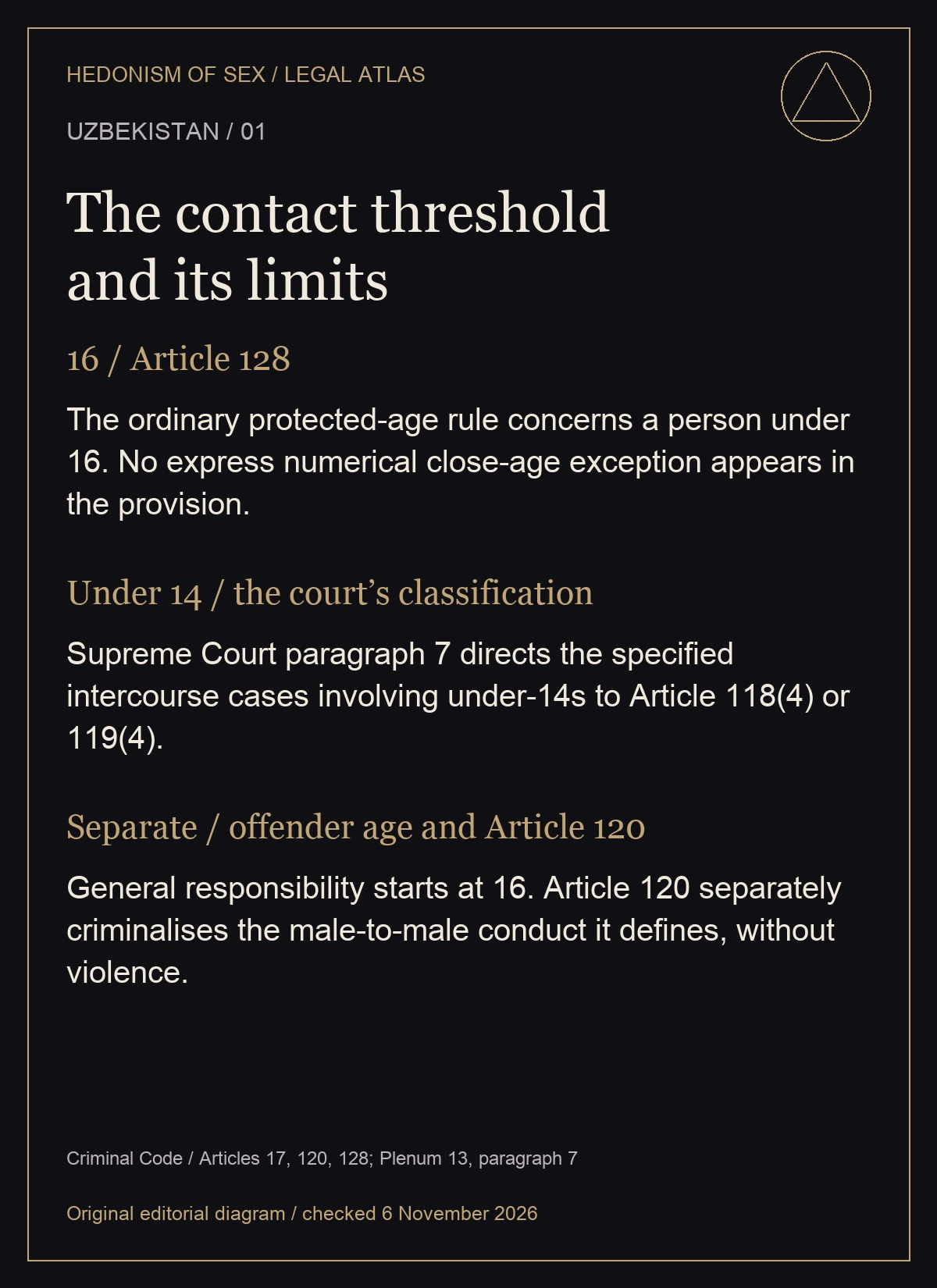
Article 120 separately criminalises the male-to-male sexual conduct it defines, without violence. Its stated sanctions include restriction of liberty from one to three years or imprisonment up to three years. Consequently, “the age of consent is 16” must not be read as an assurance that all voluntary adult same-sex conduct is lawful. This guide uses neutral English rather than adopting the legislation’s dated terminology. Criminal Code, Article 120.
Peer cases and responsibility ages
Article 128 contains no express numerical close-in-age exception. It also does not contain the adult-offender requirement found in some neighbouring countries’ laws. Article 17 sets general criminal responsibility at 16; its separate list of offences requiring an offender aged 18 includes Article 128¹, not Article 128. The enumerated offences with responsibility from 14 include Articles 118 and 119. Criminal Code, Articles 17, 128 and 128¹.
Hypothetical example: if a 17-year-old and a 15-year-old engage in conduct covered by Article 128, the older person’s being under 18 does not itself exclude liability. A reader should not import Kyrgyzstan’s adult-offender condition or Azerbaijan’s numerical age-gap condition. All elements and the rules for juvenile offenders still need to be examined; no sentence for a specific teenager follows automatically from the ordinary statutory range. Compare the independently researched Kyrgyzstan guide.
The general requirements of a complete offence and proven fault remain relevant. This guide does not infer a blanket mistake-of-age defence from older versions of Article 128 or extend a knowledge requirement from a different offence to every age provision. Criminal Code, Articles 9, 16 and 20–24.
Younger children, force and dependency
The Supreme Court expressly treats children under 14 as being in a helpless condition for the classification described in paragraph 7 and directs the relevant intercourse cases to Article 118(4) or Article 119(4). This is a verified judicial distinction, not an assumption that Article 128 supplies every under-16 case. Paragraph 6 discusses helplessness, including inability to understand or resist because of the listed physical, psychological or other conditions. Plenum Resolution No. 13, paragraphs 6–7.
Articles 118 and 119 address the specified acts with violence, threats or exploitation of helplessness. The court explains that protection extends to male and female victims. Its guidance also addresses sexual violence in the family and application of the aggravated relationship rule to a spouse: marriage does not supply a general exemption from sexual violence offences. Criminal Code, Articles 118–119; Plenum Resolution, paragraphs 2 and 15.
Article 121 separately addresses coercion by a person on whom the victim depends through employment, money or another relationship. It distinguishes coercion itself from the branch involving the sexual act, with further aggravated circumstances including a person under 18. Paragraph 7¹ of the court resolution explains this dependency-based offence’s distinction from the threats used in Articles 118 and 119. A supervisor or provider exploiting dependency therefore raises a different issue from an age-only contact rule. Criminal Code, Article 121; Plenum Resolution, paragraph 7¹.
Material benefits at ages 16–17
Article 128¹ addresses the specified sexual acts with someone aged 16 to under 18 through providing material valuables, property benefits or other benefits. Read it with Article 17’s special responsibility age of 18 for the offender. It is broader in wording than a simple cash-for-sex label: “other benefits” appears in the provision too. The statutory alternatives include non-custodial penalties and imprisonment of two to four years. Criminal Code, Articles 17 and 128¹.
Hypothetical example: an adult offering a benefit as the means of obtaining a sexual act from a 17-year-old needs analysis under Article 128¹ even though that teenager is above the ordinary contact threshold. This does not establish that every present in a relationship proves the offence. The connection required by the provision and the evidence must be examined.
Indecent acts and online conduct
Article 129 separately prohibits indecent acts without violence towards a person under 16. Its aggravated branches include deception or abuse of trust, specified relationships, a person under 14 and other listed circumstances. A branch for conduct using telecommunications or the Internet was added by Law No. 1130 in April 2026; a group-of-persons aggravator was added in October 2026. The provision also has a separate branch involving violence or threats. Criminal Code, Article 129; Law No. 1130, Article 1; Law No. 1180, Article 1(13).
The express Internet branch means a physical meeting is not a universal prerequisite. It does not mean that every discussion of sexuality is automatically an indecent act. The exact conduct and the offence elements still matter. This guide does not invent a detailed education exception, a general peer-message exemption or a separate meeting-arrangement offence from that wording.

Images and disclosure of intimate information
The new Article 129¹ has two different branches
Law No. 1130 introduced Article 129¹ in 2026 and removed the former child-related branch from Article 130. Its subject is pornographic material describing or depicting a minor; the ordinary child-protection framework concerns people under 18, not merely those under 16. The child-rights law defines a child as a person below 18. Law No. 1130, Article 1; Law on Guarantees of the Rights of the Child, Article 3.
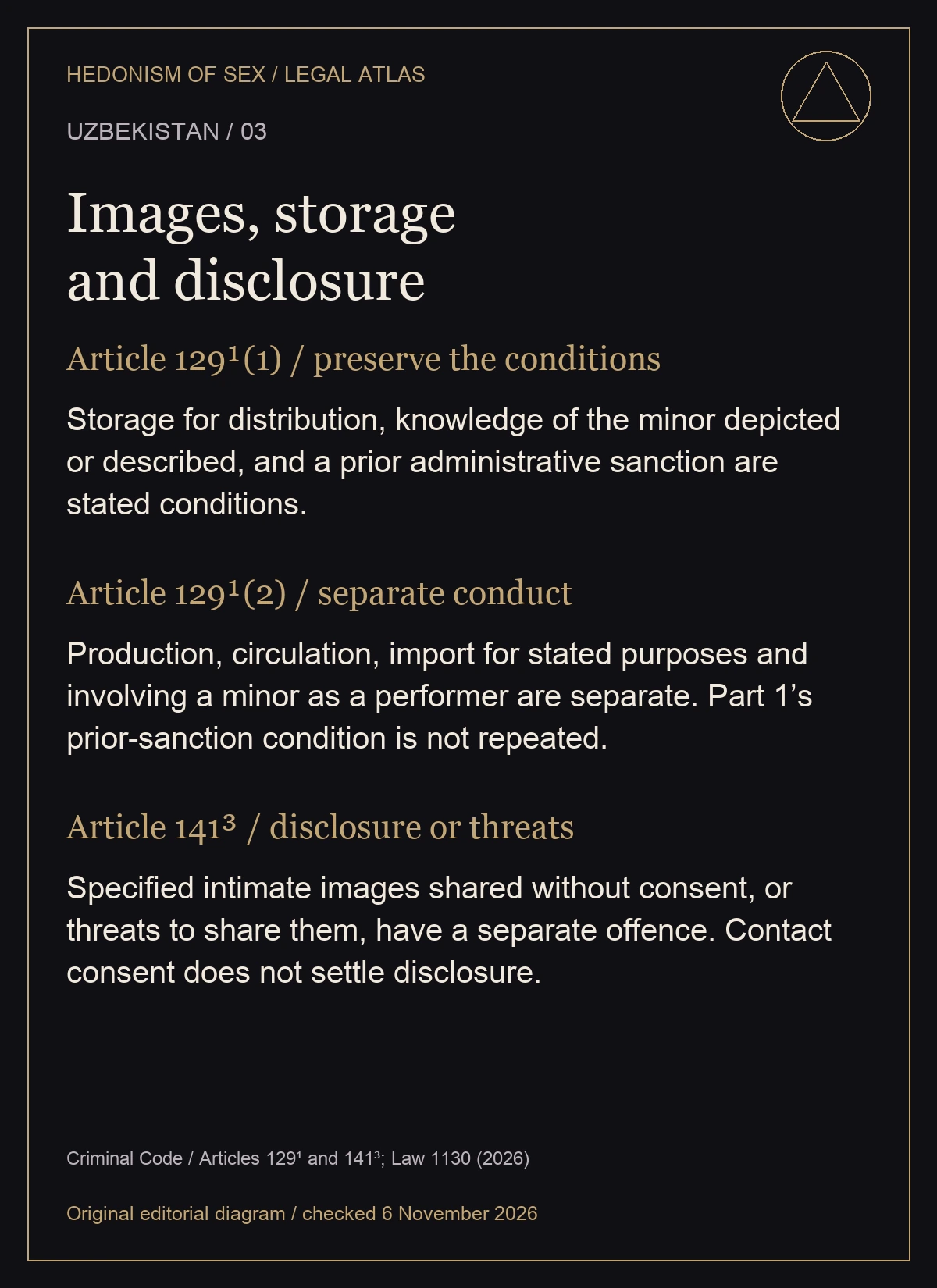
- Storage branch: Article 129¹(1) expressly requires storage for distribution, knowledge that the material describes or depicts a minor, and a previous administrative sanction for the same conduct. Law No. 1130 also introduced Administrative Code Article 188⁴ for the specified storage-for-distribution conduct.
- Production, circulation and performance branch: Article 129¹(2) separately addresses importing for distribution, advertising or display, and making, distributing, advertising or displaying the material, or involving a minor as a performer in pornographic acts. This branch does not repeat part 1’s prior-administrative-sanction condition. Its stated prison range is five to seven years.
These conditions come from the current code, Article 129¹, checked against the Uzbek original of Law No. 1130. Do not turn part 1 into an offence of every instance of private possession regardless of purpose, or carry its conditions into part 2. The text examined contains no express private-couple or close-age image exemption. That is not a determination that unlisted conduct is necessarily lawful under every other provision.
Adult material and private images raise further questions
Article 130 retains general pornography rules, including stated purposes and a prior administrative sanction in its first branch. The code’s definition of pornographic products addresses descriptions and images, including computer-created material, with wording concerning artistic value and scientific, medical or educational purpose. A label such as “art” is not a substitute for checking the actual statutory definition and conduct. This guide does not provide a complete classification of every synthetic image. Criminal Code, Article 130 and Section VIII definition of pornographic products.
Article 141³ independently addresses distributing specified photos or videos of a person’s naked body or genitals without consent, or threatening such distribution, including online. A known under-18 victim is one aggravating circumstance. Its text does not repeat the prior administrative sanction in Article 141¹’s ordinary private-life-information branch. Agreement to contact, or to taking an image, must not be treated as automatic agreement to publication. Criminal Code, Articles 141¹ and 141³.
Marriage and religious ceremonies
Family Code Article 15 sets marriage at 18 for men and women. In exceptional circumstances for valid reasons—its examples include pregnancy, a child’s birth and emancipation—the district or city hokim at the place of state registration may, at the applicants’ request, reduce the age by no more than one year. This potentially allows marriage at 17 through the authorised process; it is not an automatic consequence of family approval. Family Code, Article 15.
Criminal Code Article 125¹ separately addresses the specified de facto underage marriage, parental conduct and religious ceremonies, with a prior administrative sanction condition in its stated branches. Article 136 addresses forcing a woman into marriage or continued marital cohabitation, abduction for marriage against her will, and preventing her marriage. Preserve those distinct elements rather than presenting marriage at 18 as the same rule as sexual contact at 16. Criminal Code, Articles 125¹ and 136.
Territory and cross-border situations
Article 11 generally applies the code to offences committed in Uzbekistan, including specified acts or results across borders, with separate provisions for ships and immunities. Article 12 addresses Uzbek citizens and permanently resident stateless persons offending abroad where they have not been punished by the foreign court, and other treaty-related cases. A visitor should not substitute their home country’s rules for the applicable Uzbek provisions. The Supreme Court resolution’s paragraph 19 expressly addresses the Court of Karakalpakstan alongside regional and equivalent courts; this guide applies the national framework and does not assert an independently verified alternative regional age rule. Criminal Code, Articles 11–12; Plenum Resolution, paragraph 19.
Currentness and the 2026 reforms
Checked on 6 November 2026, the Uzbek code’s edition menu selected 3 November 2026 and displayed future versions separately. The official amendment register corroborated current and future commencement dates. A future date in a cross-reference is not, by itself, proof that a rule is already in force.
- Law No. 829 of 11 April 2023 rewrote the central contact, benefits and indecent-act provisions and introduced Article 141³. Its general commencement was official publication on 12 April 2023; the law also contains a specified delayed provision and transitional sentencing rule, so not every clause should be assigned the same effect without reading Article 18.
- Law No. 1130 of 17 April 2026 introduced the online aggravator, Article 129¹ and the administrative storage provision. Article 6 provides for commencement on official publication, recorded as 17 April 2026.
- Law No. 1180 of 14 October 2026 changed the available penalties in Articles 118(4) and 119(4) and added the group aggravator in Article 129. Article 14 and the publication record establish commencement on 15 October 2026. Sentencing still requires the general rules applicable to the individual.
The Russian LexUZ text labels several 2026 passages as unofficial translations. The relevant Uzbek originals were checked alongside them; the English explanation is this publication’s own. The Supreme Court source is the current consolidated Resolution No. 13 of 29 October 2010, including its relevant 2023 and 2024 amendments. This is a focused statutory and judicial-guidance review, not an exhaustive survey of every judgment or independent lawyer review. For older conduct, Article 13’s time-of-offence and favourable-retroactivity rules require checking the applicable historical version. Uzbek Criminal Code; official consolidated court resolution.
How to assess a real situation
Establish both exact ages and dates, identify the act, and separate any benefit, violence, dependency, online conduct, image production or disclosure. Then check the offender-responsibility rule for the particular offence and every relevant jurisdiction. An actual allegation or safeguarding decision requires a qualified Uzbek lawyer’s assessment of the original provisions and evidence. For comparison, use the Kazakhstan guide or return to the Law & Rights country library.