Age of Consent in Azerbaijan: 16, the Two-Year Condition and Separate Image Laws
The exact two-year condition, distinct younger-child protections, online meeting proposals, separate image offences and the marriage reform.
Azerbaijan’s ordinary sexual-contact threshold is 16, but the Criminal Code does not stop at one number. A note makes liability under Articles 152 and 153 conditional on an age difference of more than two years. Younger children, force, dependency, online meeting proposals, sexual material and early marriage require separate checks. This guide explains the distinctions that a short country table can miss.
The contact thresholds: distinguish under 12, 12–13 and 14–15
Article 152.1 addresses sexual intercourse or other sexual acts involving a person who has reached 14 but has not reached 16. Its stated imprisonment range is one to three years, with an optional prohibition on specified positions or activities. Article 152.2 addresses the same acts involving a person who has reached 12 but not 14, with three to six years’ imprisonment and the stated optional prohibition. These are the protected person’s ages; they are not the offender’s age of criminal responsibility. Criminal Code, Article 152.1–152.2.
Under 12 is not simply the bottom of Article 152.2’s age band. The note to Article 149 directs the specified conduct involving an under-12, or another minor unable to understand the nature and substance of the acts, to Article 149.3.3 or 150.3.3 as appropriate. Those aggravated provisions state fifteen to twenty years’ imprisonment. Their classification must not be replaced with a claim that a young child’s apparent agreement makes the conduct lawful. Article 149, note; Articles 149.3.3 and 150.3.3.
Article 153 is a different offence concerning non-violent indecent conduct towards an under-16. Its express wording also includes involving that person in observing sexual violence or sexual activity. It has aggravated provisions for under-14s and specified care or supervision relationships. The provision should neither be reduced to intercourse nor expanded into a claim that every conversation or ordinary affectionate interaction is a crime. The actual conduct needs legal assessment. Article 153.
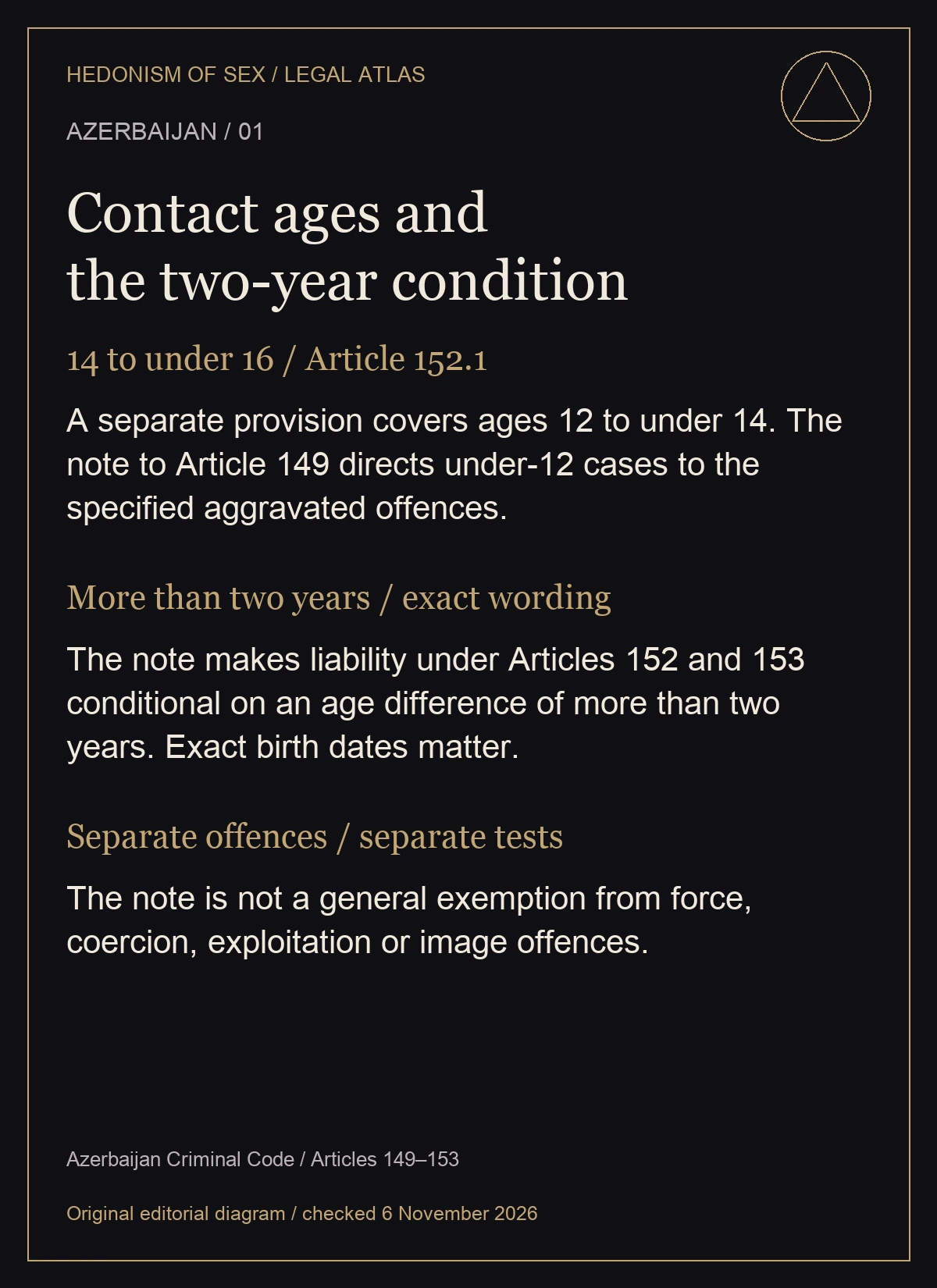
What the “more than two years” condition does—and does not—say
The note following Article 152 expressly refers to offences under both Articles 152 and 153. It says liability arises when the age difference between the person committing the acts and the affected person is more than two years. That is a statutory condition of these offences, not merely a discretionary reduction of sentence. The same wording appears in the original 2015 amending law. Article 152, note; Law of 29 May 2015, section 2.
The distinction between “more than two” and “two or more” matters. An exact difference of two years does not meet that wording; two years and one day exceeds it. Record the birth dates and the date of the conduct. Labels such as “17 and 15” do not, on their own, establish an exact two-year difference.
Hypothetical example: for conduct otherwise assessed under Article 152.1, an exact age difference of one year and eleven months does not meet the note’s more-than-two-years condition. A difference of two years and one month does. Neither calculation decides whether force, exploitation, an inability to understand the conduct, or a separate image offence was involved.
The note does not say that it exempts rape, violent sexual acts, coercion, image distribution or every act committed between people close in age. In particular, do not carry it across to Articles 149–151, the separate under-12 classification, or Article 171-1. The statutory route and all its elements must be identified first.
Nor should an adult-only condition be inserted into Article 152 from an old translation. The current provision does not expressly require an offender aged 18. Article 20 generally sets criminal responsibility at 16, with responsibility from 14 for listed offences including rape and violent sexual acts. An express adult-offender requirement does appear in the online-meeting provision discussed below. These are different legal mechanisms. Articles 20, 152 and 171-2.
Force, helplessness and dependency remain relevant at 16 and above
Article 149 addresses intercourse using violence or a threat of violence against the affected person or others, or exploiting the affected person’s helpless condition. Article 150 addresses the specified other violent sexual acts through the corresponding means. The ordinary age threshold and the two-year note do not displace those offences. Additional aggravated provisions protect minors and under-14s. Articles 149–150.
Article 151 separately covers compelling the specified sexual conduct by threatening to destroy, damage or take property, or by exploiting material or other dependency. It is therefore a mistake to ask only whether physical violence occurred. An employer, a person controlling accommodation or someone holding another person’s property may raise different factual questions about dependency and pressure; these are hypothetical contexts, not findings that every such relationship automatically satisfies the offence. Article 151.
Articles 152.3 and 153.3 address specified people responsible for upbringing, and teachers or other staff of education, care, medical or other institutions responsible for supervising the minor. Their cross-references to the underlying age-based offences still matter. These clauses should not be rewritten as a universal independent “consent age of 18 for every authority relationship.” At 16 or 17, coercion, violent offences and other exploitation provisions still need consideration. Articles 151–153.
An online meeting proposal has its own under-14 test
Article 171-2 concerns an adult who knowingly proposes a meeting to an under-14 through information and communication technology for intercourse, sexual acts or producing child pornography, and takes practical steps towards the meeting. The adult status, knowledge, protected age, purpose, technological means and practical steps are separate elements. The stated alternatives include restriction of liberty for up to three years or imprisonment for one to three years. Article 171-2.
The threshold here is under 14, not under 16 or under 18. That narrower wording does not make sexual messages, attempted offences or arrangements involving older minors automatically lawful. Other provisions, including Article 153 where its elements are present, can raise separate questions. Equally, a message alone should not be described as completing Article 171-2 without examining its practical-step requirement.

A contact-age rule is not permission to send sexual images
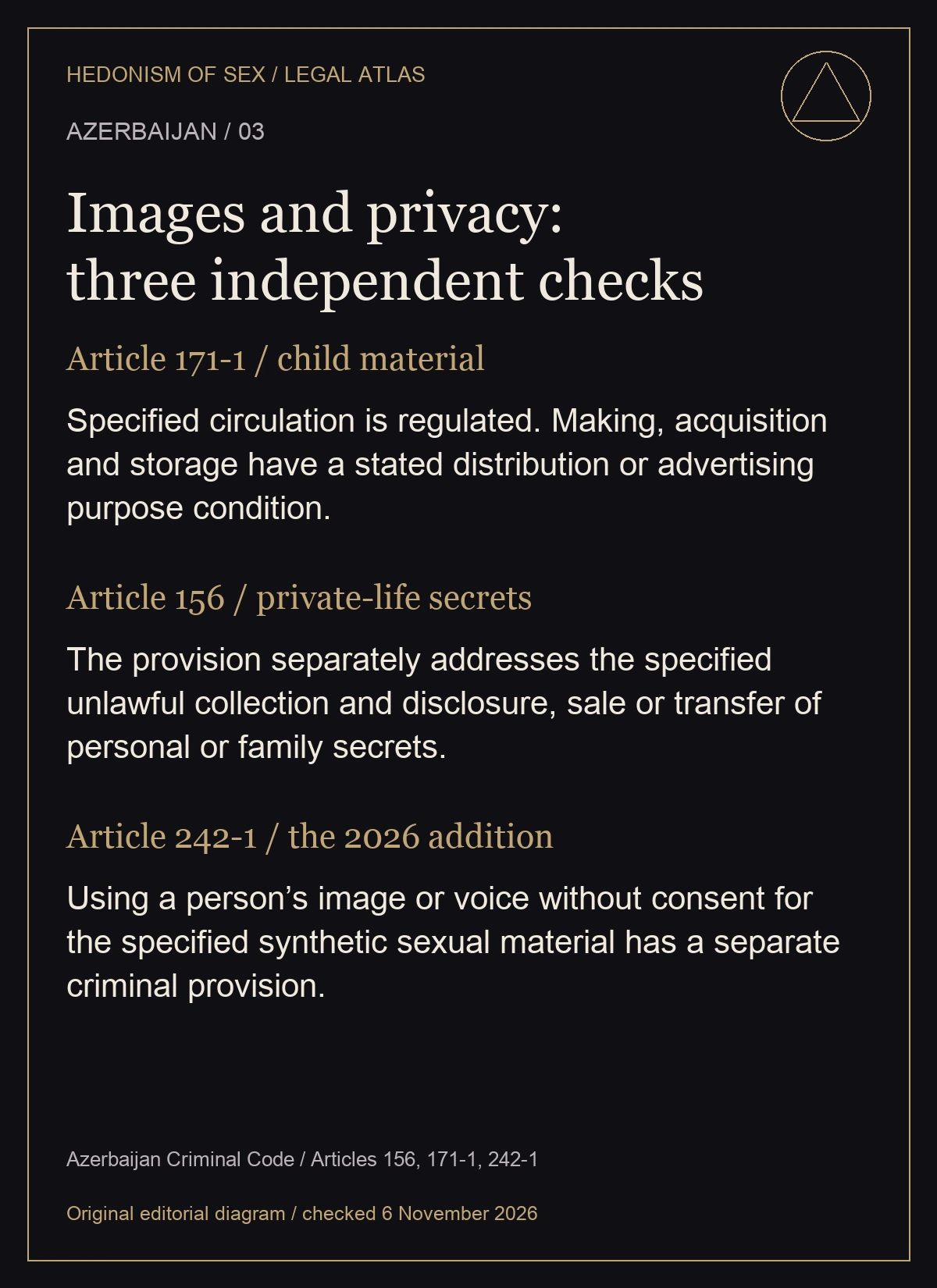
Article 171-1 separately regulates child pornography. Its definition includes the specified explicit real or simulated sexual depictions of a minor or a person appearing to be a minor, sexual-purpose depictions of minors’ genitals, and realistic depictions of a minor participating in explicit sexual acts. This is a definition of qualifying material; it does not turn every ordinary photograph of a young person into pornography. Criminal Procedure Code Article 7.0.33-1 defines a minor or child as someone under 18. Reaching 16 is consequently not a general release from the separate child-material framework. Criminal Code, Article 171-1 and note; Law 776-VIQD, section 4.1.
Read the prohibited acts carefully. Article 171-1.1 lists distribution, advertising, sale, transfer, sending, offering and facilitating acquisition. It also covers making, acquiring or storing for the purpose of distribution or advertising. Do not omit that purpose wording and claim that this particular paragraph expressly criminalises every instance of private possession or viewing. That textual limit is not an assurance that a particular file, recording, production process or exchange is lawful under all relevant provisions. There is no express general peer-image exception written into the checked article. Article 171-1.1.
Article 171 addresses involving minors in prostitution, pornographic performances or the other specified conduct. Article 242 separately concerns unlawful pornography production for distribution or advertising, circulation, advertising and trading. Neither an age-gap calculation nor agreement to a relationship replaces those separate checks. Articles 171 and 242.
Privacy and synthetic sexual material
Article 156 concerns the specified unlawful collection and disclosure, sale or transfer of personal or family secrets, including documents, photographs, video and sound recordings. Assess the information and the statutory conduct; do not assume that agreeing to one private communication authorises public redistribution. Article 156.
A further provision was introduced in 2026. Article 242-1 addresses using someone’s image or voice without consent to create pornographic or sexual photo, video or audio material with AI or specialised software, or distributing that material through the specified media or public online channels. Its stated imprisonment range is three to seven years. The rule is not confined to minors. Consent to sexual contact is not consent to this separate use of an image or voice. Law 387-VIIQD, section 1; Criminal Code, Article 242-1.
Marriage has a different age—and a separate five-year condition
Current Family Code Article 10 sets marriage at 18. Law 1198-VIQD repealed the former provision allowing a reduction of up to one year; its section 4 expressly set commencement at 1 July 2025. The law’s adoption on 28 June 2024 and presidential publication on 23 July 2024 are not that commencement date. Article 11 also requires written agreement and the other statutory conditions. Family Code, Articles 10–11; Law 1198-VIQD, sections 1 and 4.
The same reform addresses forced marriage and early unions through Criminal Code Articles 176-1 and 176-2. Article 176-2 concerns organising an under-16’s early union by the listed parents or people responsible for upbringing, or by an adult entering the union. Its note makes the adult participant’s liability under that article conditional on an age difference of more than five years. That is not the two-year condition for Articles 152–153, and it is not a five-year sexual-contact exemption. Parental approval or a religious ceremony does not replace the contact-age, coercion or image provisions. Articles 176-1 and 176-2.
Territory, historical events and verification limits
This guide explains Azerbaijan’s national criminal legislation. Criminal Code Article 11 addresses offences beginning, continuing or ending in Azerbaijan, and Article 12 sets conditions for offences abroad. Nakhchivan’s autonomous status does not itself create a separate contact-age code: Constitution Article 134(IV) makes Azerbaijan’s laws binding there. Cross-border communications and historical events in conflict-affected areas require attention to the precise location, date and applicable jurisdiction; this guide does not reconstruct every past local legal system. Articles 1 and 10–12; Constitution, Article 134.
The currentness check used the official E-Qanun code, its amendment annotations and original laws. It included the 2015 age-difference reform, Law 776-VIQD adopted in December 2022 and published in February 2023, the marriage reform, and a bounded review of the amendments published in 2026, including the law published on 4 November. That latest law concerns legal-person liability and procedure, not a replacement of the age provisions discussed here. Future commencement clauses in other amendments must not be treated as already operative merely because their wording appears on a consolidated page. Law adopted 23 October 2026, published 4 November.
A source disagreement: the Council of Europe’s 2023 comparative study lists Azerbaijan among countries without an age-difference clause. That conflicts with the express note in the current official code and the original 2015 law. The reason for the study’s classification was not established. This guide follows the primary wording and limits it to the offences it names, rather than silently repeating the comparative table. Comparative study, pages 21–22; original amendment.
Research checked 6 November 2026. The English wording here is editorial. No independent lawyer review or complete survey of litigation is claimed. For a real case, record exact birth dates, the date and location of the conduct, any force or dependency, institutional responsibilities, messages, images and practical steps. Those facts determine which provisions need examination. Browse the Law & Rights library or compare the separate Armenian and Georgian frameworks.