Latvia’s ordinary age of sexual consent is described as 16. Criminal Law Section 161 criminalises the specified sexual contact with a person below 16 when committed by an adult. It does not contain a numerical close-in-age exception. Separately, Section 166¹ treats anyone below 14 as being in a helpless state for the sexual offences in Chapter XVI. Neither someone’s agreement nor a small age difference cancels that rule. Criminal Law, Sections 161 and 166¹.
Start with the people’s ages and the particular offence
Section 161 covers intercourse, the other sexual acts it specifies and other sexual conduct involving physical contact with the younger person’s body. Its two express age conditions concern a person who has not reached 16 and an offender who is an adult. Consequently, “16” is useful as an introduction, but saying that Section 161 applies identically to every possible pair of teenagers would misstate its wording. Section 161.
| Age or situation | What to check |
|---|---|
| Younger person below 16; older person an adult | Section 161’s age-based contact offence. No numerical age-gap exception appears in this section. |
| Younger person below 14 | Section 166¹’s statutory helpless-state rule and the relevant Chapter XVI offence. |
| Both people below 18 | The adult condition in Section 161 is absent, but other offences and criminal responsibility still require assessment. |
| A person aged 16 or 17 | Sexual violence, exploitation and offences concerning minors in pornography remain separate issues. |
The relevant criminal-law protection of minors continues below 18: the Protection of the Rights of the Child Law expressly requires all corresponding minor protections to apply to a person below 18 in criminal and administrative-offence law. Its general definition of a child contains civil-status exceptions, so those exceptions should not be presented as removing the criminal-law protections. Child-protection law, Section 3(1) and (3).

A peer relationship is not a statutory age-gap exception
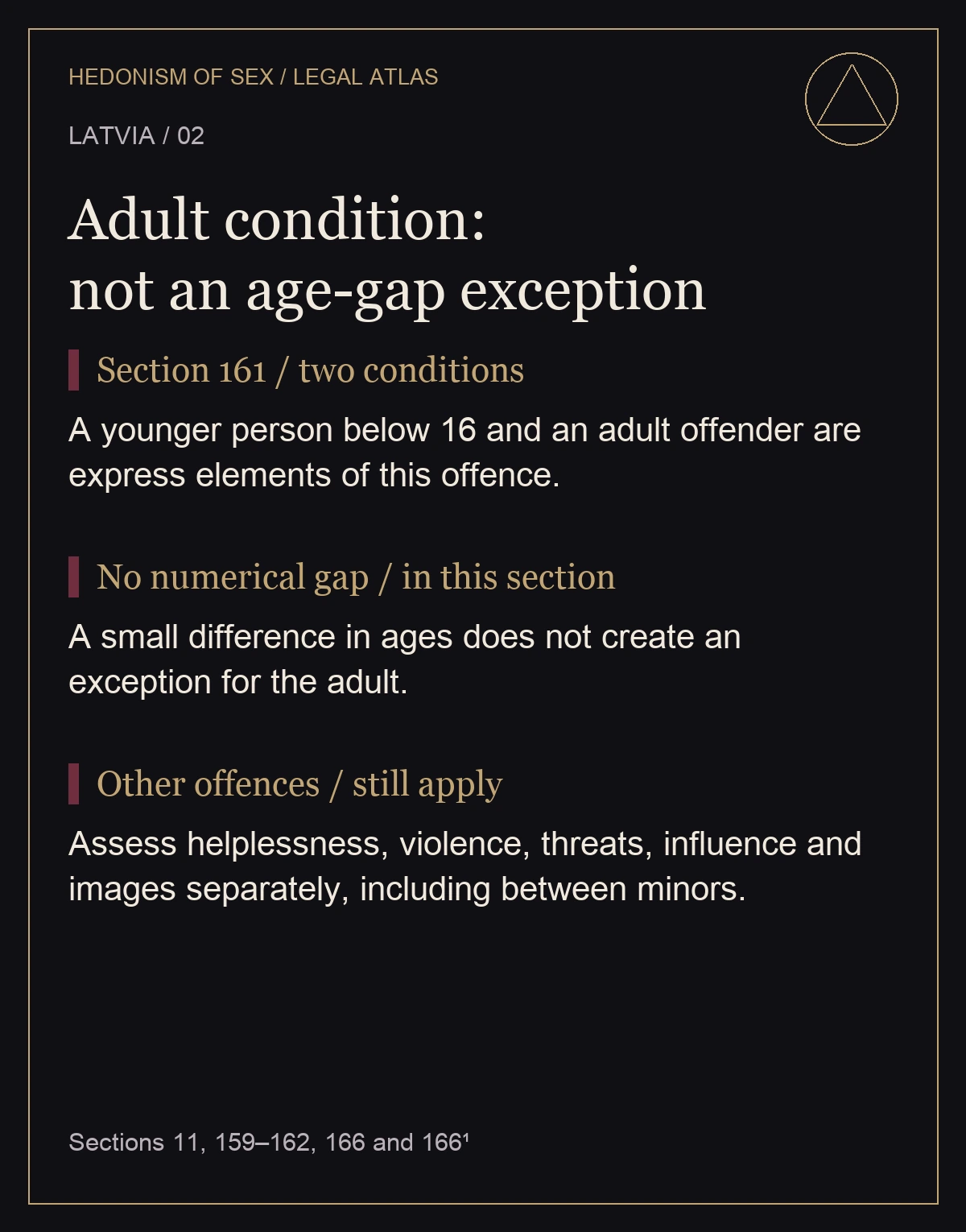
There is an important difference between an offence requiring an adult and an exception allowing a particular difference in ages. Latvia’s Section 161 uses the first structure. It does not say that an adult may rely on a two-, three- or five-year age gap. Those figures should not be imported from neighbouring countries. Section 161.
Hypothetical example: where the people are 15 and 17, the older person is not an adult, so that fact does not satisfy Section 161’s adult-offender condition. It does not establish that all conduct between them is lawful. Capacity, force, threats and the separate non-contact or image provisions still need checking. General criminal responsibility begins at 14 under Section 11; being a minor does not mean that a person cannot commit a sexual offence. Sections 11, 159–162 and 166.
A different hypothetical: if the older person has turned 18 while the younger person remains 15, the adult-offender condition is now present. A relationship beginning before that birthday is not an express grandfathering exception in Section 161. The facts and the law at the time of the conduct matter. Sections 5 and 161.
Below 14, the law expressly establishes helplessness
Section 166¹ states that a person below 14 is in a helpless state for the purposes of the offences in Chapter XVI. This provision was introduced by the Act adopted on 6 June 2024 and took effect on 4 July 2024. It is absent from the outdated English consolidation, which is one reason that translation cannot safely be used alone. 6 June 2024 amending Act, point 20; current Section 166¹ and its commencement annotation.
The rule must be read with the relevant offence, rather than treated as a new stand-alone permission at 14. Sections 159 and 160 address intercourse and other sexual violence involving helplessness, or conduct against the victim’s will involving violence, threats or the use of trust, authority or another influence. A person reaching 14 or 16 does not make those provisions disappear. Sections 159–160 and 166¹.
For teachers, coaches, carers, employers and others exercising influence, the actual use of trust or authority is therefore a central issue. The current provisions should not be reduced to a blanket statement that every relationship in one of those roles has an identical age threshold. Equally, a birthday is not an answer to evidence of coercion or exploitation. In a real situation, describe the role, dependency and conduct to a Latvian criminal-law professional. Sections 159(1), 160(1)–(2) and 162(1).
Online and non-contact conduct have their own provisions
Section 162¹ concerns an adult inducing someone below 16 to engage in sexual activities, or inducing them to meet for sexual activities or intercourse. It expressly includes information or communications technology and other forms of communication. The section is not worded as a requirement that physical contact must already have occurred. Section 162¹.
Section 162 separately addresses sexual conduct without physical contact, for the sexual purposes specified there, involving a person below 16 or a person in a helpless state. Its wording includes conduct by an adult or conduct involving the listed helplessness, violence, threats or influence circumstances. Describing every possible offence under Section 162 as adult-only would omit part of the provision. Section 162(1).
A dating app’s minimum account age does not replace either assessment. For a concrete concern, keep the distinction between ordinary conversation, sexual inducement, arranging a meeting and non-contact sexual conduct clear; the offence must be assessed on its actual elements.
Sexual contact and sexual images require separate checks
A person aged 16 or 17 remains a minor for the relevant criminal protections. Section 166 addresses circulation of material containing child pornography, attending or demonstrating the prohibited performances, and inducing, involving, coercing or using a minor in a pornographic performance or production. It provides a separate, more serious provision for involving someone below 16. The contact threshold does not authorise that production. Section 166(2)–(4); child-protection law, Section 3(3).
The Pornography Restriction Law supplies detailed definitions. Its concept of circulation includes acquisition or access, production, distribution, electronic distribution and storage. The definition also reaches specified depictions involving a person appearing to be a child and realistic depictions of a nonexistent child. It is broader than a rule limited to commercially sold photographs of real children. Pornography Restriction Law, Section 1(2)–(3).
No general private-couple exception was identified in these provisions. Section 4 prohibits child pornography; Section 9 permits particular educational, scientific, research, medical and official uses under its conditions. Those are not a general permission for partners to make, keep or forward sexual images of a minor. Nor should every ordinary photograph of a child be labelled pornography: the statutory content definitions still have to be met. Sections 1, 4 and 9; Criminal Law, Section 166.

Commercial exploitation has another independent boundary. Section 164(3¹) criminalises using a minor’s prostitution; Section 164 also addresses inducing, involving and forcing minors into prostitution. Do not turn the headline age of 16 into a conclusion that payment or exploitation involving a 16- or 17-year-old is lawful. Section 164(3)–(4).
Use the version in force on the relevant date
This guide was checked on 6 November 2026 against the official portal’s Latvian edition in force from 5 November 2026. The displayed current-edition date concerns the code as a whole; it does not mean that the age threshold changed on that date. Section 161’s annotation records its earlier amendments, while Section 166¹ records the July 2024 commencement. Current Latvian consolidation and provision annotations.
The Act adopted on 13 June 2024 made another distinct change: point 14 increased Section 160(1)’s maximum imprisonment from seven to nine years, effective 1 January 2025. It did not introduce a new age-gap exception or rewrite Section 161. This is why an amendment’s date and its exact provision both need checking. Official Gazette, 13 June 2024 Act, point 14 and commencement clause.
For historical events, Section 5 sets the temporal framework, including the law at the time of the act and the rules for a later, more favourable law. This article concerns current law and cannot decide an older case from today’s threshold alone. Latvia’s national Criminal Law applies to offences in its territory under Section 2; Section 4 also supplies rules for conduct abroad, including specified Latvian connections. Cross-border situations require a separate jurisdiction analysis. Sections 2, 4 and 5.
Common questions
Does Latvia have a three-year close-in-age exception?
Section 161 contains an adult-offender condition, not a three-year exception. No numerical gap in that section overrides its prohibition on the specified adult contact with someone below 16. Other offences remain separate. Section 161.
Does turning 16 make sexual images lawful?
No general permission follows from turning 16. Minor protections, Section 166 and the Pornography Restriction Law must be assessed independently. Section 166; Pornography Restriction Law.
Can I rely on the official English translation?
Not as a complete statement of current law. On our check date it was expressly marked outdated, with validity ending on 21 May 2024. Use the current Latvian edition and relevant amendments, with qualified translation and legal advice where needed. Translation status notice.
Sources and practical next steps
For an actual case, establish the exact ages and event dates, the conduct involved, any position of influence and whether images or payment were involved. Take those facts to a qualified Latvian lawyer. Avoid forwarding intimate material to illustrate a question; first ask the appropriate professional how evidence should be handled.
- Criminal Law, current Latvian text — Sections 2, 4, 5, 11 and 159–166¹; current-edition status.
- 6 June 2024 amending Act — introduction of Section 166¹; commencement checked against the current provision annotation.
- 13 June 2024 amending Act, official Gazette — Section 160(1) penalty amendment and 1 January 2025 commencement.
- Pornography Restriction Law — definitions and Sections 4 and 9; current edition from 1 July 2020.
- Protection of the Rights of the Child Law — Section 3; current edition 28 October 2026–30 June 2028.
- English Criminal Law translation — outdated status documented; used only as an auxiliary terminology reference.