Age of Consent in Liechtenstein: 14, Peer Exceptions and Image Rules
A three-year exception has precise conditions. Additional safeguards cover exploitation, authority, payment and sexual images involving minors.
Liechtenstein’s ordinary age-of-consent threshold is 14. Sections 205 and 206 protect people under 14, with a limited exception where the younger person is at least 12, the other person is no more than three years older and the specified harmful circumstances are absent. Reaching 14 does not remove the separate rules on exploitation, authority, payment or images. Criminal Code, §§ 74, 205–206, 208, 212 and 219.
This guide explains which questions the ordinary threshold answers and which require a separate check. It uses the consolidated Criminal Code in force from 1 August 2026, alongside the original amendment instruments. The relevant rules are national legislation; a neighbouring country’s exceptions cannot be substituted for Liechtenstein’s provisions.
What the threshold of 14 means
The code defines an unmündig person as someone under 14. It defines jugendlich as someone aged 14 to 17 and minderjährig as someone under 18. These words perform different legal functions. Translating all three simply as “minor” can conceal the age group a particular offence protects. § 74(1), points 1–3.
Section 205 covers intercourse and legally equivalent sexual acts involving an under-14 person; § 206 addresses other sexual acts and related conduct. Their age-based protection does not depend on treating an under-14 person’s apparent agreement as sufficient. Both provisions contain a specific exception in paragraph 4, explained below. Their wording does not establish different ordinary thresholds for same-sex and opposite-sex conduct. §§ 205–206.
The ordinary threshold is only one part of sexual autonomy. Sections 200 and 201 address rape and sexual coercion involving the specified force or threats. Section 204 concerns exploitation of helplessness or qualifying mental impairment. Section 204a separately addresses intercourse or equivalent conduct against a person’s will, through exploitation of a predicament or after intimidation. These provisions must be read according to their own elements; turning 14 does not disapply them. §§ 200–204a.

The exception permits a difference of no more than three years
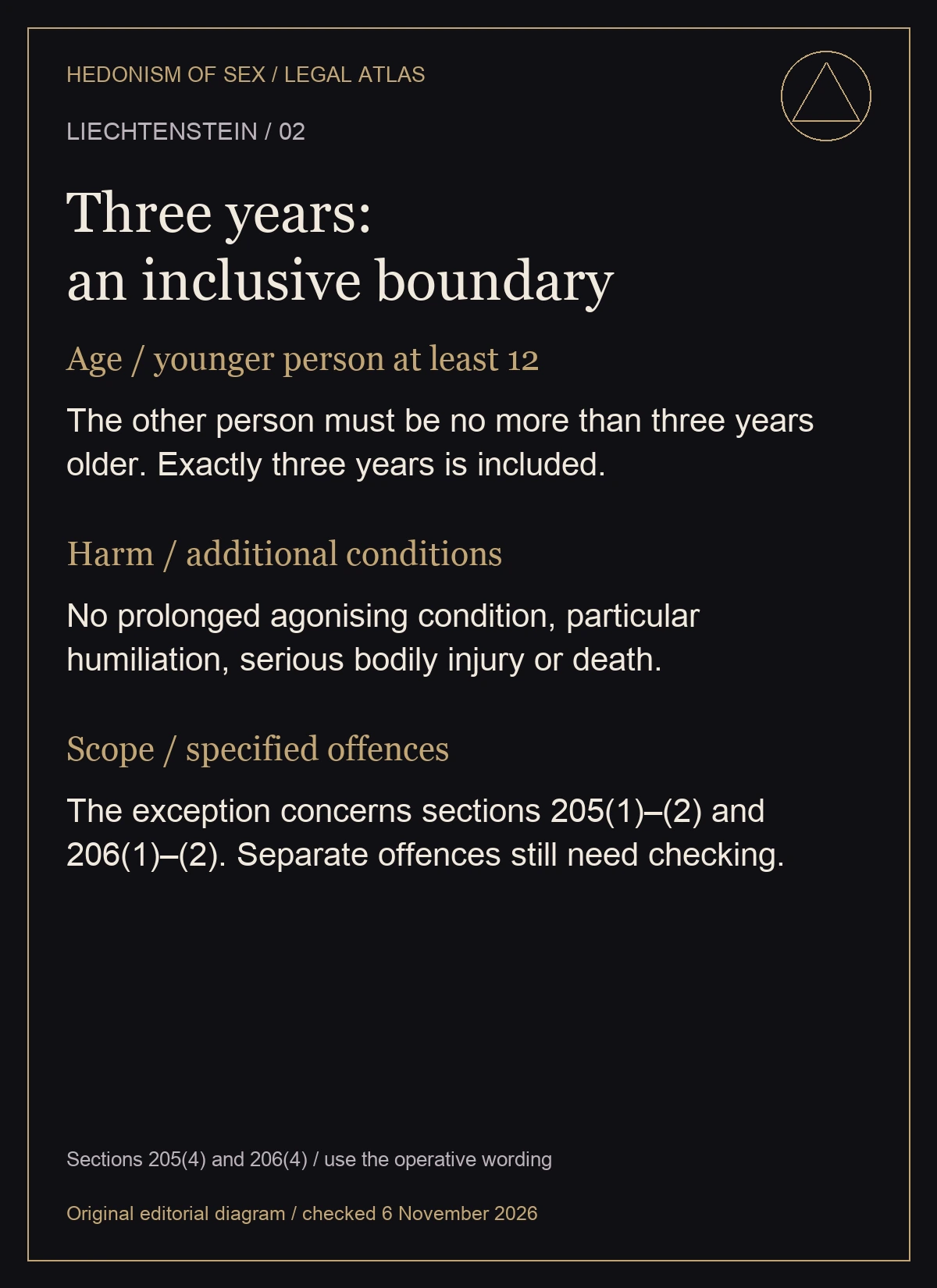
Paragraph 4 of both § 205 and § 206 provides that the offender is not punishable under paragraphs 1 and 2 when the specified conditions are met. The younger person must have reached 12, and the other person must be no more than three years older. Exactly three years is included in that wording. It is different from a provision requiring a gap strictly below three years. §§ 205(4) and 206(4).
The exception also requires that the younger person was neither put into a prolonged agonising condition nor particularly humiliated, and that the conduct caused neither serious bodily injury within § 84(1) nor death. An age calculation alone therefore does not establish the exception. Nor does this limited provision remove liability for a separate offence involving coercion, exploitation or another prohibited circumstance. §§ 205(4), 206(4) and 200–204a.
The two paragraph-4 clauses use the same age and harm conditions. Do not import Austria’s differently structured exceptions simply because the criminal codes use similar terminology. In particular, use the actual Liechtenstein text rather than adding conditions that appear only in a neighbouring statute. The clause does not state a separate requirement that the parties have similar maturity; that observation does not remove the code’s protections against incapacity or exploitation. §§ 204–206 and 208.
Higher-age protections address particular situations
Exploitation involving someone under 16
Section 208(1) concerns a person who has reached 18 and sexually abuses someone under 16 by exploiting the younger person’s lack of ability to exercise sexual self-determination or a situation of need. It also addresses the associated conduct described in that paragraph. The offence contains both an offender-age element and an exploitation element. It should not be rewritten as a universal prohibition on every relationship between an adult and someone aged 14 or 15. § 208(1).
Payment involving someone under 18
Section 208(2) separately criminalises the specified sexual conduct involving a person under 18 in return for payment. Unlike paragraph 1, it does not repeat the explicit requirement that the offender has reached 18. The code’s definition of Entgelt includes consideration capable of monetary valuation, including a benefit intended for another person. Checking only whether cash changed hands would miss the statutory definition. §§ 74(1)(6) and 208(2).
Authority, supervision and dependency
Section 212(1) addresses specified relationships with minors, including descendants, adopted children, stepchildren and wards, and abuse of a position in education, training or supervision. Section 212(2) separately covers abuse of specified professional, institutional, official-care and dependency relationships. These include certain medical or pastoral care, treatment or counselling, employment and comparable dependency situations. Not every part of § 212(2) is limited to minors. § 212.
For a teacher, coach, supervisor or professional carer, the useful question is which statutory relationship exists and whether the relevant position is being exploited. A simple claim that all relationships are lawful after 14 cannot answer that question. The same caution applies when illness, addiction, custody or economic need affects the relationship.
Online conduct and image rules require a separate analysis
Section 209(1) addresses proposing or arranging a personal approach or meeting with an under-14 person, using communication technology or the specified deception, with intent to commit one of the listed offences. It requires a preparatory act towards the meeting. Paragraph 2 separately addresses technological contact with the intention of committing the specified image offences concerning that person. These are purpose-based offences, not a declaration that every online conversation or meeting proposal is criminal. § 209(1)–(2).
Section 219 concerns pornographic depictions of people under 18 as defined in paragraph 5. It separately addresses production and making material available, distribution-related conduct, acquisition or possession, and knowingly accessing qualifying material through communication technology. The definition and the statutory exceptions matter: ordinary agreement to a relationship does not by itself settle whether an image offence has occurred. § 219(1)–(5).
The private-use and self-depiction exceptions are distinct
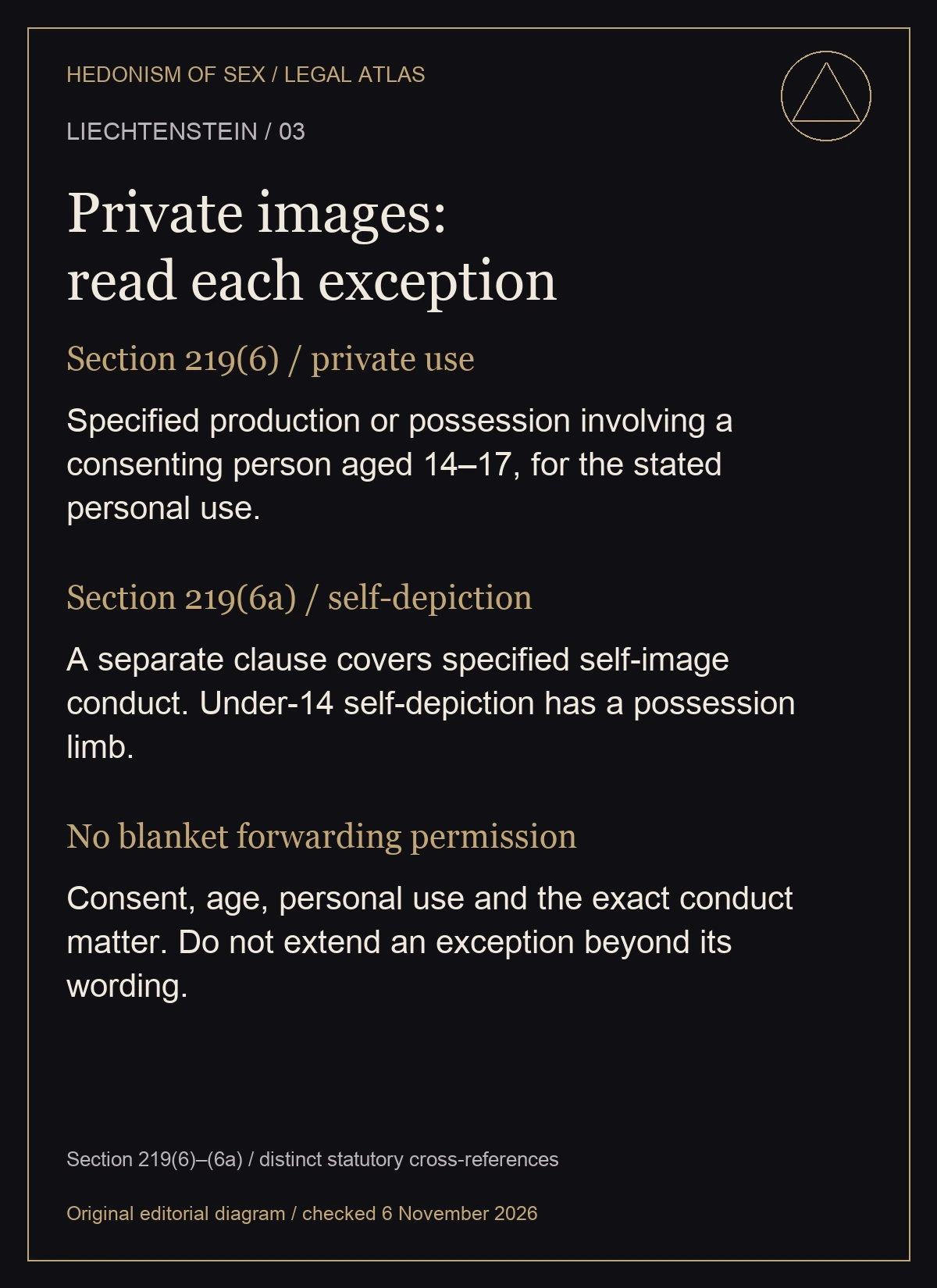
Under § 219(6), the specified production and possession offences do not apply to producing or possessing a depiction of a person aged 14 to 17 with that person’s consent and for that person’s or the producer’s own use. The clause expressly refers to § 219(1)(1) and (4)(1). It is not a general permission to circulate someone else’s image. § 219(6).
Paragraph 6a separately protects the specified self-depiction conduct: a person aged 14 to 17 making or possessing a depiction of themselves, or making it available to others for those others’ own use, within the cited provisions. Its second limb concerns possession of a depiction of oneself as an under-14 person. That second limb is about possession, not a general authorisation to create or share under-14 material. The conditions and statutory cross-references should be checked individually rather than compressed into “all consensual sexting is legal.” § 219(6a).
Section 219(7) also excludes items or performances with protectable cultural or scientific value from the provision’s definition of pornography. Separately, § 218a addresses making pornography available to people under 16 and other specified conduct. The age for that access restriction is a different question from the under-18 protection against qualifying depictions. §§ 218a and 219(7).
The current consolidation includes the August 2026 amendment
Lilex identifies version 54 of the code as effective from 1 August 2026. We checked the original 2026 amendment as well as the consolidation: the amendment concerns forensic therapeutic placement and related rules, alongside specified financial-crime provisions. It does not introduce a new ordinary consent threshold. An updated date on a code should not be mistaken for a reform of every section within it. Official version history; LGBl. 2026 No. 172.
The original amendment published as LGBl. 2023 No. 48 increased specified penalties, including provisions in §§ 205, 206 and 219, with commencement on 1 March 2023 as reflected in the version history. Older summaries can therefore reproduce the general threshold while giving outdated penalties. For earlier events, the applicable version and transitional provisions require separate assessment. 2023 amendment, parts I–III.
For cross-border situations, § 64(1)(4a) extends Liechtenstein law to listed offences committed abroad when the specified nationality, residence, national-interest or presence-and-extradition connections exist. This is not an automatic statement about every traveller. Check the facts and any other relevant country’s jurisdiction. Our guides to Switzerland and Austria explain their separate frameworks. § 64(1)(4a).
Common questions
Does the three-year exception include exactly three years?
Yes. Sections 205(4) and 206(4) use “not more than three years,” with a minimum age of 12 for the younger person and the specified harm conditions. The exception is limited to the offences it identifies. §§ 205–206.
Are all relationships lawful after 14?
No such blanket conclusion follows. Exploitation, authority, dependency, payment and non-voluntary conduct have separate provisions and conditions. §§ 200–204a, 208 and 212.
Does the law prohibit every private sexual image involving a minor?
Section 219 contains defined private-use and self-depiction exceptions. Their scope differs between production, possession and making material available, and depends on age, consent, purpose and the cited provisions. They do not create a general right to forward another person’s image. § 219(6)–(6a).
Sources and practical next steps
Checked 6 November 2026 against the current German-language primary legal documents. This is an editorial English explanation, not an official translation or an individual legal opinion. No independent lawyer review is claimed.
- Criminal Code, version 54: §§ 64, 74 and 200–219.
- Lilex chronology, identifying the current consolidation and amendments.
- LGBl. 2023 No. 48 and LGBl. 2026 No. 172, read in their original published form.
For a specific question, record the date, exact birthdays, any professional or dependency relationship, whether payment was offered, and whether images or online contact were involved. Those details let a local lawyer identify the relevant provisions and exceptions. Continue through the Law & Rights library or read our editorial approach.