Switzerland’s general age of sexual consent is 16. Article 187 contains an exception where the age difference between participants does not exceed three years. Other offences concerning non-consensual conduct, dependence, payment and images remain separate. Swiss Criminal Code, article 187.
A useful answer distinguishes three questions: does the age provision apply, was the conduct voluntary and free from abuse, and are images or payment involved? This guide explains each using the federal code in its version dated 1 November 2026. It does not turn an age calculation into clearance for a particular relationship.
One federal framework across Switzerland
The provisions discussed here are in the Swiss Criminal Code, rather than separate cantonal age-of-consent laws. Article 3 applies the code to offences committed in Switzerland. Crossing from Geneva to Zurich or Ticino does not replace article 187 with a different cantonal threshold. Article 9 separately addresses the application of juvenile criminal law to a person below 18 on the date of the act; the age for juvenile proceedings is a different question from capacity to consent. Articles 3 and 9.
For conduct outside Switzerland, additional jurisdictional rules may matter. Article 5 specifically covers certain offences against minors committed abroad where the person is in Switzerland and is not extradited. Its categories and age conditions differ by offence. A foreign location is therefore not a reason to assume that Swiss criminal law can never apply. Article 5.

The three-year rule includes exactly three years
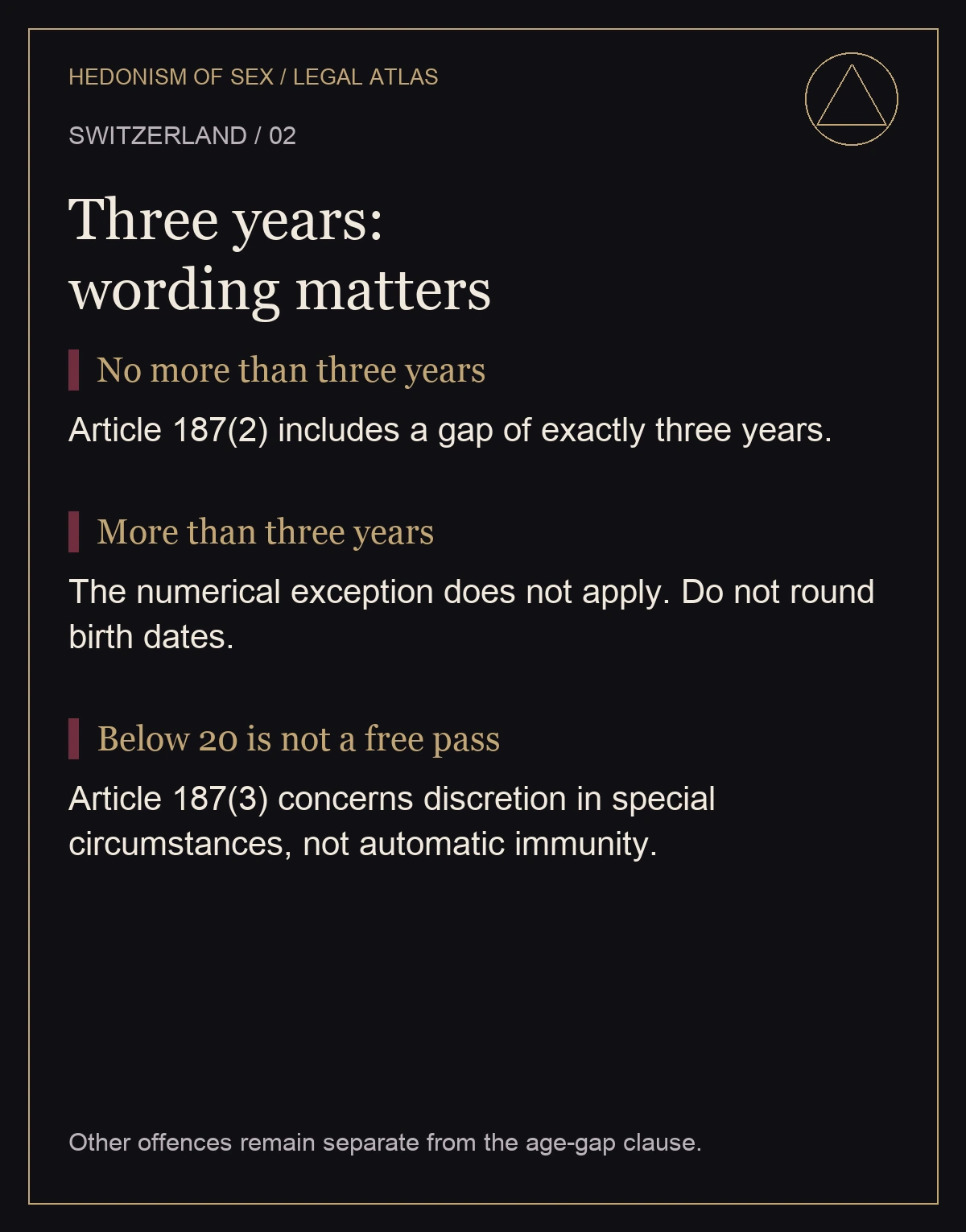
Article 187 addresses sexual acts with a child below 16, inducing such a child to perform a sexual act and involving such a child in one. Paragraph 2 says the act is not punishable if the age difference does not exceed three years. The wording is at most three years, not “less than three years.” It does not require both participants to be below 16. Article 187(1)–(2).
Use the actual birth dates. For illustration, a gap of exactly three years meets the numerical condition; a gap of three years and one day does not. These examples address only that condition. They do not establish voluntary agreement or remove an offence involving force, incapacity or exploitation.
| Question | Provision to check |
|---|---|
| Someone is below 16 | Article 187, including its maximum three-year difference. |
| A 16- or 17-year-old depends on the other person | Article 188 and the actual use of that relationship. |
| The act is against someone’s will or exploits freezing | Articles 189–190; age arithmetic cannot resolve this. |
| Sexual images are involved | Article 197, including the distinct clauses in paragraphs 8 and 8bis. |
| Payment is offered for sexual acts with a minor | Article 196, independently of the ordinary threshold. |
The close-age provision should not be described as a new general age of consent below 16. It is an exception within a particular offence. The remaining circumstances still need legal assessment.
A discretionary waiver is different from the age-gap exception
Article 187(3) allows the competent authority, in special circumstances, to refrain from prosecution, sending the case to trial or imposing a penalty where the person was below 20 at the time of the act or first act. This is not an automatic exemption for everyone below 20, and it is not another fixed age-gap allowance. The statutory conditions and the authority’s discretion both matter. Article 187(3).
Article 187(4) also addresses an avoidable mistake about the younger person being at least 16. It provides for punishment where the mistake could have been avoided by taking the required precautions. An asserted belief about age should therefore not be treated as an automatic defence. This guide does not assess whether any particular precaution would be sufficient. Article 187(4).
Protection continues at 16 and 17
Article 188 protects minors aged at least 16 where someone takes advantage of education, trust, employment or another relationship of dependence to carry out or induce a sexual act. Being above the general threshold does not answer whether a teacher, supervisor, carer or another person used a position of dependence. A label alone does not decide the issue; the relationship and its use must be examined. Article 188.
For example, in a hypothetical case involving a 17-year-old apprentice and a person controlling their training, the relevant question includes whether the dependence was exploited. “Both agreed” and “the younger person is 17” do not by themselves complete that analysis.
Article 193 addresses inducing someone into a sexual act by exploiting distress or employment-related or other dependence. Article 196 separately criminalises sexual acts with a minor in exchange for payment or a promise of payment. Article 213 contains an incest offence covering intercourse between direct-line relatives and specified siblings. These are additional legal questions rather than exceptions created by turning 16. Articles 193, 196 and 213.
What changed on 1 July 2024?
The revised sexual criminal law entered into force on 1 July 2024. Articles 189–190 now cover the specified acts against a person’s will and exploitation of a state of freezing or shock. Physical violence or threats are not prerequisites for the basic offences. Article 190 addresses intercourse and comparable acts involving bodily penetration and is worded without limiting the victim to a particular gender. Articles 189–190 and amendment notes; Basel-Stadt’s official explanation, updated October 2026.
The official explanation calls this the “no means no” approach and describes refusal through words or gestures as well as recognised freezing. This is not a reason to assume agreement whenever someone is silent. Article 191 separately covers exploiting a person’s inability to exercise judgment or resist. A person who freezes or is incapable does not need to physically fight back to merit protection. Article 191; official explanation.
The date of conduct remains important. Article 2 governs changes in criminal law and the application of more favourable law. The current wording should not simply be applied backwards without that assessment. Article 2.
Sexual images: distinguish creator, recipient and onward sharing
Article 197 contains several different rules. Paragraph 1 addresses making pornography available to people below 16. Paragraphs 3–5 address, among other things, recruiting minors for pornographic performances and specified material involving sexual acts with minors, including non-actual depictions. These rules cannot be replaced by the general age of consent. Article 197(1), (3)–(5).
The limited exception in paragraph 8
Paragraph 8 excludes punishment for the listed creation, possession, consumption or making available to the depicted minor where the minor consents, the creator neither pays nor promises payment, and the age difference is no more than three years. It is a clause for specified conduct and conditions, not unrestricted permission to circulate images. Article 197(8).
Self-created content and the recipient in paragraph 8bis
The first part of paragraph 8bis excludes punishment for a minor making, possessing or consuming material depicting themselves, or making it available to another person with that person’s consent. The next part sets conditions for the recipient’s possession or consumption: no payment or promise of payment, the people know each other personally, and either both are adults or, if at least one is a minor, their age difference does not exceed three years. Do not attach all of the recipient’s conditions to the minor creator’s separate clause. Article 197(8bis).
These exceptions do not authorise pressure to produce an image or general onward distribution. Article 197a separately prohibits forwarding private sexual content to a third party without the consent of the identifiable person; public disclosure has a separate penalty provision. Agreement to create or privately send something is not agreement to repost it. Article 197a.

Practical questions
Is the age difference rule strictly less than three years?
No. Article 187(2) says the difference must not exceed three years. Exactly three years meets that numerical condition. Other offences and the actual circumstances remain relevant.
Does being below 20 create an automatic exemption?
No. Article 187(3) gives the competent authority a discretionary power in special circumstances. It does not replace the three-year provision or grant advance permission.
What should be checked for a real situation?
Record exact birth dates, the date and place of conduct, any educational or employment dependence, whether there was free agreement or incapacity, and whether payment or images were involved. A Swiss lawyer can then assess the relevant provisions rather than relying on a single age number.
Continue with the Law & Rights library or our separate guides to France, Germany and Italy. Their exceptions are different and do not determine the Swiss answer.
Sources and verification
- Fedlex: Swiss Criminal Code, SR 311.0, status 1 November 2026. French official text; articles 2–5, 9, 187–191, 193, 193a, 195–197a and 213 checked. Amendment notes identify the 2024 reform and its commencement.
- Canton Basel-Stadt: sexual violence and the new sexual criminal law. Official public explanation, updated 7 October 2026.
- Switzerland’s November 2024 CEDAW follow-up report, section 4. Federal confirmation of actual commencement and the expanded offences; read with the current code.