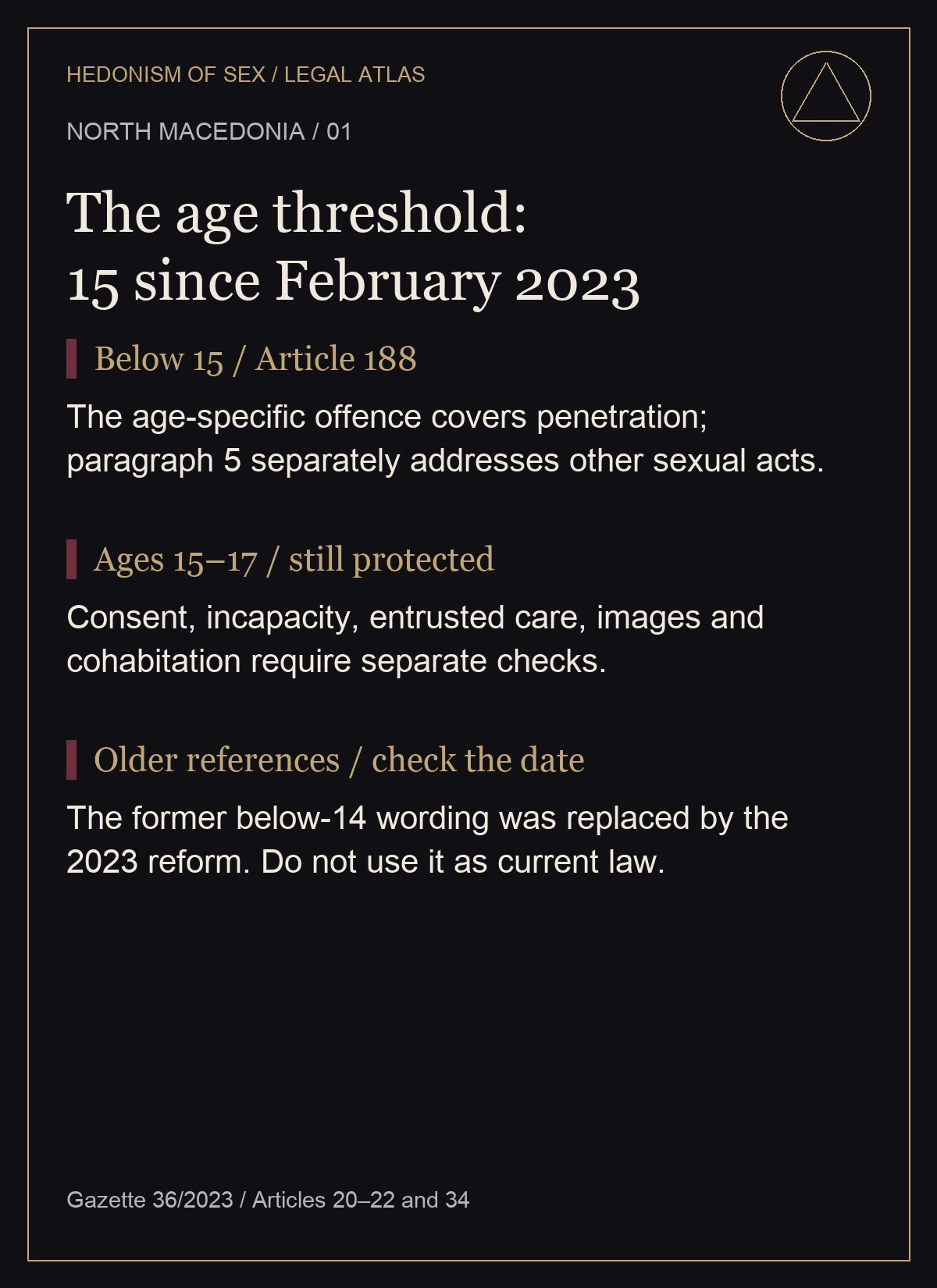
North Macedonia’s ordinary age threshold is 15. The February 2023 reform replaced Criminal Code Article 188 with an offence protecting children who have not reached 15. Its first paragraph addresses penetration and its fifth paragraph other sexual acts. The replacement text contains no express numerical close-in-age exception. Reaching 15 does not remove the separate protections discussed below. Official Gazette 36/2023, Article 22.
Research scope. The President’s Office hosts an editorial consolidation through 248/2018. We checked that historical baseline against the Ministry of Justice’s amendment record, the original 36/2023, 188/2023 and 16/2026 amendments and the 17/2026 correction. The 2018 PDF alone is not current law. This is AI-assisted editorial research without independent lawyer review; an individual case requires its facts and applicable law to be assessed.
Why an older answer of 14 is no longer reliable
The original Gazette issue is dated 17 February 2023. Article 22 of its amending law substituted the entire Article 188, including the below-15 boundary. Article 34 brought the law into force on the eighth day after publication: 25 February 2023. The age reform was not among provisions given a separate delayed application date in that law. Gazette 36/2023, pages 2–6, Articles 22 and 34.
Article 188(1) does not make force or a threat an additional condition of the basic age-specific offence. Force, threats and the child’s helplessness are addressed in paragraph 2 as more serious circumstances. The provision’s wording is not limited to an adult perpetrator; rules about an alleged offender’s age and criminal responsibility are a separate question.
The European Court of Human Rights independently records the reform in K.M. v. North Macedonia, judgment of 4 March 2025. Paragraphs 21–22 distinguish the former below-14 provision from the February 2023 amendments. The Court found that the domestic framework as applied to the earlier incident failed to protect the applicant’s Article 8 rights. This was a judgment about protection against abuse, not a ruling lowering the current threshold. K.M., application 59144/16, paragraphs 21–22 and 70–78; government-hosted translation.
There is no fixed age-gap exemption in the replacement Article 188
The five paragraphs of the substituted Article 188 contain the basic offence, aggravated circumstances, a professional prohibition and the separate rule for other sexual acts. They do not state a two-year, three-year or similar peer exemption. This guide therefore does not present a small age difference, similar maturity or parental approval as an express defence under that provision. Gazette 36/2023, Article 22.
For example, a hypothetical question involving two teenagers cannot be answered by importing Serbia’s maturity exception or another country’s numerical rule. The conduct, exact ages at the time and any rules governing proceedings against a young alleged offender need their own assessment. The absence of an express peer exception should not be turned into an invented claim that every young person faces the same procedure or sanction as an adult.
Being 15 or older does not settle consent or capacity
The same 2023 law replaced Article 186. Its first paragraph addresses the specified acts against another person’s clearly expressed will, assessed in the circumstances, and also inducing a person without consent to engage in the specified acts with a third person or upon themselves. Paragraphs 3–4 separately address force and threats, including serious blackmail threats. Other sexual acts are addressed in paragraph 7. Gazette 36/2023, Article 20.
That precise wording matters. A broad slogan about consent is not a substitute for identifying the applicable paragraph. Nor does the ordinary age threshold establish consent to a particular act. Article 186 contains additional protection where the victim is a child who has reached 15 and expressly addresses current or former spouses and intimate partners in paragraphs 8–9. A relationship does not create standing permission.
Article 187, also replaced in 2023, separately addresses exploiting a person’s mental illness, mental disturbance, helplessness, delayed mental development, physical disability or another condition of helplessness. It includes a specific paragraph concerning a child who has reached 15. A diagnosis or disability should not automatically be equated with inability to consent: the provision concerns the specified exploitation and circumstances. Gazette 36/2023, Article 21.
Authority and entrusted care are separate restrictions
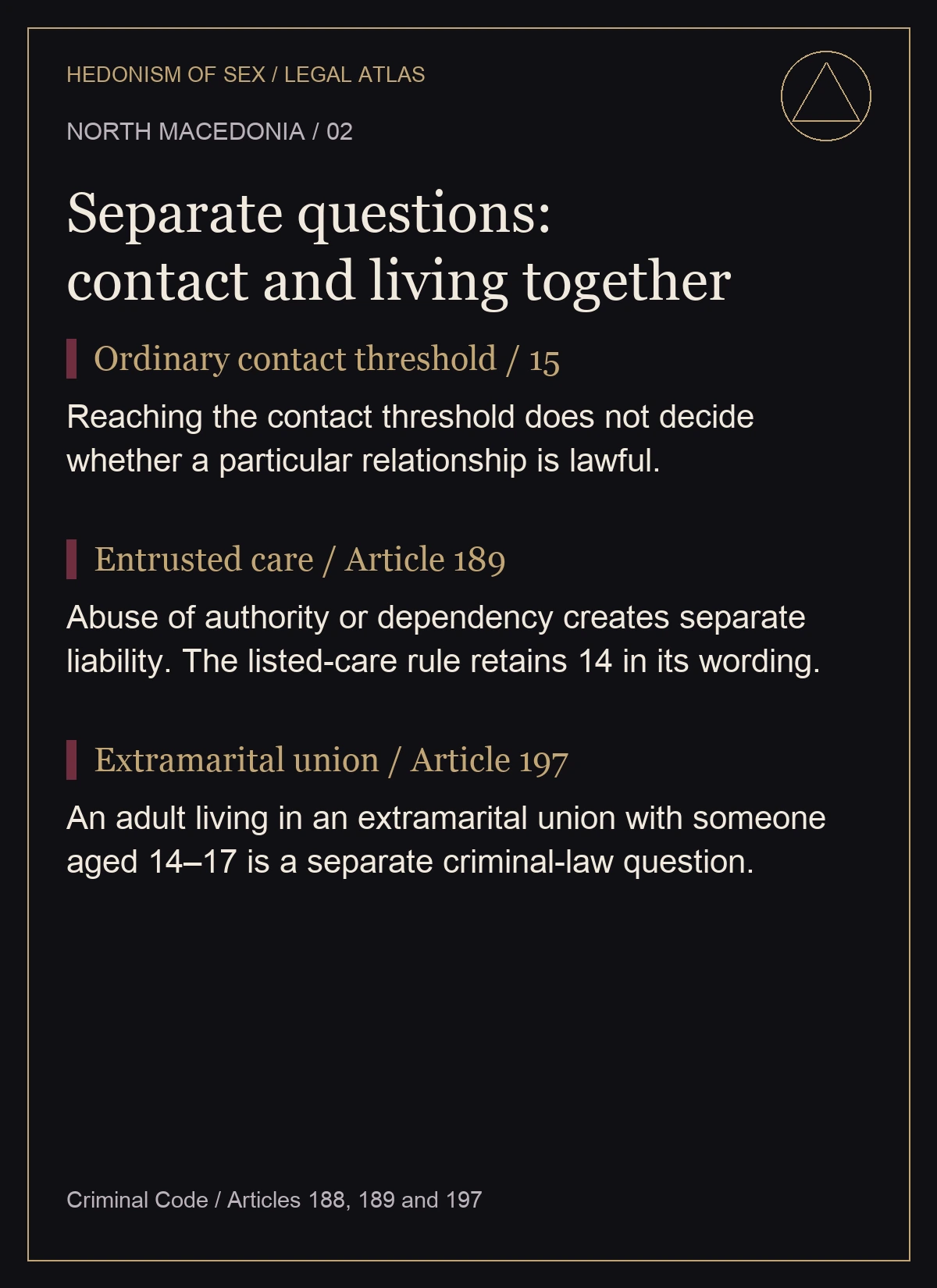
Article 189(1) concerns abuse of position involving a person in a subordinate or dependent relationship, including the specified mistreatment, intimidation or degrading treatment with the same intention. Its operation is not restricted to someone below the ordinary age threshold. Criminal Code baseline, Article 189, checked against the later amendments in the Ministry of Justice record.
Paragraph 2 lists people including teachers, educators, adoptive parents, guardians, stepparents and doctors, alongside specified relatives. It addresses abuse of position or domestic violence involving a child entrusted for teaching, upbringing, supervision or care. Importantly, that paragraph retains the wording referring to a child who has reached 14; the 2023 law did not simply replace every number 14 throughout the code with 15. Article 122(22) defines a child victim as a minor below 18. Articles 122(22) and 189(2).
For a hypothetical teacher–student situation, the useful questions are consequently about entrusted care, dependency and abuse of position, not only whether the student has passed a birthday. Article 188 can also matter where the child is below 15. The provisions should be assessed together rather than treated as mutually exclusive permissions.
An adult living with a teenager raises a different legal question
Article 197(1) separately criminalises an adult living in an extramarital union with a child who has reached 14 but not 18. Paragraphs 2–3 address specified conduct by a parent, adoptive parent or guardian, including a profit-related aggravation. Paragraph 4 provides a prosecution-on-proposal rule for the paragraph 1–2 conduct involving someone aged 16–17. That procedural distinction is not a general declaration that the union is lawful. Article 197, checked against subsequent amendments.
Thus, a hypothetical adult and 17-year-old considering living together cannot rely solely on the contact threshold of 15. Whether the facts amount to an extramarital union needs assessment. This guide does not equate every shared address with that legal concept or determine eligibility to marry under family law.
Family relationships create another independent restriction. Article 194(1) addresses intercourse with a blood relative in the direct line or a sibling. Its aggravated paragraph retains a below-14 reference; that does not displace the newer below-15 protection in Article 188. Articles 194 and 188, with Article 188 replaced by Gazette 36/2023.
Sexual images are governed independently, including a new 2026 provision
Article 193a addresses producing child sexual material for distribution, transmitting, offering or otherwise making it available. A separate paragraph covers acquisition for oneself or another person and possession. Computer-system or mass-communication use is separately addressed. Article 122(24)’s statutory definition includes specified depictions involving a minor and an older person appearing to be a minor. The text should be checked against the actual content; an ordinary nonsexual photograph is not automatically within that definition. Articles 122(24) and 193a.
Article 193 separately regulates supplying specified pornographic material or a performance to a child below 14 and exploiting children in production or performances, with different paragraphs for older and younger children. Those retained numbers must not be mistaken for an image-sharing permission at 14 or 15. The examined provisions contain no general numerical peer exemption for private couples. Article 193.
Intimate-material disclosure, fabrication and threats
Article 6 of the 16/2026 amendment inserted Article 152a. Its first paragraph addresses making sexually explicit recordings, photographs, audio or writings available to a third person without the relevant person’s consent. The next paragraphs separately address creating or altering such material and using it or making it available, and threats to disclose the specified material. These rules are not confined to photographs or to material distributed publicly on a website. Original 16/2026 amendment, Article 6.
Further paragraphs address availability to multiple people, commission against a child and specified official-person circumstances. Paragraph 5 provides a three-to-ten-year range for the specified paragraph 1–4 conduct against a child. Consent to an original recording should not be treated as automatic consent to onward disclosure; fabricated intimate material also requires separate assessment. The law’s correction in 17/2026 changes unrelated provisions, not this new Article 152a. Article 152a; 17/2026 correction.

The meeting offence still uses a below-14 boundary
Article 193b concerns use of computer-communication means to lure a child below 14, by arranging a meeting or otherwise, for intercourse, another sexual act or production of child sexual material, where a direct meeting with the minor occurs with that intention. The wording contains both the specified purpose and an actual direct-meeting element. It does not simply criminalise every conversation or invitation under that article. Article 193b, checked against the later amendments.
The retained 14 is not a general online age of consent. Conduct involving a 14-year-old can still engage the newer Article 188, and image offences or other provisions may apply before a meeting. Article 190a, inserted in 2023, also addresses sexual harassment through verbal, nonverbal or physical conduct and electronic communication, with the specified effect on dignity and feelings of discomfort, offence, humiliation or fear. Its second paragraph addresses dependency, work or public-place circumstances and specified vulnerabilities. Gazette 36/2023, Article 23.
Check the date of the conduct as well as the latest amendment
The Ministry’s record lists 36/2023, 188/2023 and 16/2026 after the 2018 consolidation. The September 2023 amendment concerns other code provisions and does not reverse the replacement Article 188. The January 2026 law adds Article 152a and amends other matters, including child trafficking; it does not replace the contact-age provision. Code amendment record; 188/2023 original; 16/2026 original.
A date discrepancy remains in the official sources: the Ministry’s 16/2026 record gives publication on 28 January and entry into force on 5 February 2026, while the Constitutional Court’s 25 February 2026 decision describes publication on 29 January. Article 15 itself provides eighth-day commencement, except for specified vehicle-related provisions with application from 1 February. We therefore do not assert a resolved exact commencement day for Article 152a. This one-day discrepancy does not change its applicability by this guide’s November check date; an incident around commencement needs verification against the original Gazette issue. Ministry record and Article 15; Constitutional Court, U.br.162/2023 and U.br.163/2023.
For an older allegation, today’s wording cannot simply be applied backwards. Criminal Code Article 3 addresses the law in force at the time and the more favourable-law rule. K.M. likewise discusses why the applicant could not rely on the later reform for the earlier incident. A travel or online case may also involve several countries: Article 116 establishes territorial application, while Articles 117–120 address specified overseas situations and conditions. Articles 3 and 116–120; K.M., paragraph 71.
Common questions
Is the age of consent 14 or 15?
The current ordinary threshold is 15 under Article 188 as replaced in February 2023. Some other provisions retain 14 for their own particular purposes; they do not restore the former general boundary.
Does a small age difference automatically create an exception?
No express numerical close-in-age exemption appears in the replacement Article 188. Do not import one from a neighbouring country. Proceedings involving a young alleged offender require separate assessment.
Can a 17-year-old live with an adult partner?
The contact threshold does not answer that question. Article 197 separately addresses an adult living in an extramarital union with a child aged 14–17. Its procedural distinction for ages 16–17 is not a general permission.
Does turning 15 allow sexual images to be shared?
No. Articles 193 and 193a regulate child sexual material separately, and new Article 152a addresses intimate-material disclosure, fabrication and threats. Consent to contact does not resolve these offences.
Sources and practical next steps
For a real situation, establish the date of the conduct and each person’s exact age then. Identify dependency or entrusted care, any proposed extramarital union, whether images or threats are involved, and which countries have a connection. Bring those facts to a qualified lawyer rather than relying on a single age in an international table. Avoid circulating suspected child sexual material while seeking help.
- Ministry of Justice LDBIS: Criminal Code amendment record — checked 6 November 2026.
- President’s Office: editorial consolidation through 248/2018 — historical baseline, read with subsequent amendments.
- Official Gazette 36/2023 — original reform, particularly Articles 20–24 and 34.
- 188/2023 amendment — subsequent original law.
- 16/2026 amendment — new Article 152a and commencement clause.
- 17/2026 correction — unrelated corrections checked.
- ECtHR: K.M. v. North Macedonia, 4 March 2025 — reform chronology and protection against abuse; government translation.
- Constitutional Court decision of 25 February 2026 — amendment chronology; publication-day discrepancy disclosed above.
Continue with the separately researched guides to Serbia, Albania, Greece and Bulgaria, or browse the Law & Rights library.
Review and corrections. Checked 6 November 2026. We retain source copies and an editorial review record. The unresolved 2026 publication-day difference is recorded explicitly; this guide makes no definitive commencement-day claim for an incident at that boundary. Original AI-assisted diagrams are labelled in their captions. No independent lawyer review or personal legal representation is claimed.