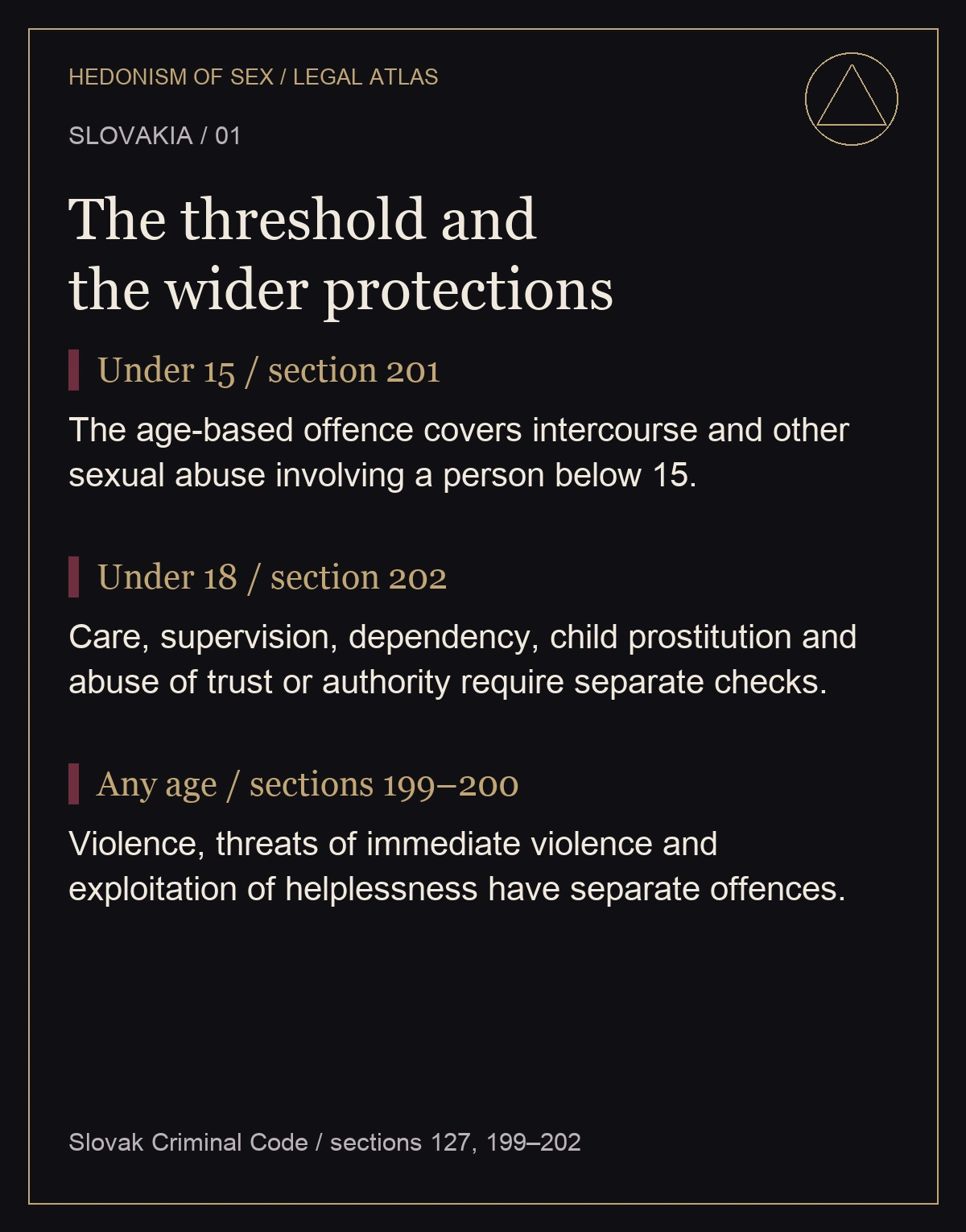
The ordinary age of sexual consent in Slovakia is 15. Section 201 of the Criminal Code criminalises intercourse with a person below 15 and other sexual abuse of that person. It contains no express numerical close-in-age exception. Separate provisions protect children under 18 in circumstances involving care, dependency, exploitation or abuse of trust; sexual images have their own rules. Sections 201–202; section 127.
This guide helps you distinguish the age threshold from the other questions that determine legal risk: the ages of both people, the conduct involved, a relationship of authority, and whether images are made or shared. It covers Slovakia, including Bratislava and the other regions, under the national Criminal Code. The territorial starting point is section 3.
What the threshold of 15 means
Section 201(1) is an age-based sexual-abuse offence. Its wording covers intercourse and other sexual abuse of a person younger than 15. The protection is not limited to situations involving force, payment or a large age difference. A statement that the younger person agreed does not remove the age element. The Code’s general provision about a victim’s consent expressly preserves offences that remain punishable even where consent was given. Section 201; section 29(3).
The relevant age is the person’s age when the conduct occurred. For an ongoing situation, dates matter: conduct before a birthday and conduct afterwards should not be treated as a single undated event. Reaching 15 removes the “younger than 15” element; it does not settle questions about coercion, exploitation, family relationships or images.
| Question | Starting point | Provision |
|---|---|---|
| Age-based contact offence | Person below 15 | § 201 |
| Responsibility for that offence | The person acting must have reached 15 | § 22(2) |
| Care, authority and exploitation | Child generally means below 18 | §§ 127, 202 |
| Images and performances | Separate definitions and offences | §§ 132, 368–370 |
Read the table with the actual provisions, rather than treating it as permission for a relationship. Official consolidated Criminal Code PDF.
Peer cases and criminal responsibility
Slovakia has an important distinction that a simple country chart can miss. Under section 22(1), the general minimum age of criminal responsibility is 14. But section 22(2) specifically excludes criminal responsibility for the section 201 offence where the person acting was below 15. That is an offence-specific rule about responsibility, not an age-gap formula.
For example, in a hypothetical situation involving two people aged 14, section 22(2) matters to responsibility under section 201. In a different hypothetical situation involving a person aged 15 and one aged 14, the older person does not obtain an express exemption merely because their ages are close. The statute does not provide a two-, three- or five-year permitted gap. Other elements and the individual facts still need legal assessment. Section 201.
Why a general juvenile rule does not create a peer exception
Section 95(2) excludes criminality for a juvenile’s low-severity prečin, a particular category of offence. It should not be advertised as an automatic escape from section 201: the basic section 201 offence carries a maximum of ten years, whereas the intentional-offence branch of the prečin definition has a maximum of no more than five years. Sections 10–11 distinguish those offence categories. Section 95; sections 10–11.
Nor does lack of criminal responsibility mean that every other offence, protective measure or safeguarding concern disappears. The Code distinguishes punishment from protective measures, including measures connected with conduct that would otherwise be criminal. Sections 31–35. An official child-protection publication also explains the special under-15 responsibility rule for section 201; its discussion is supplementary to the current statute. National coordination publication, discussion of § 201.

Protection under 18: care, authority and payment
The Code generally defines a child as a person younger than 18, unless it specifies otherwise. Section 202 therefore matters after the ordinary threshold of 15. It addresses inducing a child to intercourse outside marriage or otherwise sexually abusing the child in the specified circumstances: the child is entrusted to the person’s care or supervision or is dependent on them; the conduct involves child prostitution; or the person abuses a recognised position arising from trust, authority or influence over the child. Section 127(1); section 202(1).
This is why a situation involving, for example, a supervisor and a 16-year-old in their care requires a different assessment from a relationship without that position. The job title alone is not the complete legal test; the actual care, dependency or abuse of the recognised position matters. Section 127(8)–(9) gives definitions of a person entrusted to care or supervision and a dependent person.
Child prostitution has a separate statutory definition involving sexual activity for payment or a promise of payment. Payment can be directed to the child or to someone else. Describing it as a gift or arranging payment through a third person does not, by itself, resolve the legal classification. Section 132(2).
Family relationships also require a separate check: section 203 criminalises intercourse between relatives in the direct line or between siblings. The ordinary age threshold does not remove that provision. Section 203.
Violence, helplessness and consent
The current wording should be described accurately. Section 199 concerns forcing a woman to intercourse through violence or a threat of immediate violence, or exploiting her helplessness for that act. Section 200 separately concerns forcing another person to the sexual conduct it specifies through violence or a threat of immediate violence, or exploiting that person’s helplessness. Neither provision becomes irrelevant when someone reaches 15 or 18. Sections 199–200.
These are statutory descriptions, not a complete statement that every unwanted situation falls into only these offences. The Code’s definition of a helpless person considers age, health, the circumstances and the person acting. Do not assume that silence, intoxication, a previous relationship or a prior agreement authorises sexual activity. If someone cannot freely decide or communicate, stop rather than attempt to infer permission. Section 127(7); section 29.
Online approaches and sexual images
An online meeting proposal can have its own offence
Section 201a addresses a person who is not a child proposing an in-person meeting through an electronic communications service to a child below 15, with the intention of committing sexual abuse or producing child pornography. Its text does not require the meeting to have already taken place. Section 201b separately addresses the specified sexual exploitation of a child below 15 through sexual activities or abuse, including circumstances without the child’s direct participation. These provisions should not be reduced to a general statement that all online conversation is criminal. The ages, intent and statutory conduct matter. Sections 201a–201b.
Contact age does not decide image legality
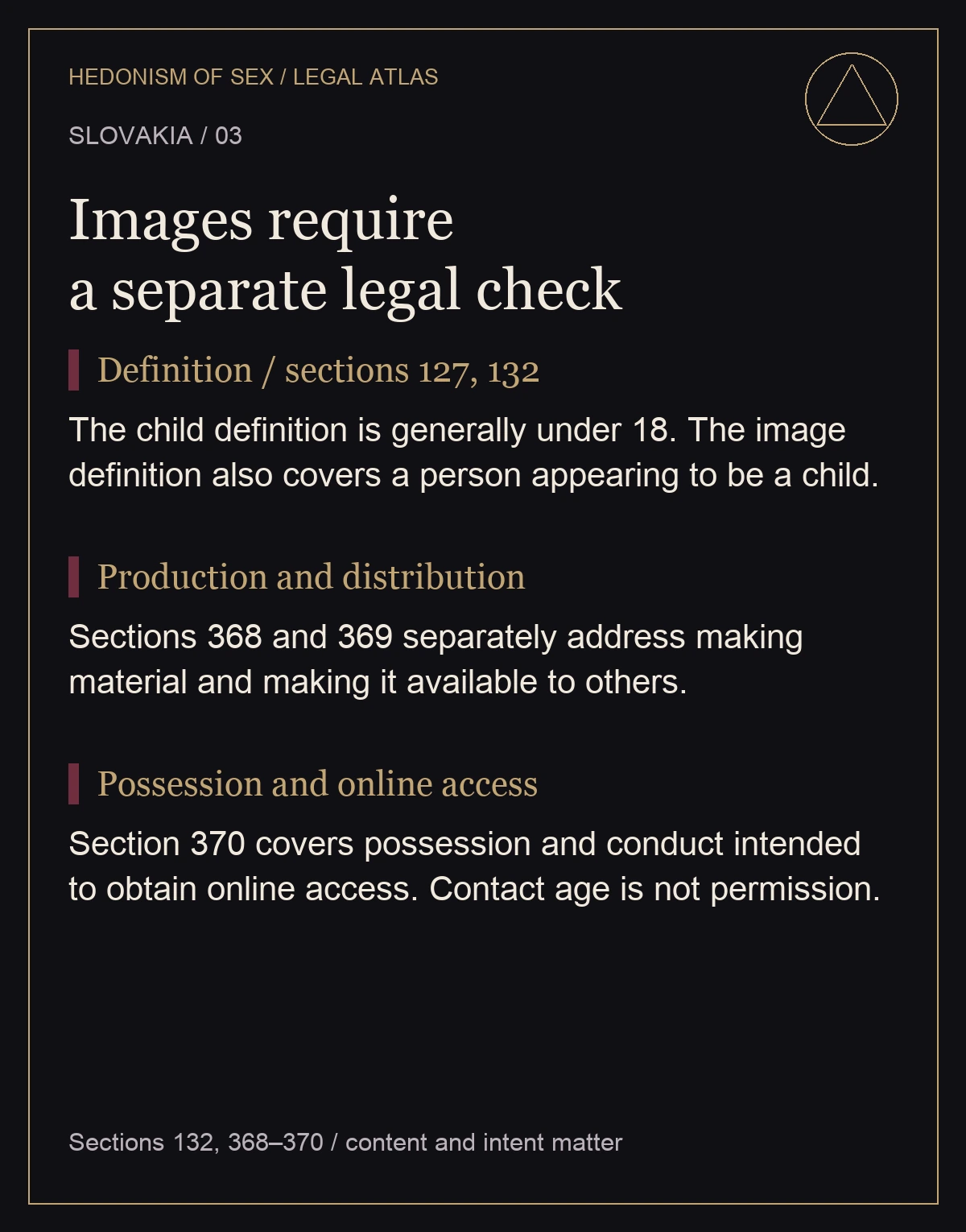
Section 132(4) defines the material covered by the child-pornography provisions. It includes specified actual or simulated sexual depictions involving a child or a person appearing to be a child, and specified depictions of exposed body parts for sexual purposes. It does not turn every ordinary photograph of a minor into prohibited material. The actual content and statutory definition matter. Section 132(4)–(5).
Sections 368–370 separately address production, distribution or making material available, possession, conduct intended to obtain access through electronic communications, and intentional attendance at a covered performance. Those provisions contain no express private-peer exception in the text checked. A person’s agreement to a photograph, or being 16 or 17, is not a substitute for checking these offences. Sections 368–370.
There are additional protections beyond images depicting children. Section 360b(1)(b), subject to its other elements, addresses unauthorised disclosure to a third person or publication of certain personal recordings originally obtained with consent, where the conduct substantially worsens the person’s quality of life. Section 372 separately restricts supplying pornography to children or making it available in places accessible to them. These are distinct from the age of consent to physical contact. Section 360b; section 372.
Practical examples and next steps
These hypothetical examples identify the questions to check; they do not give individual legal clearance.
- Two people aged 16 without a care or authority relationship: the under-15 element of section 201 is absent. Voluntariness, helplessness, exploitation and other applicable offences still require consideration.
- A person aged 16 supervised by the other person: section 202 may matter even though the younger person is above 15. Establish the real supervision, dependency and conduct.
- A 17-year-old sends a sexual image: analyse the content and the making, receiving, access or sharing separately under sections 132 and 368–370. Do not infer legality from the contact threshold.
If you need advice about an actual event, prepare a factual timeline with each person’s age at the time, the place, any supervisory relationship, what happened, and any threats or pressure. For online incidents, record the platform, account information and relevant dates without forwarding sexual material depicting a child to friends or uploading it elsewhere. A Slovak lawyer can assess how the law applies to those facts and how evidence should be handled.
Cross-border situations can involve more than the law of the place where people met. Sections 4–7 address additional bases for applying Slovak criminal law. Do not use this page to infer that conduct abroad is lawful. For comparison, consult our separately researched guides to Czechia, Poland and Austria, or return to Law & Rights. Criminal Code, sections 4–7.
Common questions
Is the age of consent 15 throughout Slovakia?
The national section 201 uses the threshold of below 15. It does not set separate thresholds for individual Slovak regions. Other offences can still prohibit particular conduct after that age.
Does Slovakia have a fixed close-in-age exemption?
Section 201 states no express numerical age-gap exemption. Section 22(2) separately excludes responsibility for that offence if the person acting was below 15. Do not confuse the two questions.
Does turning 15 make every relationship lawful?
No. Section 202 protects children in the specified care, dependency, exploitation and authority situations; violence, helplessness, family and image provisions also require separate checks.
Did the latest 2026 amendment change the consent age?
Act 168/2026 changes section 130(2), about what counts as a thing for Code purposes. It does not amend section 201. Its Criminal Code change took effect on 18 August 2026; some other parts of that Act have a later commencement.
Sources and verification record
- Criminal Code 300/2005: official legally binding PDF, effective 18 August 2026. Principal authority; relevant definitions and offences checked against the searchable official text.
- Official searchable consolidation and version history. The HTML is labelled informative; the PDF is labelled legally binding.
- Act 168/2026, Articles I and VII. Latest listed amendment: section 130(2); commencement of this change on 18 August 2026, with specified other provisions postponed until 2028.
- Act 129/2026, Articles II and IV. Earlier July amendment to section 348; effective 15 July 2026. Not a change to section 201.
- Official national coordination publication on minors committing child sexual abuse. Supplementary explanation of section 201 and section 22(2); current statute controls.