Germany’s general age-of-consent threshold is 14. Sexual activity involving a person aged 14–17 is not automatically criminal, but further offences protect teenagers from exploitation and abuse of particular relationships. Being above the threshold never replaces actual consent. The federal abuse commissioner’s legal guidance explains this distinction between children under 14 and adolescents.
The German Criminal Code (Strafgesetzbuch, or StGB) uses several age limits for different offences. This guide explains the structure rather than turning it into a single number or an age-gap calculator.
14, 16 and 18 answer different questions
| Age | What must be checked | Source |
|---|---|---|
| Under 14 | Child sexual-abuse offences; a narrow judicial power to dispense with punishment in specified peer cases. | §176 |
| Under 16 | Additional exploitation rule involving an older person over 21; particular institutional protections. | §182(3); §174(2) |
| Under 18 | Exploitation of a predicament, payment-related abuse and specified care or dependency relationships. | §182(1)–(2); §174 |
| Every age | Offences involving an identifiable contrary will, inability to form or express a will, and other specified circumstances. | §177 |

Under 14: distinguish prohibition from dispensing with punishment
Section 176(1) criminalises specified sexual acts involving a child under 14. An assertion that the child agreed does not by itself remove that protection.
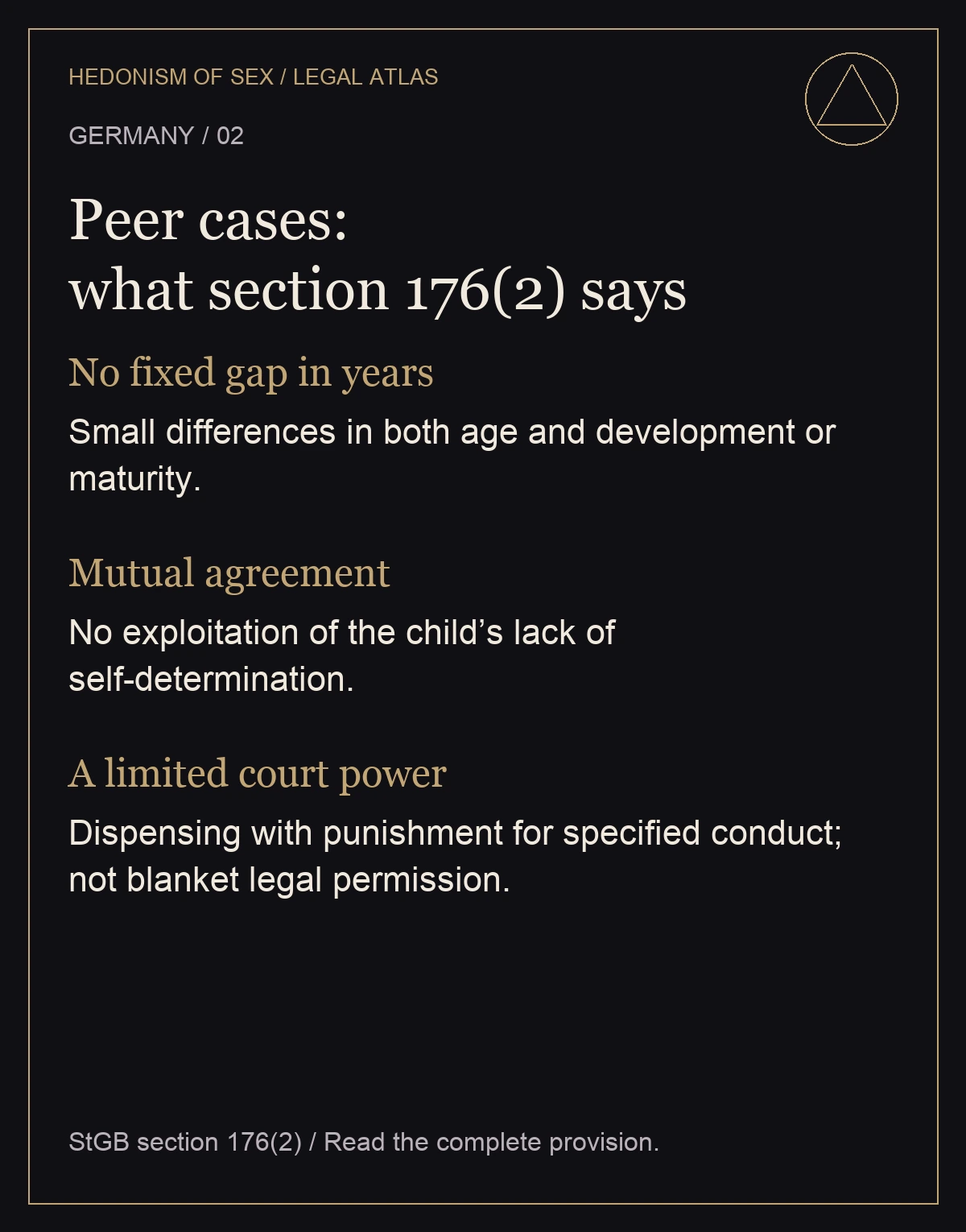
Subsection (2) gives the court a limited power to dispense with punishment under this provision for the conduct in subsection (1), number 1. The act must be mutually agreed, and the differences both in age and in developmental stage or maturity must be small. It does not apply where the offender exploits the child’s lack of capacity for sexual self-determination.
The statute supplies no fixed gap in years. This is not a general two- or three-year exemption, and the wording concerns dispensing with punishment rather than making every such act lawful. It also does not cover all the other offences involving children.
A separate issue is criminal responsibility: §19 excludes criminal culpability for a person who was under 14 when acting. That rule concerns the person accused; it does not lower the child-protection threshold.
Teenage protection: age and exploitation must be read together
Section 182 contains three distinct situations. Subsection (1) addresses abuse of someone under 18 through exploitation of a predicament. Subsection (2) addresses payment-related abuse of someone under 18 by a person over 18.
Subsection (3) concerns a person over 21 and someone under 16, where the older person exploits the younger person’s lack of capacity for sexual self-determination in relation to them. The age combination alone does not establish every element of that offence. Its complaint requirement also has an exception for prosecution in the special public interest under subsection (5); it should not be described as something only parents can activate.
The federal guidance illustrates exploitation of a predicament with a young person who has run away from home and needs help. The legal issue is the exploitation of that situation, not simply whether the younger person verbally agreed.
Care and dependency: the relationship changes the analysis
Section 174(1) protects under-18s entrusted to a person for upbringing or care in everyday life. It separately covers under-18s subordinate in training, service or employment where the associated dependency is abused, and specified descendant or family-partner relationships.
Subsection (2) concerns people entrusted with education, training or everyday care of under-18s in an institution. It distinguishes a person under 16 in the specified institutional relationship from a person under 18 where the offender exploits their position. A label such as “teacher” is not a substitute for checking the applicable relationship and subsection.
Hypothetical example: a 16-year-old being above the general age threshold does not answer whether sexual conduct with a person responsible for their upbringing falls under §174. The care relationship still requires its own assessment.
Other relationships have separate protections. Section 174c addresses abuse of specified counselling, treatment or care relationships, including psychotherapeutic treatment. It is not limited to the general child-consent age. Section 173 separately criminalises intercourse between specified biological relatives, with a particular under-18 non-punishment provision for descendants and siblings. These are different legal rules, not extensions of one universal age limit.
Actual consent is a separate legal question
Section 177(1) addresses sexual acts against another person’s identifiable will. Subsection (2) also covers specified circumstances such as exploiting inability to form or express a contrary will, substantially impaired ability to do so, surprise and certain threats or threatening situations. The impaired-ability paragraph contains its own qualification concerning ascertained agreement; the precise provision matters.
These rules cannot be reduced to “no physical resistance, therefore consent”. They address circumstances in which a person may be unable to communicate opposition as well as cases of an identifiable contrary will. Age eligibility alone does not settle that question.

Images and online conduct have different limits
Section 184b addresses child-pornographic content involving children under 14. Section 184c separately addresses youth-pornographic content involving people aged 14–17. Its offences include specified production, distribution, acquisition and possession.
Section 184c(4) has a limited personal-use exception concerning content the relevant people themselves produced with the depicted persons’ consent; it applies only to the specified production and possession-related provisions. It is not general permission to distribute such material. Being old enough for some sexual activity does not make an image lawful to share.
The absence of physical contact is not a universal defence either. §176a covers specified non-contact child sexual abuse, while §176b addresses specified preparation through content directed at a child. A message, image request or online interaction needs its own legal assessment.
Third-party facilitation is another distinct question: §180 covers specified facilitation of sexual acts involving under-16s and inducement or facilitation of paid acts involving under-18s. Its parental-care qualification is limited and must be read with its exception for gross breach of upbringing duties.
The federal framework, historical cases and next steps
These StGB provisions form a federal framework, rather than different age-of-consent statutes for Berlin, Bavaria or another Land. Criminal law is among the subjects in Basic Law article 74(1), number 1; StGB §3 states that German criminal law applies to acts committed in Germany.
Cross-border conduct may also engage German law. Section 5, number 8 extends specified sexual offences committed abroad where the offender is German or has their life based in Germany, under its stated conditions. Do not assume a foreign location removes German liability.
For historical allegations, §2 requires attention to the law at the time and, where the law changes before judgment, its rules about the more lenient law. A present-day summary cannot establish the correct historical charge.
- Identify both exact ages and the date. Keep the victim’s protective age threshold separate from the accused person’s criminal responsibility.
- Check the actual relationship. Care, employment, institutional responsibility and exploitation can change the answer.
- Separate contact, images and facilitation. Permission for one activity cannot be assumed to answer another legal question.
- Obtain German legal advice for an actual case. A lawyer can assess the applicable subsection and the evidence.
Does Germany have a fixed close-in-age exemption?
Section 176(2) uses small differences in age and development or maturity, not a fixed number of years. It gives a court limited discretion about punishment. It is not an automatic age-gap clearance.
Does being 14 make every relationship lawful?
No. The exploitation, care, dependency and actual-consent provisions discussed above can still apply. Images and third-party facilitation have separate rules.
Where can I compare other countries?
Read the independently researched guides for Canada, the United Kingdom and France. Their exceptions cannot be imported into German law.