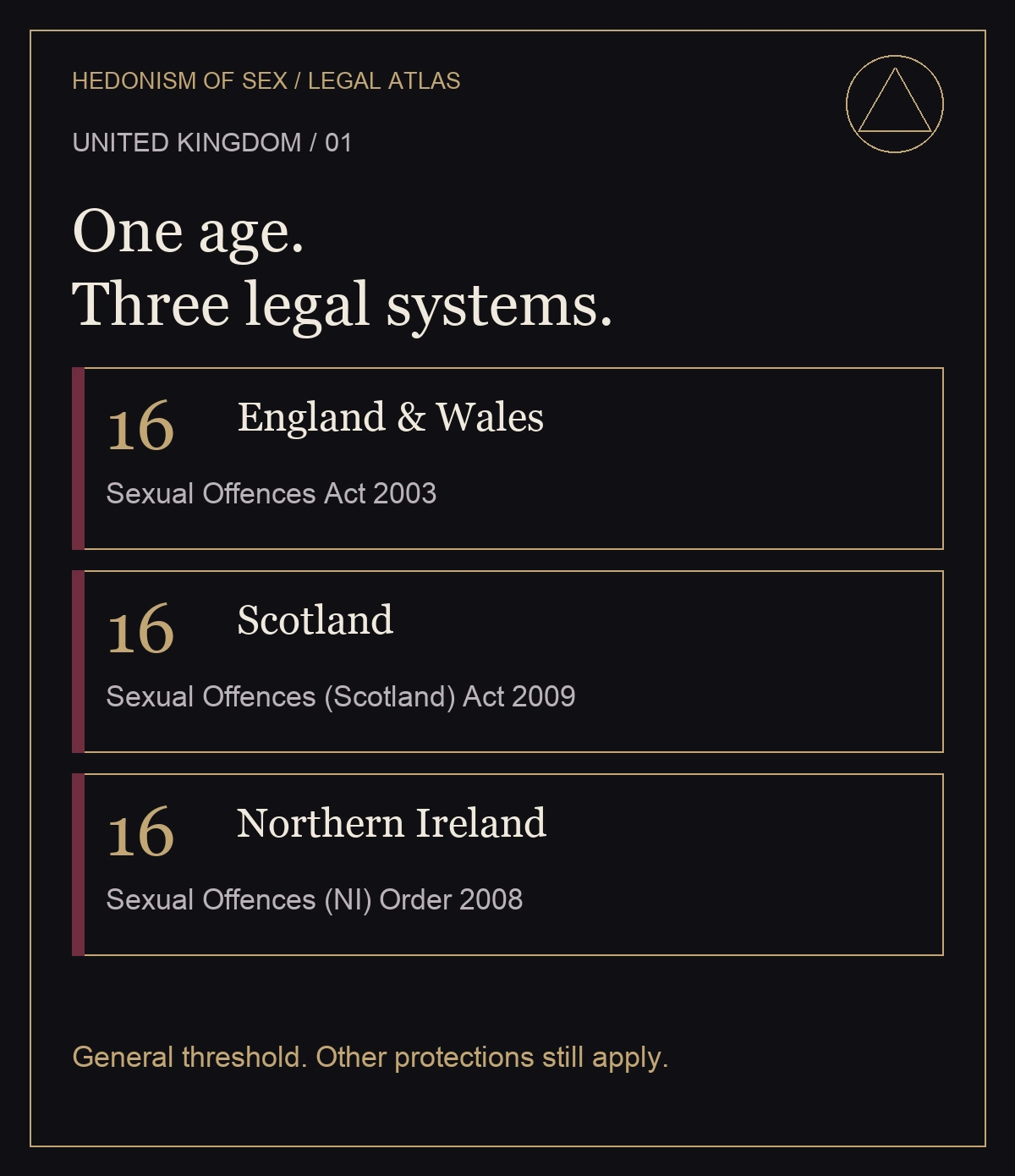
The general age of sexual consent is 16 throughout the UK. That number does not override protections for under-18s, make every relationship lawful, or replace freely given consent. England and Wales, Scotland and Northern Ireland have different governing legislation. The provisions and official guidance are linked below.
This guide explains how to read that headline age without overlooking the rules that change the answer. It covers the three UK legal jurisdictions; it does not cover the Republic of Ireland, Crown Dependencies or Overseas Territories. It concerns present-day law, not the law governing historical allegations.
The age in each UK jurisdiction
| Jurisdiction | Main legislation | Starting point |
|---|---|---|
| England and Wales | Sexual Offences Act 2003 | Section 9, with section 13 for defendants under 18 |
| Scotland | Sexual Offences (Scotland) Act 2009 | Section 28 and section 30; see the separate peer rules below |
| Northern Ireland | Sexual Offences (Northern Ireland) Order 2008 | Article 16, with article 20 for defendants under 18 |
In England and Wales, section 9 addresses sexual touching by an adult of a person under 16, subject to its specified age-belief rules; under 13, that provision has no reasonable-belief-in-age route. Northern Ireland’s article 16 has the corresponding structure. Neither should be read as making all activity lawful merely because both people say they agree. Scotland’s prosecution service also confirms the general age of 16.
Children under 13 have separate protections
Each system has a specific offence of rape of a child under 13: England and Wales, section 5; Scotland, section 18; and Northern Ireland, article 12. These provisions do not make the child’s agreement a condition that excuses the conduct. Other child-protection offences also apply; the peer-case discussion below must not be read as a general permission involving a child under 13.
Younger teenagers: an exception is not the same as a decision not to prosecute
England and Wales
Section 13 extends specified child-sex offences to defendants under 18. It does not create a general exemption for couples within a fixed number of years of one another.
The Crown Prosecution Service guidance, chapter 9, says prosecution is unlikely to be appropriate for actually agreed activity between under-16 children fairly close in age and development, without aggravating features such as coercion, grooming, exploitation or abuse of trust. That is guidance about a public-interest decision in a case. It is not a promise of immunity or a rule that lowers the age of consent.
Northern Ireland
Article 20 likewise applies specified offences to defendants under 18. The Public Prosecution Service policy, paragraph 2.22, explains that prosecution may not be required for children of the same or similar age and understanding when activity is agreed and has no aggravating features. Again, discretion about prosecution is different from a statutory age-gap defence.
Scotland: a limited statutory defence
Scotland does have a specific age-gap defence in section 39(3)–(4): the difference in age must not exceed two years. But it applies only to the offences listed there. The provision expressly excludes specified penetrative and oral conduct from parts of its coverage. It is not a general permission for sexual intercourse involving someone under 16.
Section 37 separately criminalises specified sexual conduct between children aged 13–15, including circumstances in which both participate by agreement. Reading only the two-year number misses that distinction.
Hypothetical example: two Scottish teenagers being less than two years apart does not by itself establish that every form of sexual activity between them is lawful. The precise conduct and applicable offence still matter. Likewise, an English couple cannot turn the CPS’s public-interest guidance into an automatic two-year exemption.

Positions of trust: protection can continue until 18
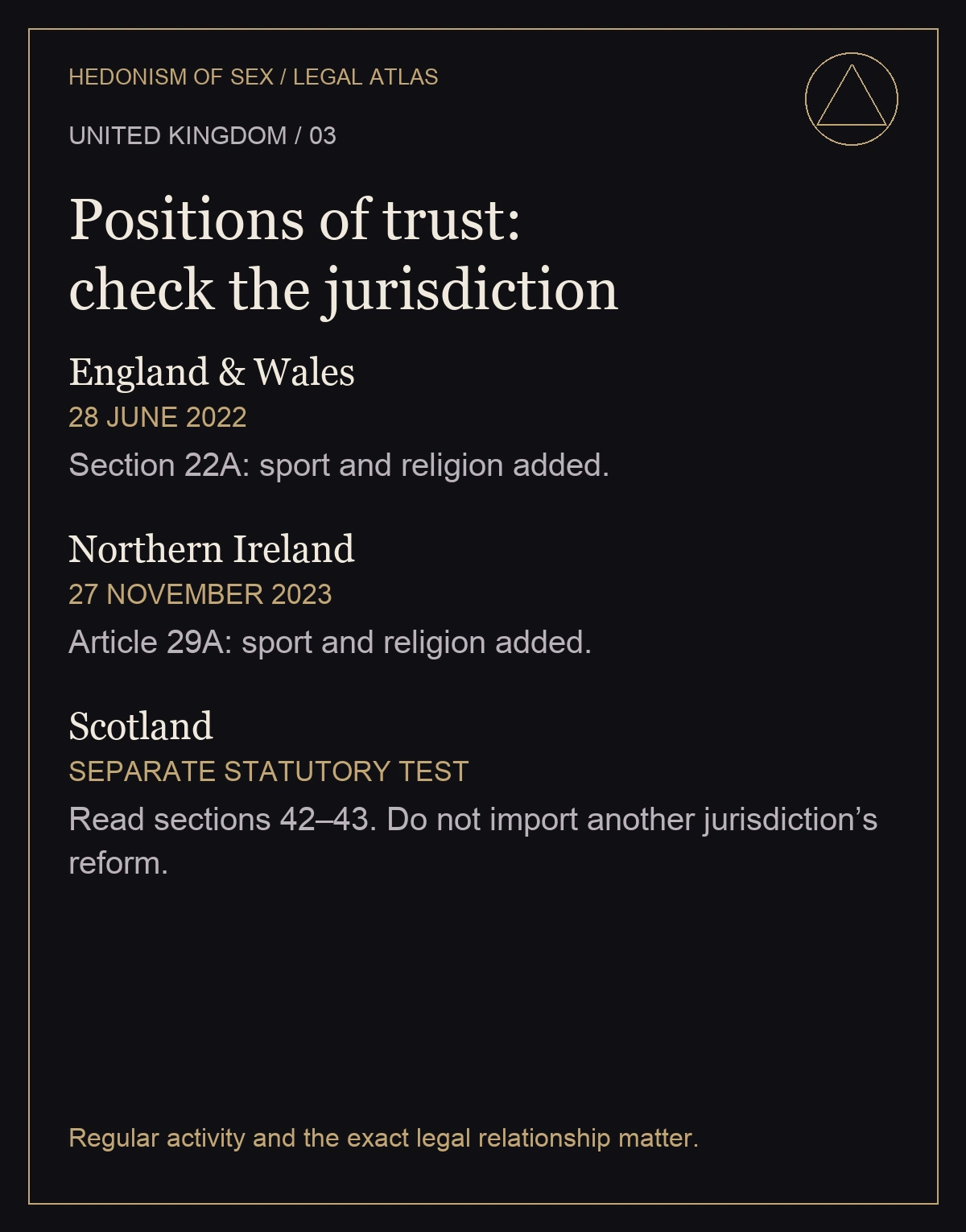
A 16- or 17-year-old being above the general age does not remove special protections against adults in legally defined positions of trust. The relevant offences and definitions are sections 16–19 and 21–22A in England and Wales; section 42 and section 43 in Scotland; and articles 23–26 and 28–29A in Northern Ireland. These regimes concern adults aged 18 or over and children under 18, with detailed statutory conditions and defences.
For example, the definitions cover specified education, care and institutional relationships. A title such as “mentor” or “coach” is not enough to decide a case without examining the legal definition and the actual relationship.
Sport and religion: two different commencement dates
In England and Wales, section 22A added regular coaching, teaching, training, supervision or instruction in sport or religion, with a knowledge requirement. The amendment annotation dates its insertion to 28 June 2022.
Northern Ireland’s corresponding article 29A was inserted on 27 November 2023. Its enabling Act was passed in 2022; that does not make 2022 the commencement date.
Scotland must be checked under its own section 43 conditions, including specified care, education and household relationships. Do not assume that the England-and-Wales reform or its date applies in Scotland.
Being old enough does not establish actual consent
In England and Wales, section 74 defines consent through agreement by choice, with freedom and capacity to choose. Northern Ireland uses the same formulation in article 3. Scotland’s section 12 uses “free agreement”.
Scotland’s section 13 lists circumstances without free agreement, including incapacity caused by alcohol or another substance, violence or threats of violence, and specified deception. The COPFS explanation also makes clear that a sleeping or unconscious person cannot consent. A relationship, previous sexual contact or reaching a birthday cannot substitute for the person’s present agreement.
Sexual images follow separate under-18 rules
The general age of 16 is not a general permission to create or share sexual photographs of 16- or 17-year-olds. The legislation on indecent photographs and pseudo-photographs uses an under-18 definition of a child: Protection of Children Act 1978, section 7 for England and Wales; Civic Government (Scotland) Act 1982, section 52; and Protection of Children (Northern Ireland) Order 1978, article 2.
Taking, making, showing and distributing such images are addressed by section 1 in England and Wales, the Scottish provision above and Northern Ireland’s article 3. Detailed exceptions, defences and prosecution policies require separate analysis. Agreement to sexual activity does not answer the image question, and agreement to one image does not provide blanket permission to distribute it.
Marriage eligibility is another separate question. For example, the official England-and-Wales marriage guidance requires age 18, despite the general sexual-consent age of 16. Do not use an age-of-consent table to decide marriage, commercial sexual exploitation or image-related questions.
What to check in a real situation
- Identify the jurisdiction and date. Use the law for the place and time of the conduct, rather than a UK-wide headline.
- Establish both exact ages. In a provision using an age gap, whole-year labels alone may conceal the actual difference.
- Check the relationship and conduct. Trust, care, family circumstances, coercion and the particular offence can change the analysis.
- Keep the legal questions separate. Age eligibility, actual consent, photographs and any prosecution policy need their own checks.
- For an actual case, obtain advice in that jurisdiction. A solicitor can assess the evidence, applicable defences and law at the relevant date.
Does parental permission lower the age of consent?
The cited age-based offence provisions do not create a general exception for parental permission. A parent cannot replace the individual’s actual consent or erase the applicable child-protection offences.
Is there one UK “Romeo and Juliet law”?
No single UK-wide fixed-gap exemption can be inferred from these laws. England and Wales and Northern Ireland have prosecution guidance on peer cases. Scotland’s section 39 age-gap defence is statutory but limited to specified offences. Those are materially different rules.
Can I apply the Canadian exceptions here?
No. Canada’s age bands and strict “less than” gaps belong to Canadian federal law. The UK provisions must be read independently. See our Canada guide for that jurisdiction.
Sources, verification and corrections
The links beside each legal statement lead to the relevant official provision or prosecution guidance. The principal source groups are:
- Sexual Offences Act 2003 — England and Wales: age-based offences, trust definitions and consent.
- Sexual Offences (Scotland) Act 2009 — separate Scottish offences, peer rules, defences and consent.
- Sexual Offences (Northern Ireland) Order 2008 — Northern Ireland’s age and trust framework.
- CPS prosecution guidance — updated June 2026; chapter 9, peer cases in England and Wales.
- PPS policy, November 2023 — paragraph 2.22, children and the public interest in Northern Ireland.
- COPFS: Sexual offences — updated 5 October 2026, Scottish public guidance.