Age of Consent in Russia: 16, Peer Sentencing Rules and Separate Image Laws
The ordinary threshold is 16. The adult-offender elements, a narrow restriction on imprisonment, and a separate marriage-related clause need to be understood on their own terms.
Russia’s ordinary age-of-consent threshold is 16. Articles 134 and 135 establish distinct age-based offences, with an offender who has reached 18. The Supreme Court explains that these provisions concern the specified conduct without violence, threats of violence or exploitation of helplessness. A person below 18 is not generally immune from sexual-offence law, and the frequently mentioned four-year provision is a rule about punishment rather than a general permission for peer relationships. Plenum Resolution 16/2014, paragraphs 16, 20 and 23; Article 134, consolidated text reproduced by ConsultantPlus.
This guide separates four questions: the age of the protected person, the age required of an offender, whether an offence is established, and what punishment a court may impose. It also explains why sexual images and online communication require a different assessment. The English text is an editorial explanation of Russian-language sources, not an official English translation.
The protected person’s age and the offender’s age
Article 134(1) addresses intercourse with a person below 16 by someone aged at least 18. Part 2 separately addresses the specified same-sex acts, also with a person below 16 and an offender aged at least 18. Article 135 concerns indecent acts without violence by an offender aged at least 18 against a person below 16. The distinction between these provisions matters when reading their penalties and cross-references; a shared age threshold does not mean every other rule is identical. Article 134; Article 135.
The Supreme Court confirms the adult-offender element for Articles 134 and 135 in paragraph 16. It does not convert that element into a universal exemption for everyone below 18. Article 20 establishes general criminal responsibility at 16 and lists rape and sexual violence under Articles 131 and 132 among offences for which responsibility begins at 14. Plenum paragraphs 16 and 20; Code Article 20.
| Age or circumstance | What to examine |
|---|---|
| Below 16 | The specified age-based offences in Articles 134 and 135; both have an adult-offender element. |
| Ages 12–13 | The aggravated provisions in Article 134(3) and Article 135(2), alongside the separate violence and helplessness rules. |
| Below 12 | The note to Article 131 places specified conduct within the rape or sexual-violence framework because the child is deemed helpless. |
| Below 18 | Separate protections involving coercion, exploitation and sexual material; the ordinary contact threshold does not settle those questions. |
Table sources: Code Articles 131, 133–135, 240.1 and 242.1–242.2. The below-12 rule is not a suggestion that every person aged 12 or older can freely agree. Helplessness may arise from the actual circumstances at other ages as well. The Supreme Court also distinguishes the adult-offender requirement for Articles 134–135 from responsibility for conduct brought within the Article 131 note. Article 131 note; Plenum paragraphs 5 and 20–21.

Less than four years: a restriction on imprisonment
Article 134 note 2 says that where the age difference is less than four years, imprisonment is not imposed for an offence under Article 134(1) or Article 135(1). The wording is strictly less than four years, not four years or less. It identifies the particular parts to which the restriction applies. Article 134 note 2; Plenum paragraph 23.
This provision does not say there is no offence, that criminal responsibility disappears, or that every punishment is excluded. Other sanctions listed for the applicable offence remain a separate question. It should therefore not be described as a general four-year close-in-age defence.
Hypothetical example: if the proven age difference is less than four years and the offence is Article 134(1), note 2 is relevant to imprisonment. That does not allow a website to declare the conduct lawful. If the legal classification is an aggravated part of Article 134 or Article 135, the note’s reference to the particular part 1 offences must be respected.
The separate same-sex provision has a different cross-reference
Article 134(2) is not one of the parts named in note 2. The court and statutory references must be read as written; the shared below-16 threshold cannot be used to extend this sentencing restriction automatically to the separate part 2 offence. The same caution applies to the marriage-related note, which also expressly identifies part 1. This is a concrete legal distinction, not an assessment of a person’s identity or relationship.

Marriage: release from punishment under limited conditions
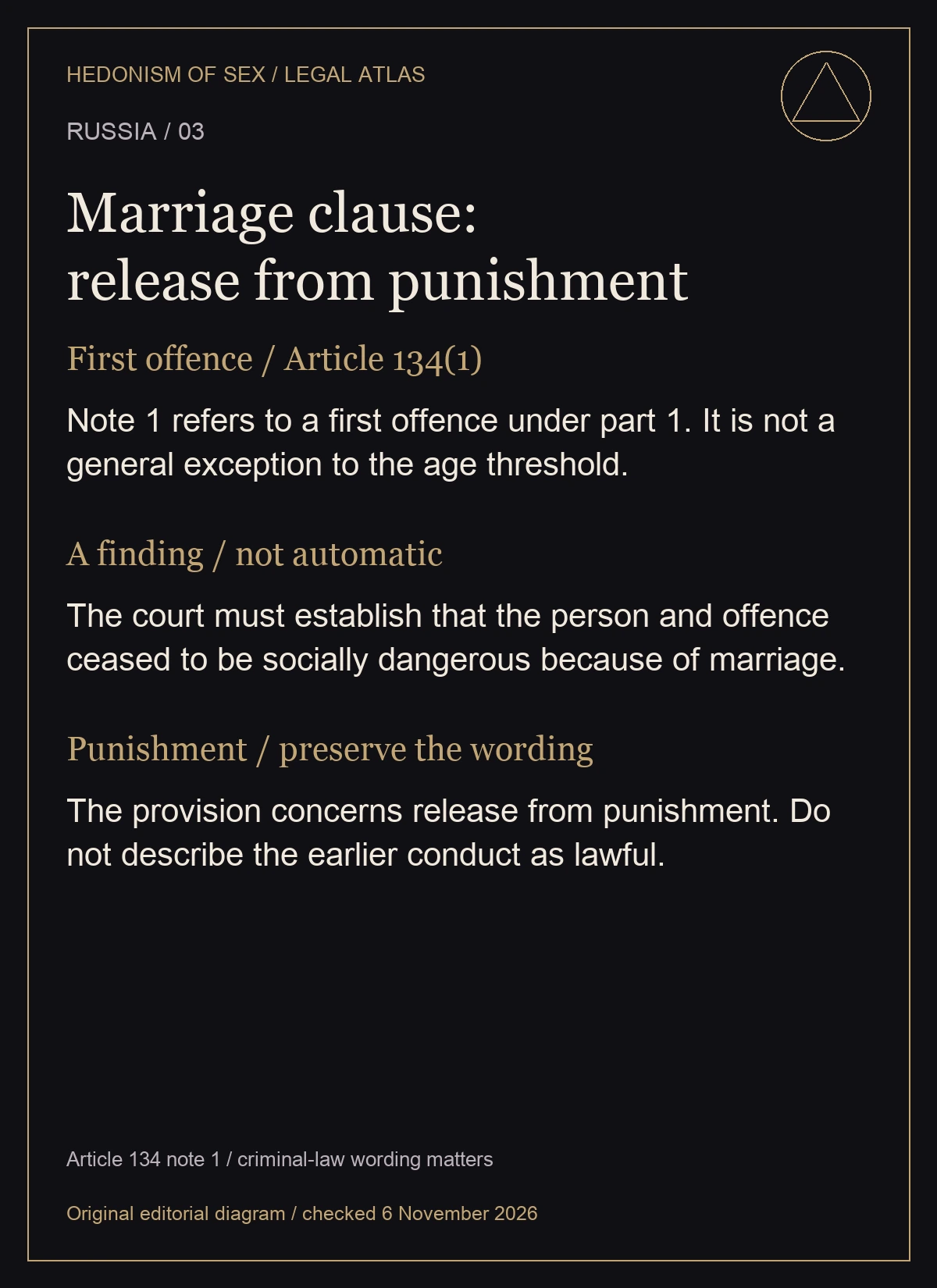
Article 134 note 1 concerns a person who has committed an offence under part 1 for the first time. It provides for release by the court from punishment if it is established that the person and the offence ceased to be socially dangerous because of marriage to the victim. Both the first-offence condition and the part 1 cross-reference matter. Article 134 note 1.
The provision uses release from punishment. It should not be rewritten as a statement that the conduct never constituted an offence, or as a general release from criminal responsibility. Nor does a future intention to marry establish that the statutory conditions have been fulfilled. The clause does not give permission to commit an offence and should not be offered as advice to marry in response to an allegation.
The Family Code sets the ordinary marriage age at 18. Article 13 allows local authorities, at the request of the people concerned and for valid reasons, to permit marriage for people who have reached 16. It also allows laws of the constituent regions to establish exceptional conditions and procedures for marriage below 16. There is consequently no single nationwide answer to eligibility for marriage below 16. The applicable regional law and permission must be checked separately; the criminal punishment clause does not itself grant permission to marry. Family Code Article 13.
The age threshold does not replace freedom from violence and coercion
The Supreme Court describes the rape and sexual-violence framework in terms of conduct against the person’s will and agreement, using violence or threats of violence, or exploiting helplessness. Its explanation of helplessness includes an inability to understand the nature and significance of the acts or to resist because of physical or mental condition, age or other circumstances. Plenum paragraphs 1 and 5.
Intoxication is assessed by its actual effect. Paragraph 6 discusses a degree of intoxication that deprived the person of the ability to understand or resist; it says that it does not matter whether the accused caused the state or it arose independently. It would be inaccurate either to treat every consumption of alcohol as the same legal condition or to assume that voluntary drinking removes protection.
Article 133 separately addresses compelling sexual conduct through blackmail, specified property threats, or exploitation of financial or other dependency. It includes additional provisions for conduct involving a minor and specified aggravated circumstances. The court explains that the coercion offence is completed when the relevant demand is expressed, whether the person agrees, refuses or the sexual act actually occurs. Article 133; Plenum paragraph 15.
The court also distinguishes the specified coercive methods from obtaining agreement through deception or abuse of trust, giving a false promise of marriage as an example. This distinction in offence classification should not be turned into a statement that deception is healthy, harmless or adequate evidence of genuine freedom of choice.
Payment or promised rewards: protection at 16 and 17
Article 240.1 separately prohibits an adult aged at least 18 from receiving sexual services from a person aged 16 or 17. Its note describes the specified sexual acts when money or another reward to the minor or a third person, or a promise of such a reward, is a condition of the acts. The ordinary contact threshold must not be treated as permission for paid sexual activity involving a minor. Article 240.1.
No physical meeting is needed for every relevant offence
Paragraph 17 of the Plenum resolution explains indecent acts under Article 135 by reference to their sexual purpose and effect. It expressly includes conduct without direct physical contact, including conduct through the internet and other information and telecommunications networks. The relevant purpose, age and intent still need to be established; the mere fact that a conversation discusses sexuality is not a complete criminal-law analysis. Plenum paragraph 17.
Sexual images have a separate under-18 framework
Article 242.1 distinguishes making, acquiring, storing or moving specified material across the state border for distribution, public display or advertising, and the acts of distribution, public display or advertising themselves. The purpose wording matters. It is not accurate to replace that wording with a blanket assertion that every act of private possession is the same offence. Network use is separately listed in part 2. Article 242.1.
Article 242.2 addresses an adult’s photographing or filming of a minor for the stated production and/or distribution purposes, or recruiting a minor as a performer in a pornographic event. Its subject and conduct elements differ from the ordinary contact-age offences. A person’s having reached 16 does not settle the legality of making or circulating sexual material depicting them. Article 242.2.
The definition and exceptions in Article 242.1’s notes must also be read. They address specified sexual depictions or descriptions, including an adult portraying a minor, and exclude certain depictions or descriptions with historical, artistic or cultural value or the specified scientific, medical or lawful educational purposes. A nude image should not automatically be assigned a criminal category without that analysis. Neither article contains an express general peer or self-created-image exception comparable to some other countries’ provisions.
National criminal rules and regional marriage rules
Criminal legislation is a federal matter under Constitution Article 71(o). The contact-age offences discussed here are national rules; the constituent republics, regions and federal cities do not each set their own Article 134 or Article 135 threshold. Family legislation is a shared field under Article 72, and the specific regional permission in Family Code Article 13 explains why marriage eligibility can vary without changing the national sexual-offence threshold. Constitution Articles 71–72; Family Code Article 13.
Occupied Ukrainian territory requires a separate jurisdictional analysis
This guide describes Russian legislation. It does not treat occupied Ukrainian territory as an ordinary Russian regional variation or decide which law can lawfully be applied there. The UN has stated that the attempted annexations of Crimea and Sevastopol and of the Donetsk, Kherson, Luhansk and Zaporizhzhia regions do not alter their status under international law. It also recalls the occupying power’s obligation to respect the laws of Ukraine in the occupied areas unless absolutely prevented. A real case in an occupied area requires analysis of the location and date, Ukrainian law, occupation practice and the applicable international rules. UN Department of Political and Peacebuilding Affairs statement on occupied Ukrainian territory.
For cross-border situations, a country-level age number cannot resolve every jurisdictional issue. Obtain advice on all jurisdictions connected with the actual conduct. For separate national frameworks, read the guides for Belarus, Finland and Estonia, or return to the Law & Rights country index.
Practical questions
Is a gap of exactly four years covered by the sentencing rule?
No. Note 2 says less than four years. It also identifies only Article 134(1) and Article 135(1), and limits imprisonment rather than removing the offence. Exact ages and the applicable legal classification require careful assessment. Article 134 note 2.
Does a parent’s approval create an exception?
Articles 134 and 135 do not contain a general parental-approval exception. Parental permission cannot replace the legal elements or remove the separate protections against violence, helplessness, coercion or sexual exploitation. Code Articles 131–135 and 240.1.
Does turning 16 settle the legality of sexual images?
No. Articles 242.1 and 242.2 use a separate minor-protection framework with their own acts, purposes and definitions. The civil-law age of majority is 18. Do not infer image permissions from the ordinary contact threshold. Article 242.1; Article 242.2; Civil Code Article 21.
What information is useful for individual legal advice?
Record both ages and dates, the specific conduct, whether threats, dependency or helplessness were involved, whether material was made or shared, and where the acts occurred. A qualified lawyer must assess those facts. Where someone is in immediate danger, first seek a safe place and local emergency help. Do not send sexual images of a minor to this website or circulate them publicly in search of advice.
Sources and verification record
Checked 6 November 2026. The Criminal Code sections were checked in the 4 August 2026 consolidated edition reproduced by ConsultantPlus and independently compared with Klerk’s legal system, which identifies that edition as in force from 15 August 2026. That consolidated-edition date does not mean the age threshold changed then. The official legacy consolidated-code service did not respond during verification; the reproductions are identified here as nonofficial publishers rather than presented as an official English or official consolidated text.
The Supreme Court originals were obtained directly from its updated official catalogue. The 21 May 2026 act amends specified paragraphs of the 4 December 2014 resolution, including guidance on attempted offences, aggravating circumstances, prior convictions and multiple victims. It does not introduce a new age-of-consent threshold. The current consolidated court reproduction lists that May act as its amendment; it was checked against the official original.
- Supreme Court Plenum Resolution 16 of 4 December 2014 — official original, especially paragraphs 1, 5–6, 15–18 and 20–23, read with the later amendment.
- Supreme Court Plenum Resolution 16 of 21 May 2026 — official original, item 3, pages 9–10.
- Criminal Code, consolidated statutory reproduction by ConsultantPlus — Articles 20, 131–135, 240.1 and 242.1–242.2; compared with the independent consolidated reproduction in Klerk’s legal system.
- Family Code Article 13 and Civil Code Article 21 — consolidated statutory reproductions.
- Constitution published by the Ministry of Justice — Articles 71–72 for allocation of legislative powers.
- UN DPPA statement on occupied Ukrainian territory — territorial-status and occupation-law context, rather than a source for Russia’s sexual-offence elements.
For an individual concern, take the precise facts to a qualified adviser. A general threshold, a sentencing restriction or a marriage provision cannot by itself establish the outcome of a particular case.