Age of Consent in Belarus: 16, Adult-Offender Rules and Online Protection
Sixteen is the ordinary sexual-contact threshold. Understanding it requires a second age, the precise offence, and separate rules for coercion, children and sexual images.
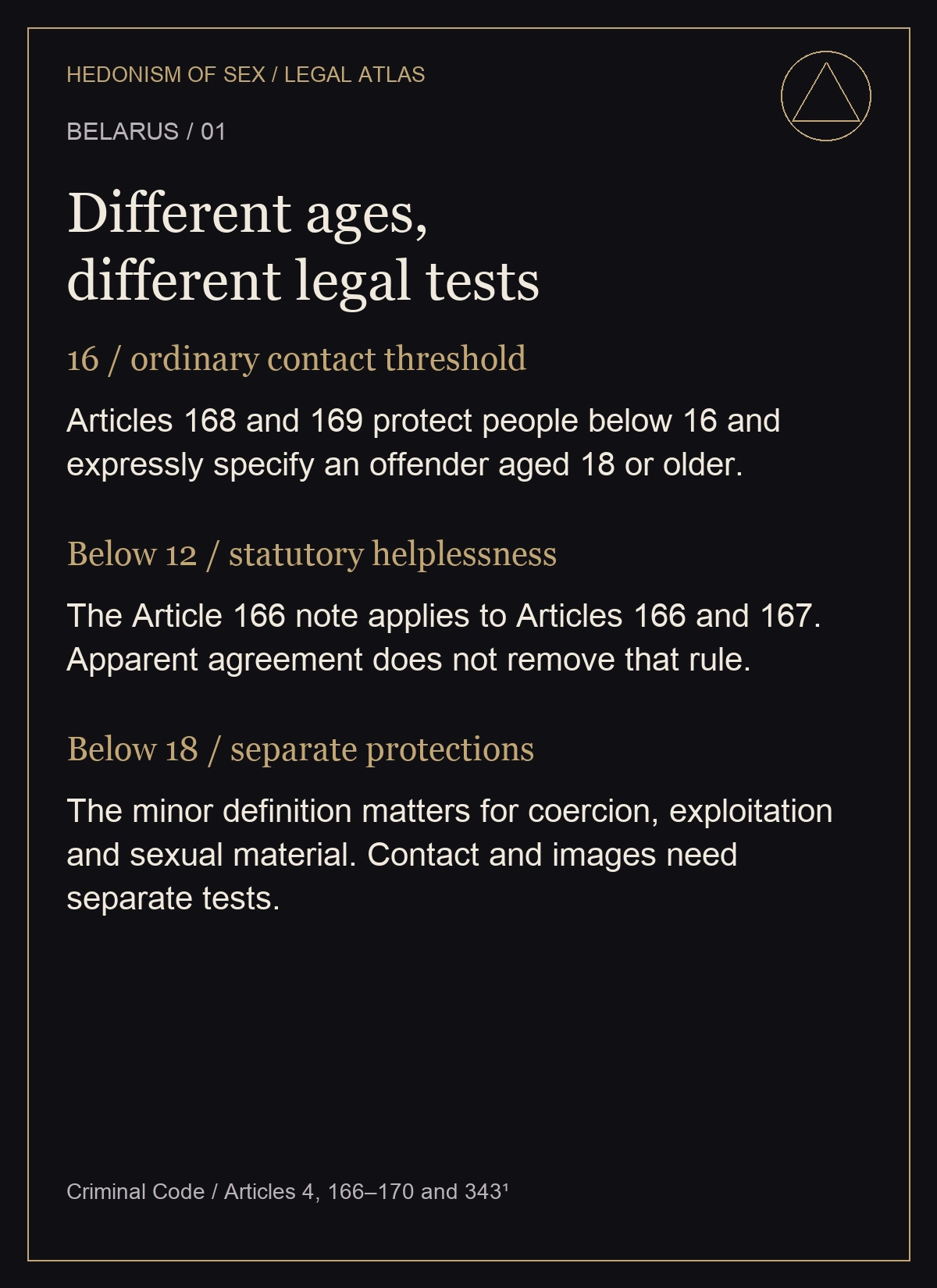
The ordinary age-of-consent threshold in Belarus is 16. Criminal Code Article 168 addresses specified sexual conduct by someone aged 18 or older with a person known to be below 16, where the rape or sexual-violence offences do not apply. Article 169 separately addresses indecent acts and also expressly requires an offender aged at least 18. Neither provision contains a fixed two-year or three-year close-in-age defence. These age elements do not remove the separate offences involving violence, helplessness or coercion. Criminal Code Articles 166–170; Supreme Court Plenum Resolution 7, paragraph 2.
This guide explains the national rules, the difference between the age of the protected person and the age of criminal responsibility, the limited marriage-related release provision, and why online conduct needs its own assessment. It uses the official Russian-language legislation and court guidance; English explanations are editorial translations, not an official English version.
The ages and offences at a glance
Belarus does not put every sexual offence into a single consent provision. Article 168 covers intercourse and other sexual acts specified in its wording; Article 169 covers indecent acts outside Articles 166–168. The Supreme Court explains that Article 168 concerns voluntary conduct without violence, threats of violence or exploitation of helplessness. Apparent agreement from someone below the protected age does not therefore settle the legal question. Code Articles 168–169; Plenum paragraphs 14 and 17.
| Age or circumstance | Legal significance |
|---|---|
| Below 16 | The protected-person threshold in Articles 168 and 169; both expressly specify an offender aged 18 or older. |
| Below 12 | The note to Article 166 deems the child helpless for Articles 166 and 167. Apparent consent cannot be treated as voluntary for these purposes. |
| Below 14 | The Code’s definition of a young child (малолетний), relevant to aggravated offences. This is distinct from the below-12 helplessness rule. |
| Below 18 | The Code’s definition of a minor. Protections involving coercion, exploitation and sexual material continue beyond the ordinary contact threshold. |
Sources for the table: Code Article 4(7)–(8), Article 166 note, Articles 168–170 and 343¹; Plenum paragraphs 6 and 14. A person aged 12 or 13 is not automatically capable of consenting: helplessness may still follow from the actual circumstances, and the other age-based protections remain relevant.
An adult-offender element is different from a close-in-age defence
Both Articles 168 and 169 expressly identify a person who has reached 18 as the offender. The Plenum confirms this in paragraph 2. This is part of the definition of those offences; it is not a defence calculated by subtracting one birthday from another. The retrieved current provisions do not specify a permitted gap of two, three or four years. Code Articles 168–169; Plenum paragraph 2.
Hypothetical example: a person aged 18 and someone aged 15 may be close in age, but closeness alone does not disapply Article 168. Conversely, a person aged 17 does not meet that article’s express adult-offender element. That second observation cannot establish that all conduct involving a 17-year-old is lawful: the rape, sexual-violence, coercion and image provisions require separate examination.
The responsibility rules make that distinction concrete. Article 27 establishes general criminal responsibility at 16 and lists rape and sexual violence under Articles 166 and 167 among offences for which responsibility can begin at 14. The Plenum states that the offender age for coercion under Article 170 is 16. A person below 18 is therefore not generally exempt from sexual-offence law. Code Article 27; Plenum paragraph 2.
Knowledge of age is an element, not a paperwork shortcut
Articles 168 and 169 use wording requiring knowledge that the other person is below 16. The Plenum tells courts to examine whether the accused knew the relevant age, taking account of appearance, behaviour, information available to the accused and other circumstances showing awareness. An online profile, claimed age or informal assurance should not be presented as a guaranteed legal defence. The factual and evidential question is assessed in the case. Plenum paragraph 2.
Reaching 16 does not remove protection against violence or coercion
Articles 166 and 167 address conduct against the victim’s will using violence or threats, or exploiting helplessness. Their legal classification differs: the Plenum describes Article 166 in relation to intercourse by a man with a woman, while Article 167 covers other specified sexual violence by a man or woman against a person of any sex. Article 168 itself includes same-sex acts as well as other specified sexual conduct, using the same below-16 protected-person threshold. Code Articles 166–168; Plenum paragraph 3.
Helplessness can arise when someone cannot understand the nature and significance of what is happening or cannot resist because of their physical or mental condition or other circumstances. The court guidance expressly discusses unconsciousness and a disabling state caused by alcohol, medicines or other substances. Drinking voluntarily does not exclude that protection. For a child below 12, the Code itself establishes helplessness for Articles 166 and 167; the Plenum says apparent agreement in that statutory situation cannot be voluntary. Article 166 note; Plenum paragraphs 6 and 14.
Marriage is not an exemption from sexual-violence law. The Plenum explicitly states that being married to the accused, earlier conduct or other personal-history information does not prevent recognition as a victim. A previous relationship does not give continuing permission. Plenum paragraph 3.
Dependency and threats do not have to involve physical force
Article 170 addresses compelling sexual conduct through blackmail, threats to destroy, damage or take property, or exploitation of employment, financial or other dependency. Its second paragraph concerns a person known to be a minor. The Plenum explains that the offence is completed when the coercive demand is made, whether the person agrees, refuses or the sexual conduct actually takes place. It also distinguishes such coercion from a mere proposal or promise of improved circumstances; classification depends on the actual conduct, not simply the existence of an unequal relationship. Code Article 170; Plenum paragraph 21.
The marriage-related clause is a limited release provision
The note to Article 168 provides for release from criminal responsibility for conduct under part 1 if it is established that the person and the offence ceased to be socially dangerous because of marriage to the victim. That is the statutory formulation. It does not say that intending to marry makes the earlier conduct lawful, and its express reference to part 1 must not be expanded to the aggravated offence or to other sexual offences. Article 168 note.
The Supreme Court adds an important practical restriction: the relevant marriage is one registered by the civil-status authorities. An intention to marry, an application for registration or living in a shared household does not itself establish the required loss of social danger. Registered marriage also does not erase the separate assessment required by the statutory test. Plenum paragraph 16.
Marriage eligibility is a different question. The Marriage and Family Code sets the ordinary marriage age at 18. Article 18 allows the registration authority to reduce it by no more than three years in specified exceptional circumstances involving pregnancy, a shared child or a minor’s acquisition of full legal capacity. The application is made by the people seeking marriage; the provision says parental or guardian consent is not required for that reduction. These rules are not an alternative age-of-consent formula and do not authorise coercion. Marriage and Family Code Articles 17–18.

Online conduct and sexual images require their own assessment
Physical contact is not a prerequisite for every relevant offence. The Plenum’s explanation of indecent acts under Article 169 includes correspondence or conversations of a corrupting sexual character, exposure to pornographic material, and specified conduct through the internet or another telecommunications network. It describes the purpose and awareness required; ordinary health education should not be labelled criminal merely because it discusses sexuality. Plenum paragraph 17.
The new text adopted on 30 October 2025 also explains overlapping charges. Paragraph 20 addresses indecent acts accompanied by distribution, advertising, transmission or display of pornographic material to the victim, including online, and directs courts to assess Article 169 together with Article 343(2). It separately addresses production of material depicting the victim for distribution, or inducing the victim to produce and/or distribute sexual material depicting themselves, with reference to Articles 169 and 343¹. A request for self-produced material is therefore not made harmless simply because the adult did not operate the camera. Original Plenum Resolution 9/2025, replacement paragraph 20.
Sixteen is not the image threshold
Article 343¹ concerns pornographic material depicting a person known to be a minor; the Code defines a minor as someone below 18. Its provisions distinguish production, storage for distribution or advertising, distribution, advertising, transmission and public display. Using a minor in production is separately specified, and use of the internet or another listed network is an aggravating circumstance in part 2. The purpose and conduct elements matter: this guide does not recast all private possession as the same offence, nor assume that every nude image necessarily meets the statutory material category. Code Article 4(8) and Article 343¹.
The current Article 343¹ does not contain an express self-created-image or close-in-age exemption of the kind found in some other countries. Do not import such an exemption from a neighbouring country’s law. Equally, do not assume that a 16- or 17-year-old’s apparent agreement to sexual contact establishes permission to make or circulate sexual material depicting them. Individual classification requires the relevant conduct, purpose, knowledge and material to be assessed.
Hypothetical example: an adult who induces a 15-year-old to create and send sexual material cannot answer the legal issue by saying there was no meeting. Paragraphs 17 and 20 require consideration of the online conduct and potentially overlapping offences. Avoid forwarding questionable material to friends or posting it publicly to seek advice; obtain legal or safeguarding help without creating further circulation.

National rules, including Minsk and every region
This is a national Criminal Code framework. The Code applies to offences committed within Belarus; Article 5 also explains when conduct is considered to occur there, including conduct begun, continued or completed on its territory. The age rules discussed here do not set a separate threshold for Minsk, Brest, Vitebsk, Gomel, Grodno or Mogilev. A particular location still matters for the competent authorities and the facts of a case. Code Articles 1 and 5.
For cross-border contact or online communication, nationality, residence and where conduct occurred may bring more than one jurisdiction into play. Article 6 contains rules for conduct outside Belarus, including conditions and exceptions; it is not enough to choose whichever country appears to have the lower threshold. This country guide does not resolve an individual international-jurisdiction dispute. For comparisons, read the independently researched guides for Poland, Lithuania and Latvia, then check every jurisdiction relevant to the actual situation.
Practical questions
Is there a three-year close-in-age exception?
Neither Article 168 nor Article 169 states such an age-gap defence. Both specify an offender aged at least 18. The three-year figure in the marriage legislation concerns the maximum exceptional reduction of marriage age; it is not a sexual-contact age-gap exemption. Articles 168–169; Marriage and Family Code Article 18.
Does parental approval change the ordinary threshold?
Articles 168 and 169 do not create an exception based on parental approval. A parent’s permission cannot substitute for the elements of the relevant law or the person’s own freedom from violence and coercion. The marriage-related clause has its own limited conditions. Code Articles 166–170.
Can online messages be relevant without a meeting?
Yes. The Plenum describes online indecent acts and explains how sexual-material offences can overlap. Whether a particular message meets the legal test depends on its content, intent, the ages and knowledge involved, and the circumstances. Plenum paragraphs 17 and 20.
Does this page decide whether a particular relationship is legal?
No. For a real concern, record the exact ages and dates, identify whether the issue involves contact, threats, dependency, online communication or images, and obtain confidential advice from a Belarus-qualified lawyer. Where someone is in immediate danger, prioritise reaching a safe place and contacting local emergency services. Do not send sexual images to this website for assessment.
Sources and verification record
Checked 6 November 2026. The official system identifies the Criminal Code’s current edition as effective 1 January 2026, the Marriage and Family Code’s as effective 17 January 2026, and the relevant Plenum resolution’s current edition as effective 30 October 2025. An edition date describes the consolidated document; it does not mean every provision discussed here changed on that date.
- Criminal Code of Belarus, 9 July 1999, No. 275-Z — official current text; Articles 1, 4–6, 27, 166–170 and 343–343¹.
- Supreme Court Plenum Resolution No. 7, 27 September 2012, current edition — particularly paragraphs 2–6, 14, 16–17, 20–21.
- Supreme Court Plenum Resolution No. 9, 30 October 2025 — original act replacing Resolution 7’s text; the complete replacement was checked, including the online and image guidance.
- Marriage and Family Code, 9 July 1999, No. 278-Z — official current text, Articles 17–18.
Continue with the Law & Rights country index. For an individual situation, the useful next step is a factual account for a qualified adviser, rather than relying on a country-level age number.