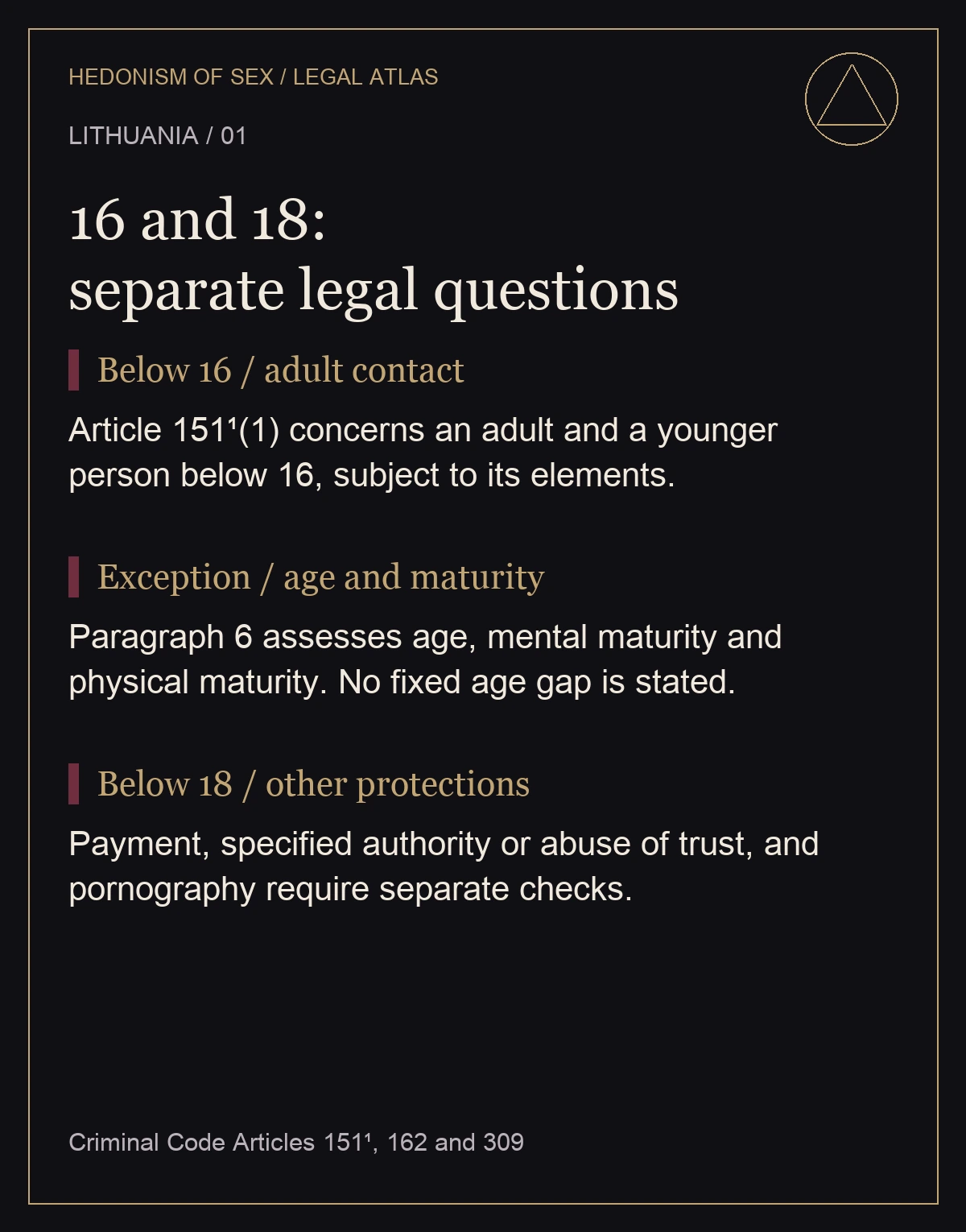
Lithuania’s ordinary age of sexual consent is 16. Criminal Code Article 151¹(1) addresses an adult’s intercourse or other sexual gratification with someone below 16, where the elements of rape, sexual assault or coercion into sexual intercourse are absent. Article 151¹(6) excludes the paragraph 1 conduct from being a crime when there is no significant difference in the participants’ age, mental and physical maturity. It gives no fixed numerical age gap. Criminal Code, Article 151¹(1) and (6).
Sixteen is the starting point, not the whole assessment
Article 151¹(1) uses an express adult-offender condition. It concerns intercourse or other sexual gratification with a person who has not reached 16, provided the specified more serious sexual offences are not present. It therefore differs from a provision that applies identically to every pair of teenagers. The exception in paragraph 6 is an additional question after identifying the relevant conduct and people. Article 151¹(1) and (6).
Reaching 16 does not end the separate protections for minors. Article 151¹(2) addresses sexual activity for payment or another reward involving a minor. Paragraph 3 addresses parents, guardians, other legal representatives, people with statutory authority over a minor and people abusing trust, authority or influence. Pornography offences use separate child protections. The child-rights law’s general definition of a child is a person below 18, subject to exceptions provided by Lithuanian law; it does not turn the ordinary sexual-contact threshold into a pornography permission. Articles 151¹(2)–(4), 162 and 309; Law on Fundamentals of Protection of the Rights of the Child, Article 2(12).
| Situation | Relevant rule |
|---|---|
| Adult and person below 16 | Article 151¹(1), subject to its elements and paragraph 6’s age-and-maturity exception. |
| Sexual activity involving payment and a minor | Article 151¹(2); paragraph 6 refers only to paragraph 1. |
| Minor and a listed representative, statutory authority figure or person abusing trust | Article 151¹(3); paragraph 4 adds the below-16 circumstance. |
| Sexual images or exploitation for pornography | Articles 162 and 309, assessed independently from the contact rule. |
The exception considers age and both forms of maturity
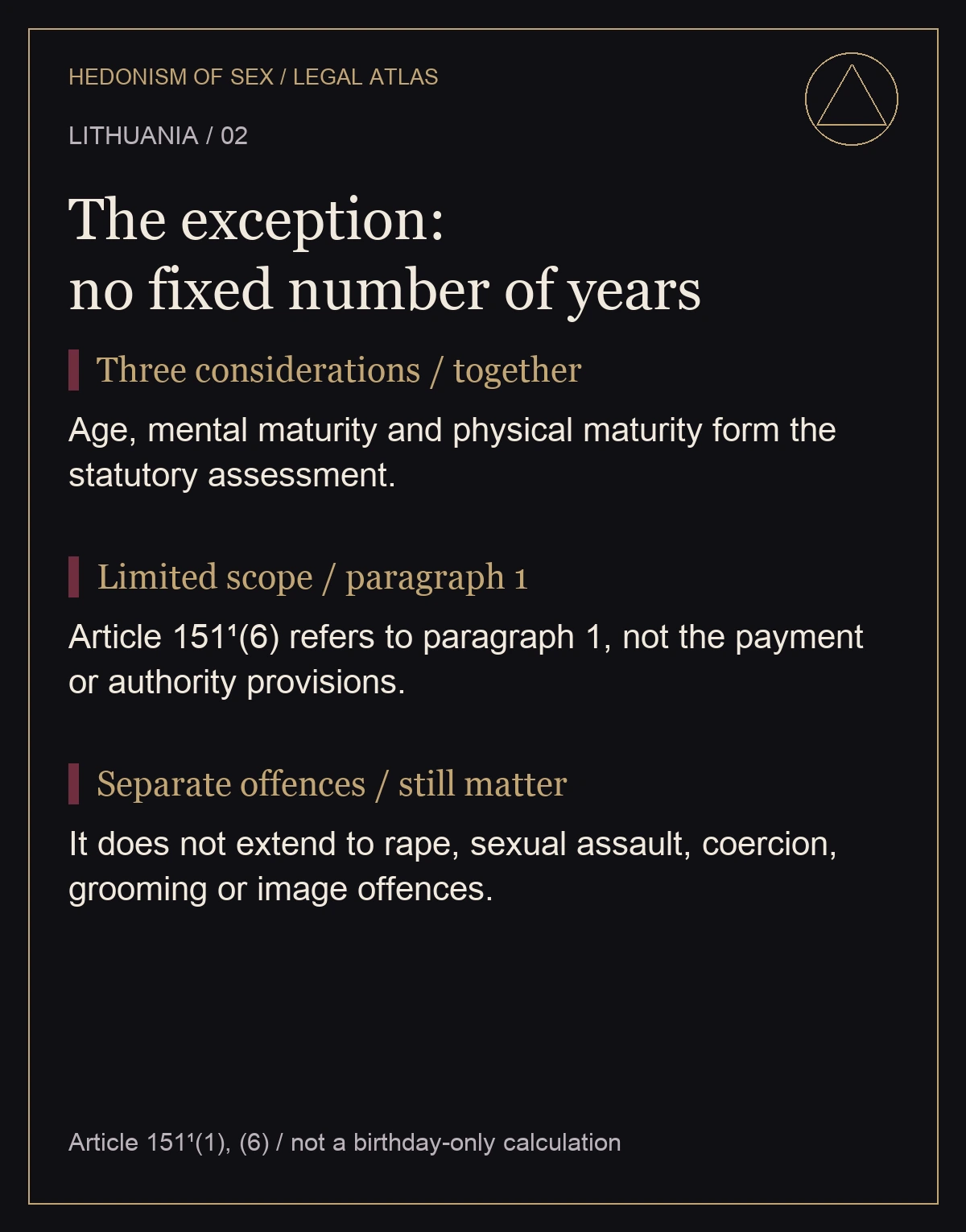
Article 151¹(6) says that the conduct referred to in paragraph 1 is not considered a crime if there is no significant difference in age, mental and physical maturity between the participants. Those are the statutory considerations. The text does not supply a two-, three- or five-year limit, or a calculator that converts birthdays alone into a definitive answer. Article 151¹(6).
Hypothetical example: an 18-year-old and a 15-year-old cannot conclude that their situation is automatically permitted because their stated ages differ by three. The adult and below-16 conditions make Article 151¹(1) relevant; whether paragraph 6 excludes the conduct requires the actual age difference and the maturity assessment, alongside the absence of other offences. This example illustrates the questions to examine, not a legal finding about a real couple.
The provision does not require both participants to be minors. It qualifies a paragraph that expressly concerns an adult. Conversely, it is not a general exemption for paid activity, abuse of authority, images, rape or sexual assault: its cross-reference is specifically to paragraph 1. There is also no express minimum age written into paragraph 6 itself. That absence must not be presented as permission concerning very young children; the separate sexual offences and capacity assessment remain essential. Articles 149–151 and 151¹(1)–(6).
Where both people are below 18, Article 151¹(1)’s adult condition is absent. That is a narrower statement than saying that all sexual conduct between minors is lawful. Under Article 13, ordinary criminal responsibility begins at 16, with responsibility from 14 for listed offences including rape and sexual assault. Other offence elements must still be considered. Articles 13, 149–150 and 151¹.
A position of trust or a reward changes the question
Article 151¹(3) does not simply restate the ordinary below-16 offence. It covers sexual activity with a minor by a parent, guardian, carer or other legal child representative, a person with statutory powers concerning that minor, or a person who has abused the minor’s trust or their authority or influence over the minor. Paragraph 4 separately addresses the paragraph 3 conduct where the person is below 16. Article 151¹(3)–(4).
The distinction matters for a 16- or 17-year-old as well. A professional title alone does not describe all the facts: the relevant statutory authority, representative status or abuse of trust, authority or influence has to be identified. But the ordinary age threshold is not an answer to conduct falling within this separate provision. Paragraph 6’s exception does not refer to paragraphs 3 or 4.
Article 151¹(2) concerns intercourse or other sexual gratification with a minor after offering, promising or providing money or another form of reward to that minor or another person, in the absence of the listed more serious offences. The reward need not be handed directly to the younger person. Neither a relationship label nor a small age gap makes paragraph 6 an exception to this payment provision. Article 151¹(2) and (6).
Force, dependency and incapacity remain separate grounds
Articles 149 and 150 address the sexual conduct they specify against a person’s will involving physical violence, a threat of its immediate use, otherwise removing the ability to resist, or taking advantage of the victim’s helpless state. Article 151 addresses compelling sexual activity through threats of violence, other psychological coercion or exploitation of dependency. These provisions must be considered before treating a situation as only an age-based Article 151¹(1) case. Articles 149–151 and 151¹(1).
Someone’s apparent willingness is therefore not the end of the legal assessment. Whether a person could understand and participate, whether resistance was prevented, and whether dependency was exploited are different factual questions. The guide does not assign a universal capacity outcome to everyone of one age or claim that intoxication always has the same legal effect. A specific case requires the relevant evidence and Lithuanian legal advice.
A proposed meeting and non-contact conduct need separate checks
Article 152¹ concerns an adult proposing a meeting to someone below 16 for intercourse, other sexual gratification or exploitation in pornographic production, followed by concrete steps to make the meeting happen. Those concrete steps are part of the wording. It should not be described as an offence requiring completed physical contact, nor as a rule saying that every conversation alone necessarily completes this particular offence. Article 152¹(1).
Article 153 separately criminalises acts of sexual corruption or molestation of a person below 16. Its text does not repeat Article 151¹(1)’s adult-offender wording, and it does not incorporate paragraph 6’s exception. The precise classification of conduct requires interpretation of the offence and the facts; it cannot be settled by changing the label from contact to messaging or by relying on the contact exception. Article 152 also addresses sexual harassment of a person dependent through employment or otherwise under its specified conditions. Articles 152–153.
The 2026 amendment explicitly covers urging a child to create material
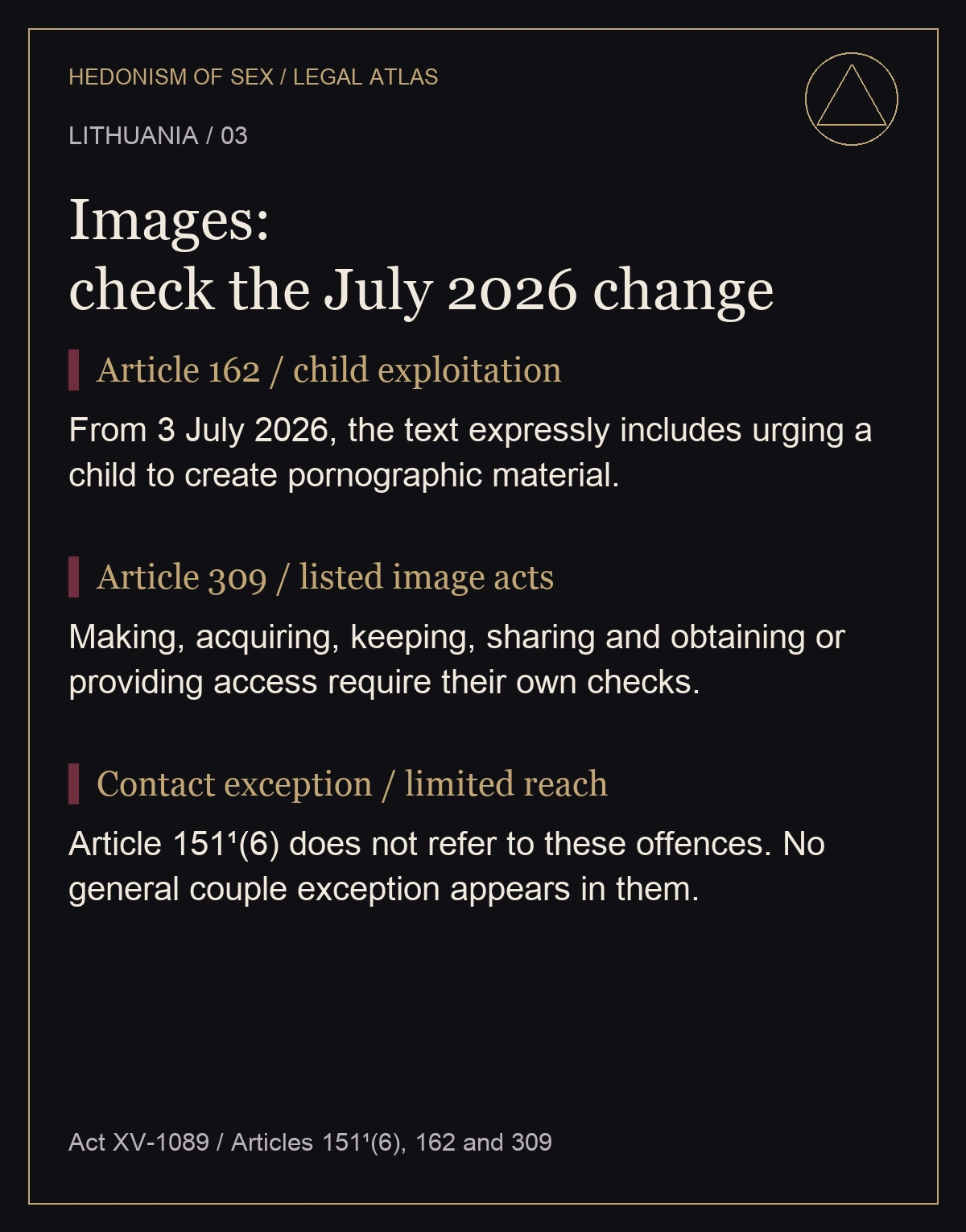
Article 162(1) addresses recruiting, forcing, involving or exploiting a child in pornographic events or production, and profiting from that activity. From 3 July 2026, its wording expressly includes urging a child to create a pornographic item. The change came from Act XV-1089, adopted on 25 June and published on 2 July 2026. The current text must therefore be checked even where an older summary appears to describe the same general subject. Act XV-1089, Article 1 and official commencement record.
Article 309(2) separately covers making, acquiring, keeping, showing, advertising, offering or distributing pornographic material depicting a child or a person presented as a child. It also covers obtaining or providing access through information and communications technology or other means. Unlike Article 309(1), paragraph 2 does not require a purpose of distribution for all of those listed acts. Storage alone is expressly included. Article 309(1)–(2).
No general private-couple or numerical peer exception appears in Articles 162 or 309. Article 151¹(6) does not refer to them. Consequently, do not assume that material is lawful because the depicted person is 16 or 17, made it themselves, agreed to its creation, or intended it for one recipient. Whether particular content is pornographic still has to be established; an ordinary photograph of a child is not automatically within the offence. Articles 151¹(6), 162 and 309.
Check the event date and the actual edition of the text
This guide uses the official Criminal Code consolidation headed “from 3 July 2026”, checked on 6 November 2026. The current register identifies that edition as applicable. Its latest amendment changes Article 162; the consolidation date does not mean that the ordinary age threshold first became 16 in July 2026. Current code and amendment record.
The original Act XI-989, adopted on 2 July 2010 and effective on 20 July 2010, introduced the relevant below-16 adult-offender wording and the age-and-maturity exception in the amended Article 151¹. The exception was then paragraph 5; it is paragraph 6 in the current code. For today’s rule, use the current text rather than copying the older numbering or penalties. Act XI-989, Article 1 and commencement record.
Article 3 governs the law applicable in time, including the effect of a later law that removes criminality, reduces punishment or otherwise improves the person’s legal position. Article 4 addresses offences in Lithuanian territory and specified Lithuanian vessels or aircraft; Articles 5–8 supply further rules for conduct abroad. A travel situation can therefore require more than checking the country where two people meet. Articles 3–8.
Common questions
Is the Lithuanian exception a fixed three-year rule?
No. Article 151¹(6) refers to no significant difference in age, mental and physical maturity. It gives no fixed number of years and refers specifically to paragraph 1. Article 151¹(6).
Does a 16- or 17-year-old remain protected?
Yes. Separate provisions address payment, specified positions of authority or abuse of trust, and child pornography. Reaching the ordinary contact threshold does not cancel those rules. Articles 151¹(2)–(4), 162 and 309.
Does the contact exception also cover images?
Article 151¹(6) refers to paragraph 1’s conduct, not Articles 162 or 309. Those image and exploitation provisions need their own assessment, including the express July 2026 wording about urging a child to create material. Articles 151¹, 162 and 309.
Sources and next steps
For a concrete concern, establish the full dates of birth, the date of the conduct, the relationship and any authority or dependency, whether a reward was involved, and whether material was requested, made, kept or shared. A qualified Lithuanian lawyer can assess the offence elements and any exception on those facts. Ask how to preserve evidence before copying or forwarding intimate material.
- Criminal Code, official current consolidation — edition from 3 July 2026; Articles 3–8, 13, 149–153, 162 and 309. The full 150-page official PDF was checked.
- Act XV-1089 of 25 June 2026 — original Article 162 amendment, published 2 July; effective 3 July 2026.
- Act XI-989 of 2 July 2010 — original below-16 and maturity-exception amendment; effective 20 July 2010. Portal interface language does not translate the Lithuanian statutory text.
- Law on Fundamentals of Protection of the Rights of the Child — Article 2(12); official current edition from 1 May 2026, full PDF checked.