France’s general age threshold is 15. It is a starting point for reading the criminal law, not blanket permission. Adult sexual conduct involving a child under 15 remains punishable even where the specific five-year-gap rape or sexual-assault provisions do not apply. Authority, incest, actual consent and separate image rules must also be checked.
The French expression mineur de quinze ans means a child under 15, not a child who is exactly 15. A person remains a minor until 18 under Civil Code article 388. These two ages serve different legal purposes.
The main age thresholds
| Age or condition | Legal significance | Primary provision |
|---|---|---|
| Under 15; adult involved | Age-based protection against adult sexual conduct; the five-year condition is not a universal exemption. | 227-25 |
| Under 15; gap of at least five years | Specific age-based rape and other sexual-assault provisions, according to the conduct. | 222-23-1; 222-29-2 |
| Under 18 | Further protection concerning authority, incest and pornographic images. | 227-27; 222-23-2; 227-23 |
| At every age | Actual consent must be assessed; age alone cannot supply it. | 222-22 |

The five-year condition changes the legal classification
Article 222-23-1 creates an additional age-based rape offence for specified penetrative and oral acts involving an adult and a child under 15 where their age difference is at least five years. Article 222-29-2 provides a corresponding age-based offence for sexual conduct other than rape. Neither requires the reader to treat an assertion of agreement as a defence to the age-based offence.
The five-year condition is expressly disapplied where the acts are exchanged for payment, a promise of payment, a benefit in kind or a promise of such a benefit. It must not be converted into a rule that gifts always establish an offence: the statutory requirement concerns an exchange.
A smaller gap does not erase article 227-25
Outside the rape and sexual-assault cases covered by the relevant section, article 227-25 still punishes an adult’s atteinte sexuelle involving a child under 15. It contains no general five-year-gap exception. Calling every case “rape” is therefore too imprecise, but calling the remaining conduct lawful is also wrong.
Hypothetical example: if one person is 18 and the other 14, a gap below five years does not by itself make sexual conduct lawful. Article 227-25 still needs to be considered, alongside any non-consensual conduct and other applicable offences. This example illustrates the structure of the law; it is not a verdict on an individual case.

Ages 15–17: authority and incest still matter
Article 227-27 covers sexual conduct involving a minor above the 15-year threshold, outside the specified rape and sexual-assault cases, where an adult has legal or factual authority over the minor or abuses authority attached to their functions. The real relationship matters; reaching 15 does not remove this protection.
A current-law detail: the revised article, effective 20 August 2026, also lists conduct in collective passenger transport or places intended for access to it. This added paragraph should not be omitted by relying on a pre-August 2026 summary. A case involving that setting requires the current text, rather than an assumption that authority is the article’s only condition.
Incest has its own provisions. Article 222-23-2 addresses specified acts by an adult involving a minor where the adult is an ascendant, or another listed person who has legal or factual authority over the minor. Article 222-29-3 provides the corresponding incestuous sexual-assault offence for conduct other than rape. These provisions concern minors under 18; they do not contain the general five-year condition.
The list in article 222-22-3 includes ascendants, specified relatives such as siblings, uncles and aunts, and certain spouses or partners with authority. The family category and authority requirements must be read precisely, rather than replacing them with an undefined label such as “family friend”.
What consent means after the 2025 reform
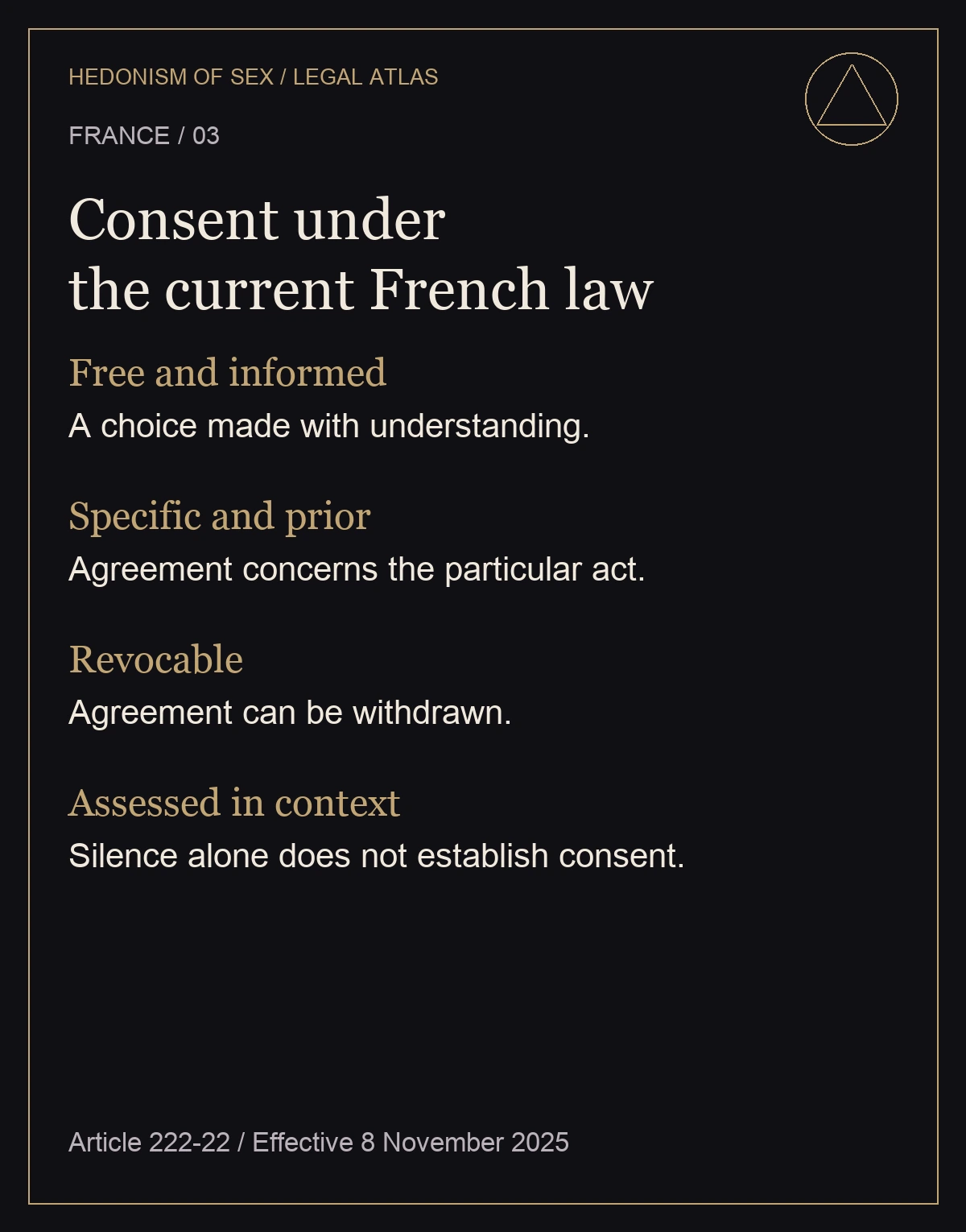
The revised article 222-22 describes consent as free and informed, specific, prior and revocable, assessed in the circumstances. Silence or an absence of reaction alone cannot establish it. Violence, coercion, threats or surprise negate consent, whatever their nature. The article also makes clear that marriage does not prevent rape or other sexual assault from being committed.
This wording comes from Law 2025-1057 of 6 November 2025, effective 8 November 2025. It is therefore misleading to describe the present law only through an old explanation of violence or resistance.
Article 222-22-1 separately explains coercion in cases involving minors. Age difference and legal or factual authority can matter; significant age difference can help characterise factual authority. For under-15s, abuse of vulnerability where the child lacks the necessary discernment is specifically addressed. A birthday is not a substitute for assessing these circumstances.
Images, online conduct and payment are separate questions
Article 227-23 addresses pornographic images or representations of minors, including recording for dissemination, distribution, acquisition and possession. For a child under 15, its recording-related rule also applies without an intention to disseminate. It also covers certain images of people who appear to be minors unless adulthood at recording is established. Being 15–17 and agreeing to sexual activity does not clear an image for production or sharing.
The Code also separately addresses adult electronic solicitation of sexual acts from minors and requests for pornographic images of a minor in articles 227-22-2 and 227-23-1. The contact question and the image question need their own analysis.
Official victim guidance confirms that paying or promising an advantage for sexual activity involving a minor is prohibited, including where the minor is 15, 16 or 17. Do not use the general age threshold as permission for commercial sexual activity.
Territory and the date of the conduct
For overseas cases, check the Code’s territorial provisions rather than assuming that local civil-law arrangements change the sexual-offence rules. Article 711-1 extends Books I–V to New Caledonia, French Polynesia and Wallis and Futuna, subject to the title’s adaptations. The 2025 reform expressly updated this extension. For a particular overseas location, verify the applicable adaptation and the version at the relevant date.
The date matters for historical allegations too. The Cour de cassation’s July 2026 explanation distinguishes conduct before and from 8 November 2025. Do not apply the present wording backwards without assessing the criminal-law rules on application in time.
Use the sources to answer the actual question
- Establish exact ages and the date. Whole-year descriptions may conceal the precise gap. “At least five” includes exactly five years.
- Identify the conduct and relationship. Actual consent, authority, family links and any exchange require separate checks.
- Read the current provision. This is particularly important for the 2025 consent reform and the August 2026 amendment.
- For a real case, consult a French lawyer. The applicable offence and evidence cannot be settled by a country table.
Does a gap below five years make adult–under-15 activity legal?
No. It can affect whether the specific age-based rape or sexual-assault provision applies, but article 227-25 remains relevant. Other offences may also apply.
Is 15 the same as adulthood?
No. Civil Code article 388 sets minority at under 18. The age threshold for particular sexual offences does not remove the other protections that apply to minors.
Can I use another country’s exceptions in France?
No. The Canadian age bands and the UK’s jurisdiction-specific rules cannot be imported into French law. Compare the separately researched guides for Canada and the United Kingdom.