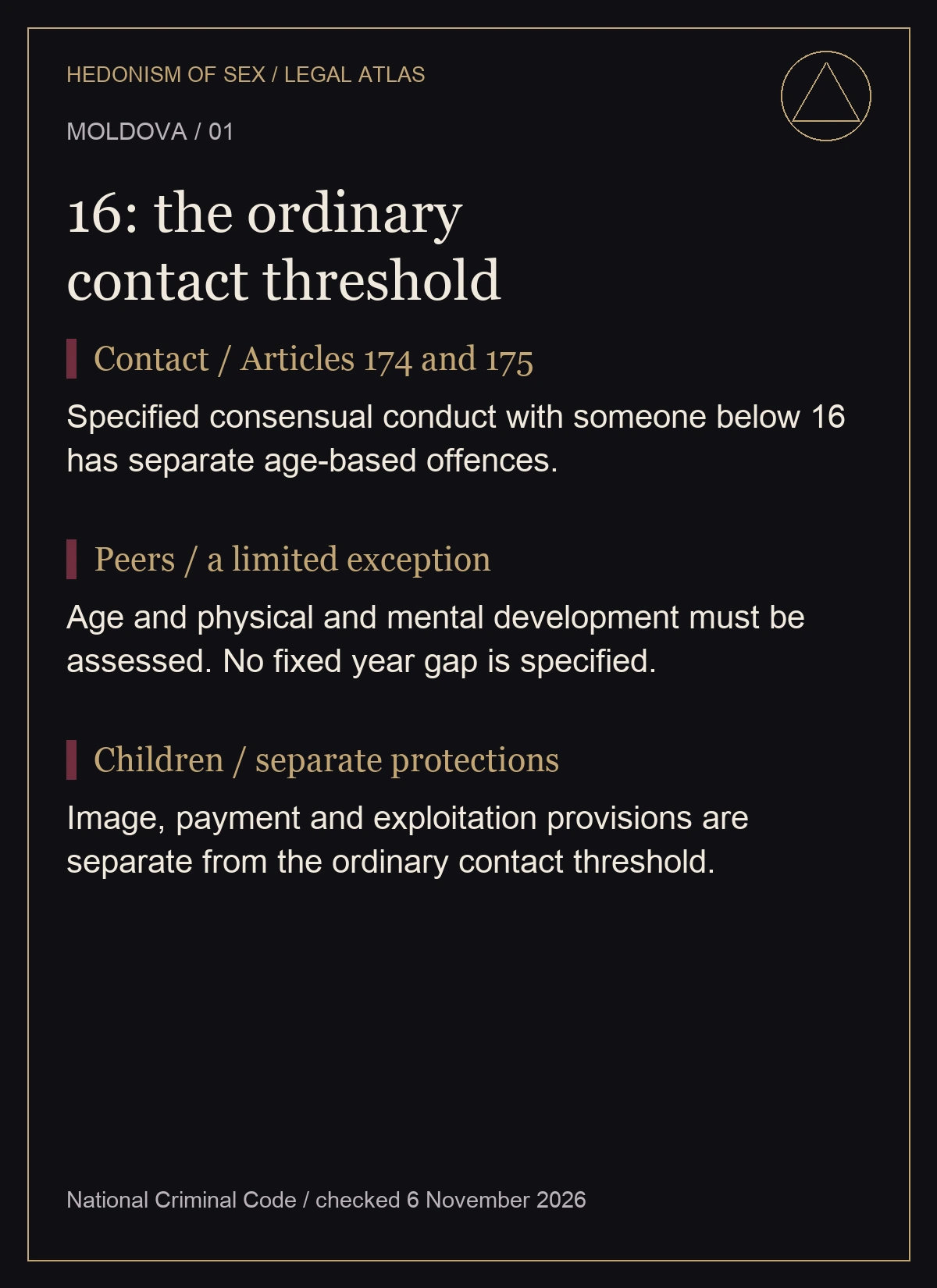
The ordinary threshold under Moldova’s national code is 16 under Criminal Code Articles 174 and 175. Both concern specified consensual conduct knowingly involving someone below 16. Article 174(2) and Article 175(3) contain limited exceptions based on closeness in age and physical and mental development. Neither supplies a fixed number of years. The separate de facto Transnistrian code uses an adult-offender condition; see the territorial comparison below. Articles 174–175.
The ordinary threshold is 16, with two distinct contact offences
Article 174(1) concerns a consensual sexual act knowingly performed with a person who has not reached 16. Article 175(1) separately concerns consensual actions of a sexual nature knowingly involving a person below 16. The distinction is legal, rather than a distinction between different kinds of couples. Article 132²(1) defines a sexual act by reference to sexual penetration; paragraph 2 defines other actions of a sexual nature. Articles 132², 174 and 175.
The wording matters in two ways. First, willingness alone does not remove the age-specific offence: these provisions expressly concern consensual conduct. Second, the statute includes a knowledge element concerning the younger person’s age. A disputed mistake about age requires assessment of the evidence and applicable legal rules; an online profile or an assurance should not be presented as an automatic defence.
| Question | Main provision | Key distinction |
|---|---|---|
| Ordinary contact threshold | 174 and 175 | Below 16; specified consensual conduct |
| Peer exception | 174(2), 175(3) | Age, physical development and mental development |
| Nonconsensual conduct | 132², 171 and 172 | Independent offences; peer clauses are not blanket defences |
| Child sexual material | 132⁴, 208¹ | Separate definition and limited paragraph 4 clause |
| Payment for sexual activity | 208² | Child protection extends beyond the ordinary threshold |
The ordinary threshold is also different from the alleged offender’s age of criminal responsibility. Article 21(1) sets the general responsibility threshold at 16, while paragraph 2 lists particular offences for which responsibility can begin between 14 and 16. Articles 171 and 172 appear in that list; Articles 174 and 175 do not. The February 2026 law expressly removed Article 175 from paragraph 2. These rules concern criminal responsibility, not permission to harm a younger person. Article 21; Law 5/2026, Article I(1).
The peer exceptions are not a three-year rule
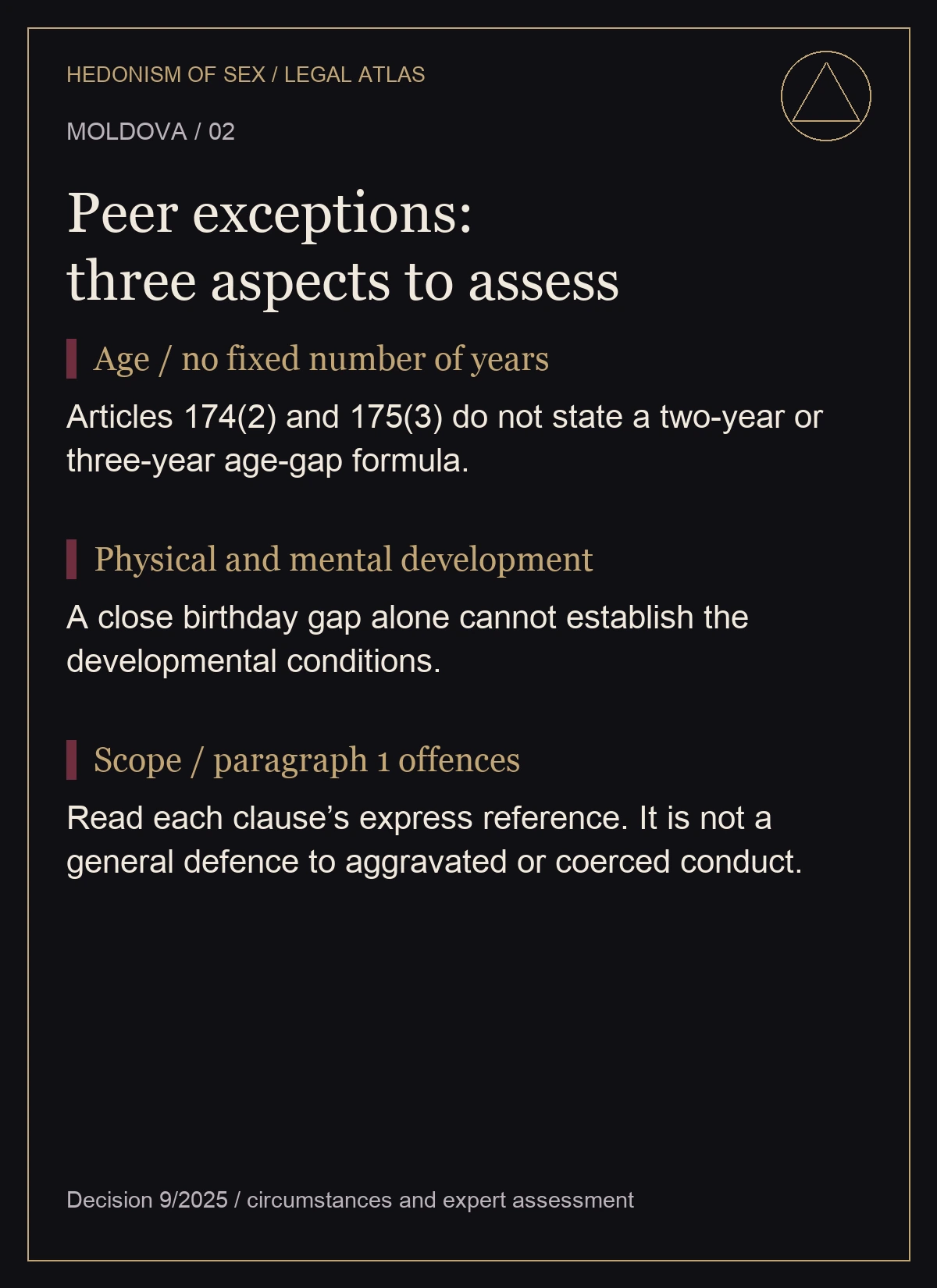
Article 174(2) states that the person is not liable to criminal responsibility for the paragraph 1 conduct if close to the victim in age and physical and mental development. Article 175(3) states a corresponding rule for that article’s paragraph 1 conduct. These are separate statutory clauses with specified paragraph references. They do not expressly extend to Article 174(1¹) or Article 175(2), which cover aggravated circumstances. Articles 174(2) and 175(3).
A hypothetical pair aged 15 and 16 illustrates why subtraction is insufficient. Knowing that their birthdays are roughly a year apart does not establish the statutory physical-and-mental-development conditions, consent or the absence of an aggravated circumstance. Conversely, this guide does not invent a two-year or three-year cutoff that is missing from the text. A close birthday gap is one relevant fact, not a complete legal determination.
What the Constitutional Court actually explained
In Decision 9 of 30 January 2025, the Constitutional Court considered an admissibility challenge involving Article 174. Paragraphs 25–28 distinguish consensual under-16 conduct from rape and discuss assessment of the circumstances, intellectual development and, where necessary, a forensic psychological examination. Paragraph 28 applies the preceding assessment reasoning to the challenge about closeness in age and development. Decision 9/2025, paragraphs 25–28.
The operative result was that the constitutional referral was inadmissible. It was not an acquittal in the underlying criminal case, and the Court did not substitute a numerical age-gap formula. The fact that an exception exists should therefore be explained together with its evidential and procedural limits. Decision 9/2025, paragraphs 29–30 and operative part.
Age does not replace consent, capacity or freedom from coercion
Article 171 addresses nonconsensual sexual acts, and Article 172 addresses other nonconsensual sexual actions. Article 132²(3) describes nonconsensual conduct involving physical or psychological coercion against the victim or another person, or exploitation of a person’s inability to defend themselves or express their will. This is the statutory wording being reviewed; it should not be replaced with another country’s differently drafted consent test. Articles 132²(3), 171 and 172.
The Constitutional Court explains that all circumstances must be examined to determine whether the person understood the acts in question, with expert assessment where necessary. A diagnosis alone, apparent agreement or a statement that someone is “mature for their age” cannot decide an individual case. The peer clauses expressly concern the consensual paragraph 1 offences; they do not provide a general defence to coercion or rape. Decision 9/2025, paragraphs 26–28.
Authority and entrusted care also require their own analysis. Article 174(1¹) and Article 175(2) include the listed care, protection, education or treatment relationships. Law 5/2026 added abuse of a position of authority to both aggravated provisions. The same reform added authority-related aggravation to other sexual offences and introduced Article 172¹ concerning coercing a child into the specified nonconsensual conduct with a third person. Article I(12)–(17).
For a 16- or 17-year-old, crossing the ordinary contact threshold does not end protection against nonconsensual conduct, sexual harassment or exploitation. Article 173 contains its own elements, including the specified sexual demand, hostile or degrading atmosphere, dependency or threat, and a child-related aggravated paragraph. Do not summarize every uncomfortable interaction as that offence, or assume that reaching 16 removes it. Articles 171–173.
The image rule is separate, including its child-created-material clause
The February 2026 reform introduced Article 132⁴’s definition of material concerning sexual abuse of a child. It includes specified visual depictions of a child in real or simulated explicit sexual conduct, relevant sexual-organ depictions and realistic images meeting the definition. This is not a rule criminalizing every ordinary photograph of a young person. Article 208¹ separately covers knowing technological access and the listed circulation, acquisition, use, possession, production and sale activities. Article I(7) and (20); Articles 132⁴ and 208¹.
The distinction between 16 and 18 matters here. The child-rights framework defines a child as a person below 18, as explained in the Children’s Ombudsman’s legal-framework review. A 16- or 17-year-old’s ordinary contact-age position therefore does not settle the separate child-material question. Children’s Ombudsman report, page 14, citing Law 370/2023 Article 3.
Read the two alternatives in Article 208¹(4) accurately
Paragraph 4 refers expressly to the acts in paragraphs 1 and 2. Its wording describes material held or produced by the child depicted in it, or material created by a child with another child’s voluntary participation for their exclusively personal use. These alternatives should be preserved when summarizing the provision. The first branch should not be silently rewritten to contain every condition of the second, and the contact-age maturity test should not be imported into either branch. Article 208¹(4); original wording in Law 5/2026, Article I(20).
The clause does not state a general permission for adult recipients or public distribution. Its specific child-production and possession circumstances must be established; it cannot safely be reduced to “consensual sexting is legal.” The express paragraph references, the actual activity and any aggravated provision need to be examined together. No private-material exception should be assumed to authorize forwarding another person’s image.

Privacy offences are a separate layer. Article 177(1) concerns the specified unlawful collection or knowing disclosure of protected private information without consent. Paragraph 2 includes dissemination through information technologies or electronic communications. Paragraph 3 specifically concerns dissemination of sexual information, images or recordings for revenge, hatred, humiliation or injury to honour and dignity. Its purpose element should not be omitted when describing it. Article 177.
Grooming does not require a completed sexual encounter
Article 175¹ addresses the specified proposal, persuasion, manipulation, threat or promise of advantages aimed at arranging a meeting with a minor for the listed sexual offences. It includes technological communications, and requires that the actions be followed by material acts leading toward such a meeting. The wording should not be shortened to either “all online flirting” or “nothing is criminal until sex occurs.” Article 175¹(1).
The 2026 amendment expanded the listed purposes to Articles 208¹–208⁵ and added an authority-related aggravated circumstance. A meeting involving a 16- or 17-year-old can still require assessment where the intended conduct is a child-material or exploitation offence. At the same time, the intended offence and the material-acts condition must actually be established; the ordinary threshold alone cannot answer that question. Article I(18); Article 175¹.
Payments and sexual performances have additional child protections
Article 208² addresses sexual activities with a child where money, remuneration or benefits are given or promised in exchange. The recipient can be the child or a third party. Consequently, a hypothetical payment for sexual activity with a 17-year-old is not made lawful merely because the ordinary contact threshold is 16. The exchange condition distinguishes the provision from a general claim that every gift within a relationship is itself this offence. Article 208².
Other provisions added or rewritten in 2026 address inducing someone below 16 to witness specified conduct or supplying the listed material (Article 208³), child participation in pornographic performances, including specified knowing viewing (Article 208⁴), and inducing or coercing a child into prostitution (Article 208⁵). Child trafficking under Article 206 is another separate offence. These provisions have different elements and should not be merged into one rule about “consent at 16.” Article I(20)–(21); Articles 206 and 208²–208⁵.
The February 2026 reform changed safeguards, not the headline age
Law 5 was adopted on 12 February 2026, published in Official Gazette 96–99 on 26 February, and Article V makes it effective on publication. The relevant commencement date is therefore 26 February 2026. It added authority-related provisions, reworked child-material and exploitation offences, and changed the responsibility rule concerning Article 175. It did not replace 16 with a different ordinary threshold. Law 5/2026, Articles I and V.
The official registry’s 28 August 2026 Criminal Code edition was the latest effective edition displayed before the 6 November review date. Its header includes Laws 173/2026 and 201/2025; the later listed November and December editions were still future. A law adopted or displayed in advance must not automatically be described as already applicable. The August changes checked here concern drug-related legislation, rather than a replacement of Articles 174–175. Official Criminal Code edition; Law 173/2026.
For an earlier incident, Articles 8–10 govern temporal application and more favourable criminal law. The Constitutional Court decision also discusses the need to identify which version applies. Today’s wording should not simply be applied backwards to conduct from before a reform. This guide identifies the current national framework; it does not resolve a particular historical case or determine overlapping territorial jurisdiction. Articles 8–10; Decision 9/2025, paragraph 15.
Transnistria: a separate de facto framework
The national provisions above must be distinguished from the code published by the de facto authorities in Transnistria. This comparison describes that published text; it does not recognize a separate sovereign state or suggest that Moldova’s national law ceases to matter. The OSCE’s settlement framework is based on Moldova’s sovereignty and territorial integrity within its internationally recognized borders, with a special status for Transnistria. OSCE Mission to Moldova: mandate and work.
The de facto legislature’s current-code page supplies a consolidation labelled 1 September 2026. In that text, Article 131(1) addresses the specified sexual conduct by a person who has reached 18 with someone known to be below 16. Article 132(1) separately addresses the specified nonviolent indecent acts, again with an offender-at-least-18 condition and a person known to be below 16. Their subsequent paragraphs cover younger age groups and other aggravated situations. De facto legislature: code collection; 1 September 2026 consolidation, Articles 131–132 (Word file).
| Framework | Age-specific provisions | Peer mechanism reviewed |
|---|---|---|
| Moldova’s national code | 174 and 175: below 16 | Closeness in age and physical and mental development, for the specified paragraph 1 offences |
| De facto Transnistrian code | 131 and 132: adult offender, person below 16 | Express offender-at-least-18 element; these articles do not reproduce the national maturity clauses |
The adult-offender element is not a declaration that all conduct involving younger alleged offenders is lawful. Articles 128–129 separately address violence, threats or helplessness; Article 130 addresses the specified coercion through blackmail, property threats or material or other dependency, with an aggravated provision for minors. The code’s general responsibility rules must also be considered. Do not import the national Article 174(2) exception into this different numbering and structure. Articles 19 and 128–132.
The note to de facto Article 131 contains a distinct marriage-related release from criminal responsibility for a person at least 18 who committed intercourse for the first time with someone known to be below 16, where the stated loss-of-social-danger condition connected with marriage is established. This is a limited statutory release, not advance permission, not an automatic consequence of every marriage and not an exception stated in Article 132 or in the violence provisions. This guide does not determine eligibility to marry. Article 131, note.
Images require a separate check here too. De facto Articles 240-1 and 240-2 address specified pornographic depictions of minors and the use of a minor in producing material or performances. Article 240-1’s opening production, acquisition, storage and movement wording includes the stated distribution, public-display or advertising purpose; it should not be summarized as an identical copy of national Article 208¹. Its note contains specified cultural, scientific, medical and educational exclusions, rather than the national child-created-material clause. Neither the national contact exception nor national Article 208¹(4) should be assumed to transfer to this text. Articles 240–240-2 and Article 240-1 notes.
Currency check. The de facto presidential law archive was checked beyond the September consolidation. The two later Criminal Code amendments located there, Laws 234 and 237 of 12 October 2026, concern punishment provisions and digital-currency-related changes respectively; they do not replace the age or offender-age elements in Articles 131–132. Law 234’s Article 2 provides commencement after 30 days following official publication, rather than immediate commencement on signature. The September label is the consolidation date, not a claim that the age rule itself first began then. Law 234/2026 original (Word file); Law 237/2026 original (Word file).
A situation connected with this region calls for advice about both the national legal position and the separate de facto proceedings or enforcement risk. This comparison does not resolve which authority will act in a particular case or any cross-border jurisdiction question.
Common questions
Is Moldova’s age of consent 16 or 18?
The ordinary threshold in Articles 174–175 is 16. Separate child-material, payment, exploitation and other safeguards can still apply to 16- and 17-year-olds. The legal question must be identified before choosing a number.
Does Moldova have a three-year peer exception?
Articles 174(2) and 175(3) do not specify three years. They require closeness in age and physical and mental development, and expressly refer to their respective paragraph 1 offences.
Does parental approval replace the legal conditions?
No parental-permission exception appears in the reviewed contact provisions. Parental approval does not establish the peer-development test or replace the younger person’s own consent and capacity.
Does the contact exception also permit exchanging images?
No automatic extension follows. Article 208¹(4) has its own wording about the depicted child and child-created material. Adult recipients, onward disclosure and aggravated conduct require separate analysis.
Sources and practical next steps
For advice on a real situation, collect the date, location and exact ages at the time, along with the relationship of care or authority, any pressure or incapacity, and any payment, recording, disclosure or planned meeting. Keep a factual timeline. Obtain qualified advice about the applicable provisions and any cross-border or territorial issues; do not forward suspected child sexual material to seek an informal opinion.
- Official Criminal Code, 28 August 2026 edition — Articles 8–11, 21, 132², 132⁴, 171–175¹, 177, 206 and 208¹–208⁵.
- Law 5 of 12 February 2026 — original amendment, publication and Article V commencement; checked against the consolidated code.
- Constitutional Court Decision 9 of 30 January 2025 — admissibility outcome and paragraphs 25–28 on consent, circumstances and developmental assessment.
- Law 173/2026 and Law 201/2025 — later amendment context checked in the official registry.
- Children’s Ombudsman legal-framework report — page 14, child definition and Law 370/2023 Article 3.
- De facto Transnistrian legislature: current code collection — 1 September 2026 consolidation; read with the later presidential law archive and original Laws 234 and 237/2026.
- OSCE Mission to Moldova — territorial context, separate from the substantive de facto-code comparison.
Compare the independently researched guides to Bulgaria, Hungary and North Macedonia, or browse the Law & Rights library.