In the European Netherlands, the general age of sexual consent is 16. There is a limited statutory exception for peers in an equal situation involving a child aged 12–15. Older minors remain protected in specified circumstances. Criminal Code, articles 245–250.
A useful answer needs more than a number: where did the conduct take place, when did it happen, and was there pressure, dependence or exploitation? This guide starts with the European framework, then distinguishes the separate Caribbean codes. It does not treat the European reform as a law for the entire Kingdom.
Which legal system applies?
The Kingdom contains four countries: the Netherlands, Aruba, Curaçao and Sint Maarten. Bonaire, Sint Eustatius and Saba are public bodies within the country of the Netherlands. They nevertheless have a separate BES Criminal Code. A Dutch passport or a shared language does not make the criminal provisions identical. Government explanation of the Kingdom’s structure; BES Criminal Code.
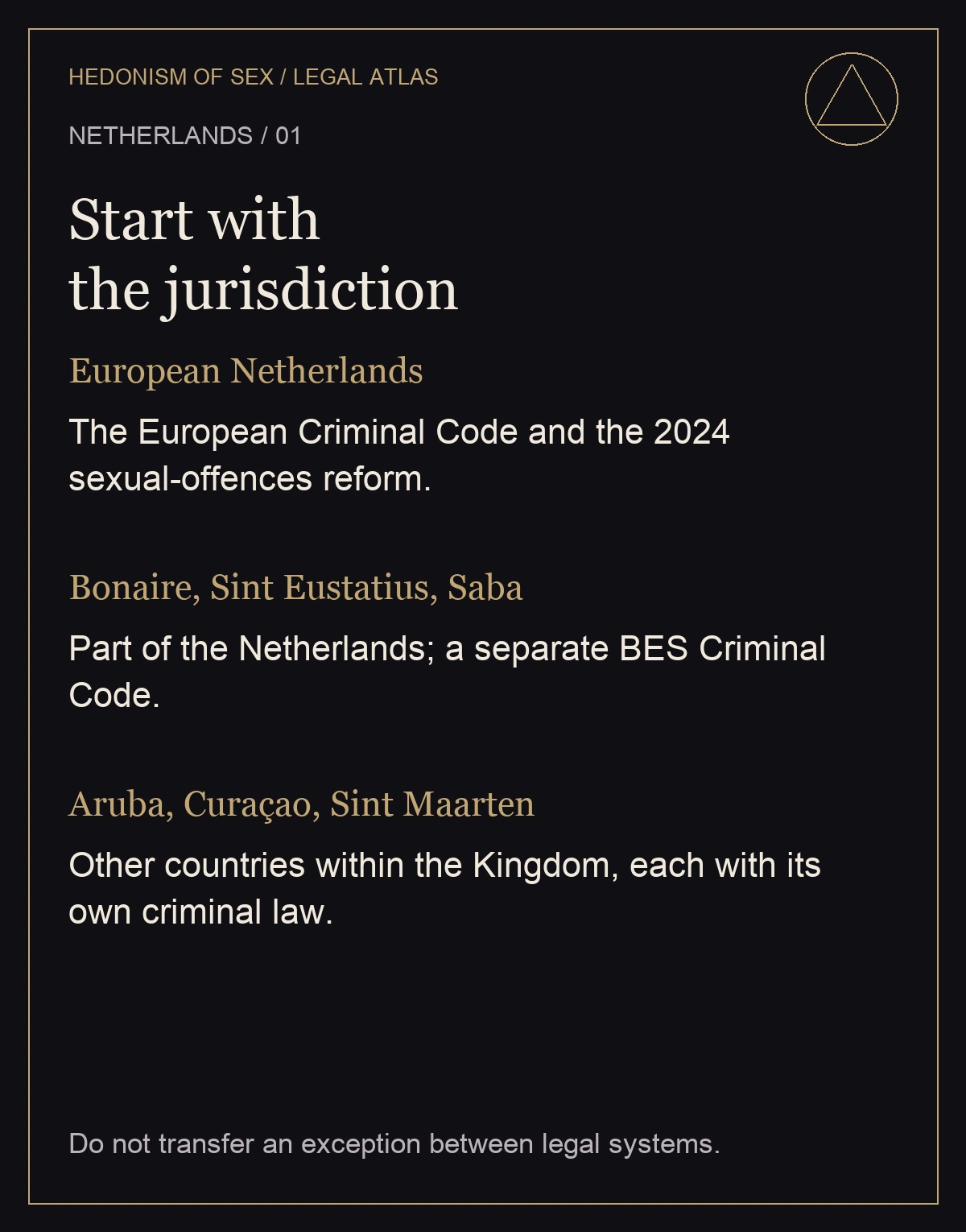
| Jurisdiction | Core provisions to check |
|---|---|
| European Netherlands | Criminal Code 245–250: age categories and the 12–15 peer provision. |
| Bonaire, Sint Eustatius and Saba | BES Criminal Code 250–253 and 256–257: the under-16 framework and added protections. |
| Aruba | Aruba Criminal Code 2:199–2:208. |
| Curaçao | Curaçao Criminal Code 2:199–2:208, using the current amended text. |
| Sint Maarten | Sint Maarten Criminal Code 2:199–2:208. |
These references identify different codes. An article number such as 2:200 is not a citation to the European Criminal Code. The sources for each Caribbean row are linked in its section below.
The European peer exception for the 12–15 age category
Articles 247(3) and 248(3) exclude punishment for the basic offences where a person acts as a peer in an equal situation with the child aged 12–15. The clauses do not set a fixed numerical age gap. The under-12 offences in articles 249–250 do not contain that peer clause. Articles 247–250.
The government’s explanation says there must be a small age difference and a case-specific assessment. Development, life stage, voluntariness and the relationship can matter. An exploitative relationship is not made equal by the participants being close in age. This explanatory material helps interpret the test; it does not replace the enacted wording. Parliamentary response, 36 222 C, discussion of articles 247–248.
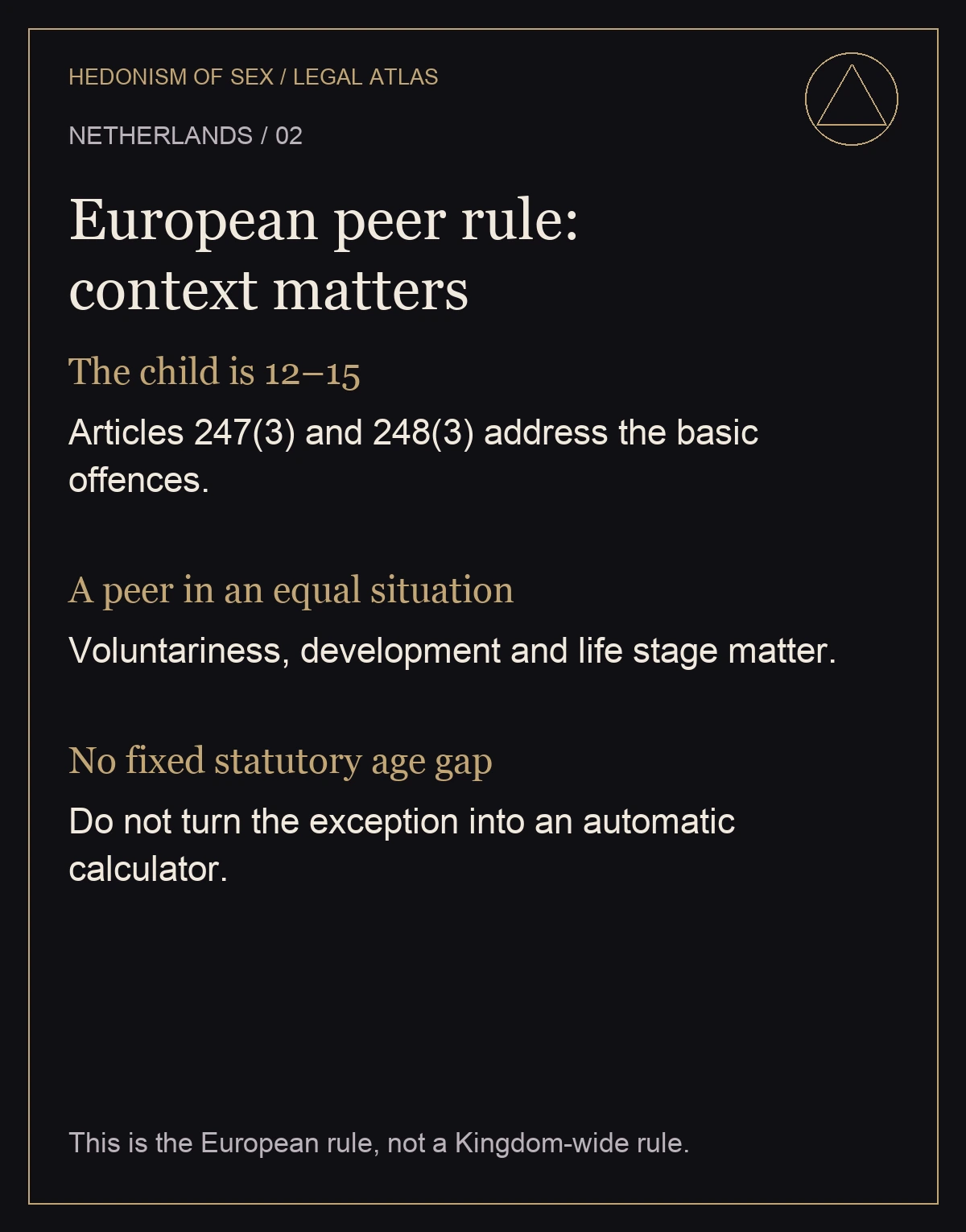
For example, “the gap is only a few years” is not a complete legal analysis. It omits the equality requirement. Conversely, this guide does not invent a two-, three- or four-year safe harbour where the statute supplies none.
Protection continues at 16 and 17
Articles 245–246 protect 16- and 17-year-olds in specified family, authority, entrusted-care, supervision, training and subordinate relationships; particularly vulnerable circumstances; abuse of factual dominance, gifts or promises of money or goods, or deception; and paid sexual services involving a third party. A person being above the general threshold does not remove these provisions. Articles 245–246.
The statutory conditions differ from the peer test. If a teacher, carer, employer or family relationship is involved, identify the actual responsibilities and power relationship rather than relying on a label or the age gap alone.
Actual consent after the 2024 reform
The Sexual Offences Act entered into force on 1 July 2024. The commencement decree confirms that date. The reform changed the offences and their numbering; older guides referring to the former articles can therefore mislead. Commencement decree, Staatsblad 2024, 61; Sexual Offences Act, Staatsblad 2024, 59.
Current articles 240–243 distinguish conduct where someone knows the other person does not want the sexual activity from conduct where there is serious reason to suspect that unwillingness. Force or threats are not required for every offence. Article 244 also addresses circumstances such as unconsciousness, reduced consciousness and specified incapacity. Articles 240–244.
The government’s practical guidance stresses mutual consent before and during sexual contact. Freezing, becoming passive or turning away can be warning signs. Previous agreement does not answer whether a person still wants what is happening. Government explanation of consent under the new Act.
For conduct before 1 July 2024, the prosecution service explains that the former offences apply. A current summary should not be used to classify an older allegation without checking the relevant historical law. Public Prosecution Service: sexual offences.
The Caribbean frameworks need their own analysis
Bonaire, Sint Eustatius and Saba
The BES Code’s articles 251 and 253 address sexual conduct involving under-16s, with separate provisions for under-12s and for penetration. The under-16 provisions use the terms ontuchtige handelingen and buiten echt—lewd sexual acts and outside marriage. These are legal elements, not the wording of Europe’s new peer exception. Article 251(2) gives the minor, where possible, an opportunity to express a view before prosecution; it does not give a veto over prosecution. BES articles 250–253.
Articles 256–257 add protections concerning inducement, abuse of dominance, deception and specified family, care or subordinate relationships involving minors. Images are separately governed by article 246bis, using an under-18 framework. BES articles 256–257; article 246bis.
Aruba
Aruba’s articles 2:200 and 2:202 contain the under-16 framework, including the outside-marriage wording and the opportunity for the minor to express a view before prosecution. Articles 2:203–2:204 and 2:208 cover additional inducement, payment and relationship protections; article 2:196 separately concerns sexual images involving under-18s. The official consolidated code includes the amendments listed by Aruba’s legal register. Official Aruba register and consolidated Criminal Code, articles 2:196–2:208.
Curaçao
Curaçao’s own articles 2:200 and 2:202 address the under-16 framework. Articles 2:203–2:204 and 2:208 provide further protections, while article 2:196 addresses sexual images involving under-18s. Use the current Curaçao text, not an Aruba or Sint Maarten provision with the same number. Curaçao government’s consolidated Criminal Code and amendment history.
Sint Maarten
The official consolidated Sint Maarten Code likewise contains its own under-16 provisions in articles 2:200 and 2:202, the minor’s opportunity to express a view before prosecution, added protections in 2:203–2:204 and 2:208, and a separate under-18 image offence in 2:196. These should be read as Sint Maarten law. Current official Sint Maarten Criminal Code.
Across these Caribbean sections: the European clauses in articles 247(3) and 248(3) cannot simply be imported. The meaning of ontucht, the facts and applicable case law require local analysis. Nor should the outside-marriage wording be treated as a general licence: marriage validity, force, incapacity, exploitation and other offences remain separate questions.
Sexual approaches and online meetings
In the European Netherlands, article 251 separately addresses specified harmful sexual approaches to under-16s and certain approaches to 16- and 17-year-olds. Its peer exception is limited to the meeting provision in 251(1)(c), in an equal situation where the child is at least 12; it is not a general exception for every form of messaging. Article 251.
The Caribbean codes have their own online-meeting offences: BES article 256d and Aruba, Curaçao and Sint Maarten article 2:207. These address a sexual-purpose meeting proposal involving an under-16 plus a step towards carrying it out, with their own statutory elements. Curaçao’s 2026 amendment increased its article 2:207 maximum sentence; an older copy will miss that change. BES code; Aruba register; Curaçao current text and amendment history; Sint Maarten code.
Sexual images: age of consent and prosecution policy differ
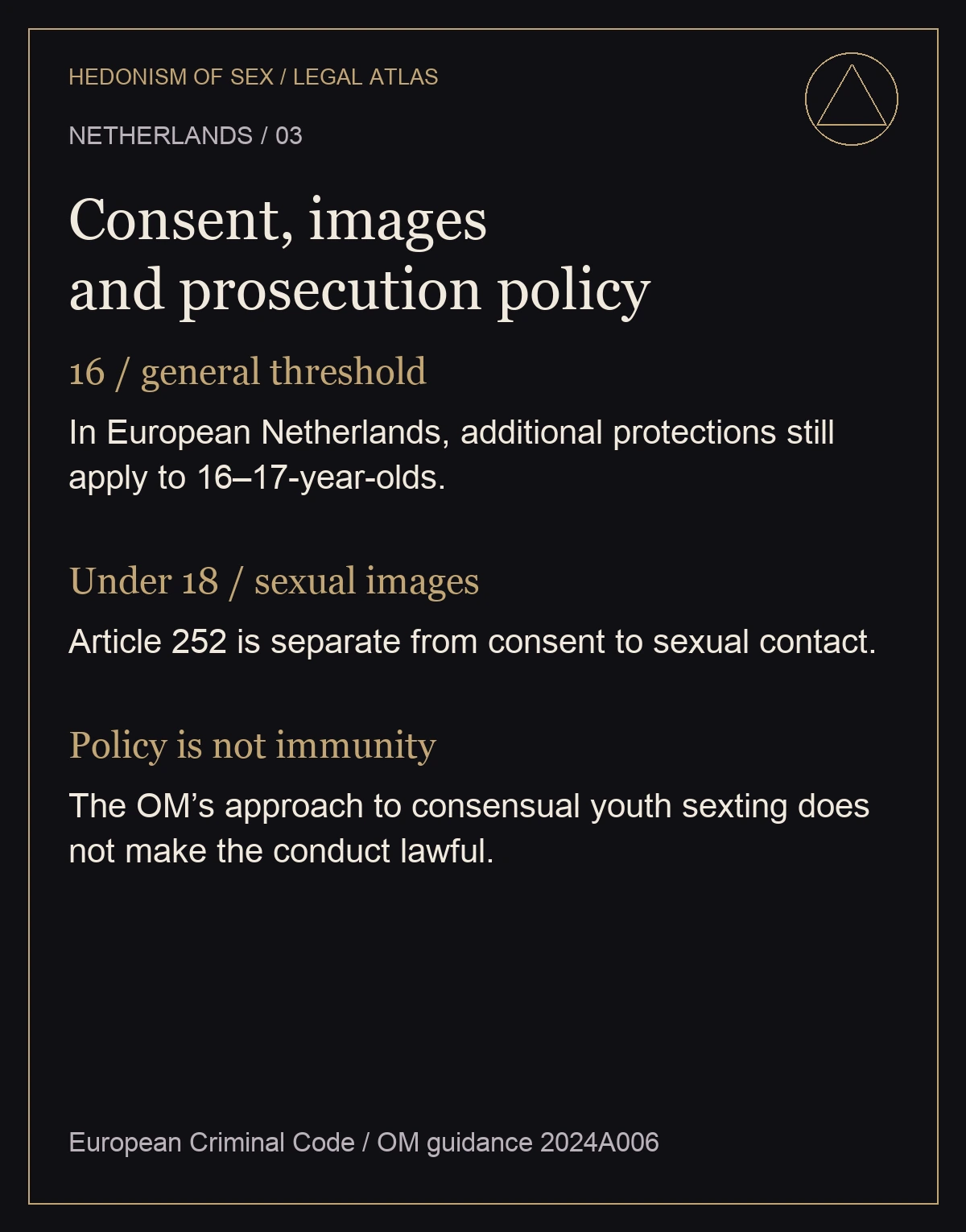
In the European Netherlands, article 252 separately regulates sexual visual material involving someone apparently under 18, including apparent involvement. Reaching 16 does not remove that offence. The conduct covered includes production, distribution, possession and obtaining access. Article 252.
The prosecution service’s guidance distinguishes consensual, age-appropriate youth sexting from harmful conduct. It explains that some conduct can technically fall within the offence while criminal intervention is not considered appropriate. That is prosecution policy, not statutory immunity. Pressure, blackmail, bullying, sharing and harm change the assessment. Do not assume that this European guidance governs another Kingdom jurisdiction. OM guidance 2024A006, section 1.3.
Practical questions and next steps
Is a small age gap enough to establish legality?
No. In the European framework, the statutory test requires peers in an equal situation, with the stated age category and limits. Other offences still matter. For a Caribbean jurisdiction, begin with its own code and case law rather than applying that European provision.
What facts should I give a lawyer?
Provide the location, exact ages and date of conduct; any family, school, work or care relationship; pressure, dependence or incapacity; and whether money, sexual messages, images or sharing were involved. Explain what happened rather than asking only whether an age gap is permitted.
For a current concern, use local legal advice and appropriate support. Do not circulate intimate material as a way of seeking a second opinion. Preserve relevant non-explicit information and ask the responsible professional how evidence should be handled.
Sources, currency and editorial review
Checked 5 November 2026. The European consolidation read was current from 1 July 2026; the BES consolidation from 1 July 2025. The Sint Maarten register identifies its version as current from 19 November 2019. Aruba’s official PDF is dated 19 March 2025 and is linked from its current legal register. The Curaçao government’s consolidation includes an amendment history through the amendment effective 6 October 2026.
Explore the Law & Rights country library, or compare the independently researched guides to Germany, France and Italy. Their exceptions differ.