Portugal’s basic age threshold is 14, but that does not settle every case. Article 171 protects children below 14. Article 173 separately prohibits an adult’s relevant sexual acts involving a 14- or 15-year-old where the adult abuses the adolescent’s inexperience. Additional protections concerning dependence, vulnerability, payment and sexual images extend to minors below 18. Criminal Code, Articles 171–176.
A country table showing only “14” leaves out the provision that often matters most to an adult dealing with a teenager. This guide explains the different legal questions and identifies which official documents support them. It does not turn a birthday or an age gap into a legal clearance.
One national framework, several age distinctions
The relevant provisions are in the national Criminal Code. Article 4 applies Portuguese criminal law to conduct in Portuguese territory, regardless of the actor’s nationality, subject to contrary treaty provisions. The age rules discussed here are national provisions rather than separate municipal age limits. Article 4.
Article 171(1) covers a legally relevant sexual act with or on a child below 14, or inducing that child to perform it with someone else. Paragraph 2 provides a more serious offence for the specified forms of penetration. The provision does not contain a numerical close-in-age exemption. A young person’s apparent agreement does not remove Article 171’s age element. Article 171; Law 59/2007, Article 1.
| Age | Principal distinction | Provision |
|---|---|---|
| Below 14 | Specific child sexual-abuse protection | Article 171 |
| 14–15 | Adult’s abuse of the adolescent’s inexperience | Article 173 |
| 14–17 | Specified dependent or vulnerable situations; adult’s payment or other consideration | Articles 172 and 174 |
| Below 18 | Minor-specific sexual-image protections | Article 176 |
Adulthood begins at 18 under Civil Code Article 130. Criminal responsibility is another concept: Criminal Code Article 19 says children below 16 are not criminally responsible. That does not create a sexual-consent age of 16 or an exemption permitting harmful conduct. Likewise, Article 173’s reference to an adult is not a reference to everyone who has reached the criminal-responsibility threshold. Civil Code, Article 130; Criminal Code, Articles 19 and 173.

At 14–15, the law asks about an adult’s abuse of inexperience
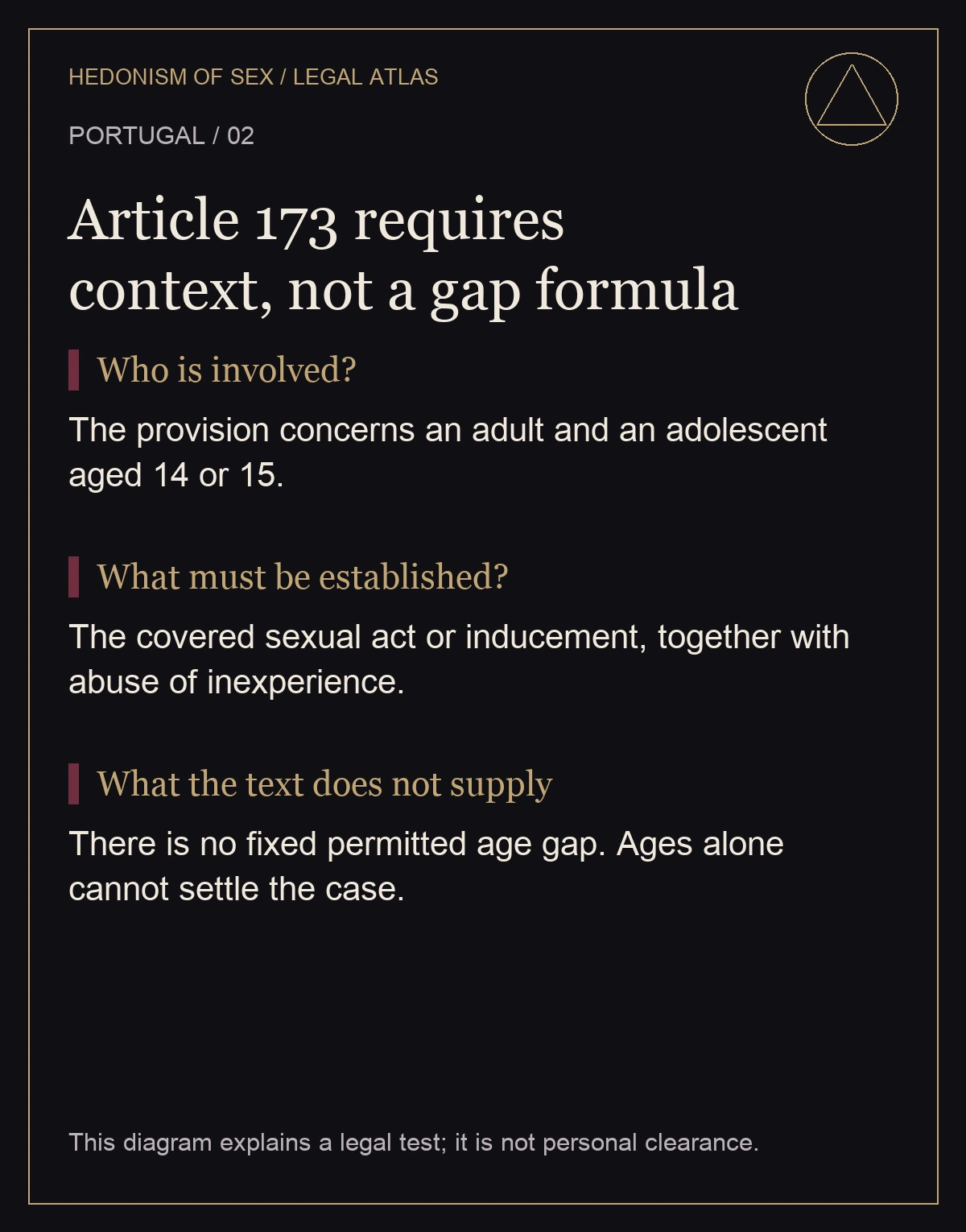
Article 173(1) requires an adult, a minor aged 14 or 15, a relevant sexual act or the specified inducement involving another person, and abuse of the adolescent’s inexperience. Both the adult status and the abuse element matter. It is inaccurate to describe every adult–adolescent interaction in this age band as automatically the same offence; it is equally inaccurate to present the fourteenth birthday as unrestricted permission. Article 173; Law 103/2015, Article 2.
The statute sets no fixed permitted age difference for this provision. Its test cannot be replaced with “within three years,” a rule borrowed from another country, or the claim that parental approval settles the issue. Whether inexperience was abused requires assessment of the actual circumstances. The Diário da República’s official legal dictionary also identifies exploitation of inexperience as an element of this offence. Official legal dictionary: sexual acts with adolescents.
For a hypothetical situation involving a 15-year-old and an adult, knowing only the two ages is insufficient. The relevant questions include what happened, how the adult acted and whether the adolescent’s inexperience was exploited. This is not an invitation to test boundaries: an individual case needs Portuguese legal advice, especially where influence, pressure or dependency is involved.
Dependence, authority and vulnerability remain relevant at 16–17
Article 172 protects minors aged 14–17 through distinct routes. It covers a person who exercises parental responsibilities or has been entrusted with the minor’s education or assistance. It separately covers abuse of a position of manifest trust, authority or influence, and abuse of another situation of particular vulnerability, including health or disability. These routes should not be flattened into a single age-gap rule. Law 40/2020, Article 2: current Article 172.
For example, a hypothetical case involving a 17-year-old and someone responsible for their education cannot be resolved by saying the teenager is over 14 or 16. The relationship and the applicable statutory route must be examined. Article 166 also separately regulates specified abuse of institutional care relationships, so the end of minor-specific protection does not make every professional relationship permissible. Articles 166 and 172.
Article 174 prohibits an adult’s relevant sexual act with a 14–17-year-old in return for payment or other consideration. Article 175 separately addresses facilitating or recruiting minors into prostitution. These provisions concern exploitation and transactions; apparent agreement or reaching the ordinary age threshold does not displace them. For a child below 14, Article 171 remains central. Articles 171 and 174–175.
Age never authorises coercion or exploitation of incapacity
Articles 163 and 164 regulate sexual coercion and rape. Their basic forms are not confined to violence or a grave threat: paragraph 3 of each provision refers to other means used against the victim’s recognisable will. Separate, more serious forms address violence, grave threats and specified means of rendering the person unconscious or unable to resist. Article 165 addresses taking advantage of someone who is unconscious or otherwise incapable of resisting. Articles 163–165; Law 101/2019; Law 45/2023.
The practical implication is that an age calculation cannot establish voluntary participation. Pressure, inability to resist and conduct against someone’s will require their own assessment. This English explanation does not replace the Portuguese statutory wording with an invented rule that only physical resistance or a particular spoken formula counts.
Sexual images and online approaches follow separate rules
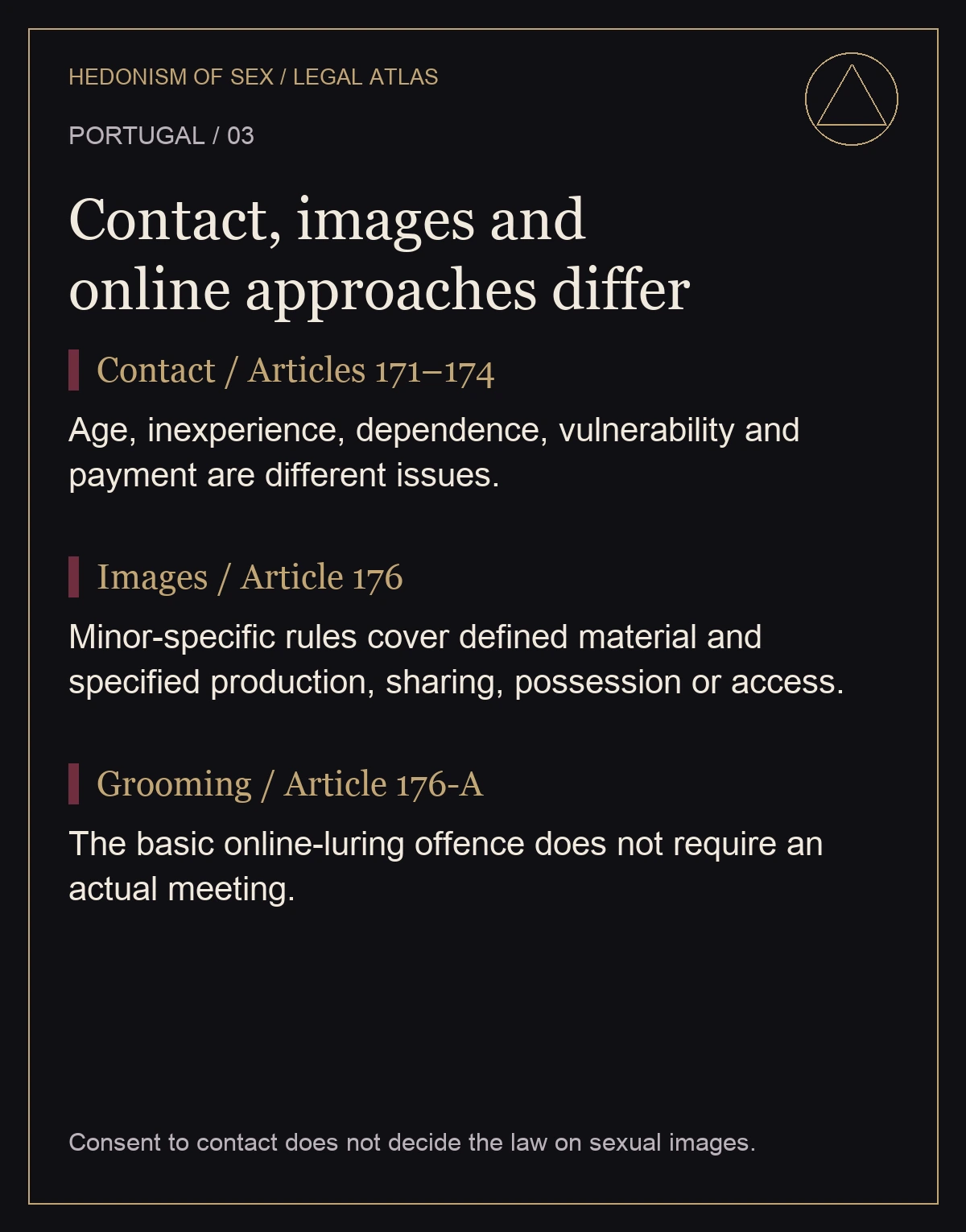
Article 176 concerns pornographic material involving minors, including specified production, distribution and availability, as well as intentional acquisition, possession or access. Its definition in paragraph 8 concerns material made for sexual purposes depicting minors in explicit real or simulated conduct, or representations of their sexual organs or another body part. The definition and the conduct must both be examined; the legal category cannot be reduced to “any photograph.” Article 176.
The text does not provide an express numerical close-age or general private-youth-sexting exemption. Do not import another country’s exception or assume consent to contact also authorises making, keeping or sharing material. This is not a determination that a young person seeking help has committed an offence: individual responsibility and the nature of the material require separate assessment. Avoid forwarding intimate material when seeking assistance.
Article 176-A addresses an adult’s use of information and communication technologies to lure a minor into a meeting aimed at the listed child sexual-abuse or image offences. Paragraph 1 establishes the basic offence; paragraph 2 increases the penalty when material acts towards the meeting follow. An actual meeting is not required for the basic offence. Law 103/2015, Article 3.
Cross-border facts also need care. Article 5 specifies circumstances in which Portuguese law reaches conduct abroad, subject to Article 6. Article 176-B separately addresses organising or facilitating travel for offences against minors, including its express rule concerning destinations where the conduct is not punished. A foreign location should not be treated as a legal workaround. Articles 5–6 and 176-B.
Current law must be separated from earlier conduct
The official Criminal Code consolidation was inspected with the version date set to 5 November 2026. It lists its latest overall amendment as 19 August 2026. That latest law changes Articles 5 and 160; it does not replace Article 173’s age-and-inexperience framework. An overall code-update date should not be presented as the date every age rule changed. Law 53/2026, Article 7.
Important dates for this guide include 23 September 2015 for Law 103/2015’s relevant amendments and new grooming offence; 1 September 2020 for Law 40/2020’s amendments to Article 172 and image provisions; and 14 February 2024 for Law 4/2024’s changes to Article 176(3) and sexual-tourism provisions. These dates follow the acts’ commencement clauses and the official consolidation’s version records. Law 103/2015, Article 10; Law 40/2020, Article 6; Law 4/2024, Article 4.
For an earlier incident, establish the date and compare the applicable versions. Article 2 governs criminal law over time, including the more favourable-law principle. Neither today’s consolidation nor a news report about a proposed reform is, by itself, a complete assessment of past conduct. Article 2.
Practical questions
Is the Portuguese age of consent 14 or 16?
Fourteen is the basic threshold associated with Article 171. For a 14- or 15-year-old, Article 173 separately prohibits an adult’s abuse of the adolescent’s inexperience. Reaching 16 ends that particular age band, but other protections continue.
Is there a fixed close-in-age exception?
Articles 171 and 173 do not contain a numerical permitted-age-gap exemption. Article 173 instead requires an adult actor and abuse of inexperience. Criminal responsibility below 16 is a different legal question.
What should someone collect before asking for legal advice?
Exact birth dates, the date and place of conduct, the relationship between the people, relevant communications, any pressure or payment, and whether images were involved. Describe images without circulating them. Ask a Portuguese lawyer to assess the applicable law and reporting options.
Find other jurisdictions in our Law & Rights library, including separate guides to Spain and France. Their age rules and exceptions require their own analysis.
Official sources and verification
- Diário da República: Criminal Code. Current version inspected for 5 November 2026; Articles 2, 4–6, 19 and 163–176-B.
- Law 59/2007 and Law 103/2015. Original amendments checked against the current age provisions.
- Law 40/2020 and Law 4/2024. Dependency, vulnerability, images and travel provisions, with commencement clauses.
- Law 101/2019 and Law 45/2023. Coercion and rape provisions read with the current code.
- Law 53/2026. Latest overall code amendment checked for its actual scope.
- Civil Code, Article 130, and official legal dictionary entry on Article 173.