The general age of sexual consent in Spain is 16. Article 181 protects children below that age. Article 183 bis provides a limited close-in-age and maturity exception; it does not set a fixed two-, three- or five-year gap. Being 16 or 17 also does not remove the laws on non-consensual conduct, exploitation or sexual images.
The threshold rose to 16 through Organic Law 1/2015, effective 1 July 2015. Explanations still giving 13 are historical. But an old article number can also mislead: the 2022 reform reorganised this part of the Criminal Code.
The age framework: 16 is not the same as 18
| Question | Relevant provision |
|---|---|
| Sexual acts involving someone under 16 | Article 181, subject to the limited exception below |
| Close in age and maturity, with free consent | Article 183 bis; excludes the article 178(2) circumstances |
| Actual consent and abusive circumstances | Article 178 |
| Commercial exploitation and pornographic material involving minors | Article 188; article 189 |
Adulthood is a separate threshold: Constitution article 12 places the age of majority at 18. Reaching the general consent age does not turn a 16- or 17-year-old into an adult for the other protections discussed here.

Article 183 bis: a real exception, with specific conditions
The current rule, introduced in its present form by Organic Law 10/2022, provides that a person under 16’s free consent excludes criminal responsibility for offences in the relevant chapter when the other person is close in age and in the degree of physical and psychological development or maturity. It expressly excludes cases involving any article 178(2) circumstance.
This is an exclusion of criminal responsibility under the stated conditions. It should not be confused with Germany’s differently worded judicial discretion about punishment or with a prosecutor deciding not to bring a case.
There is no numerical age-gap formula
The Prosecutor General’s Circular 1/2023, section 12, explains that the provision seeks to avoid criminalising freely agreed activity between young people similar in age and maturity. It requires a careful assessment of balance between them; significant differences in age, development or maturity cannot simply be ignored.
The statute does not let an editor turn “close” into a universal number. Hypothetical example: knowing only that two people are two years apart does not establish the exception. Free consent, their development and maturity, and the excluded abusive circumstances still need examination. This is an illustration of the questions to ask, not a ruling on a particular pair of ages.
The circular also limits the exception to offences within Chapter II. It does not provide a general exemption from every image, exploitation or other offence elsewhere in the Code.
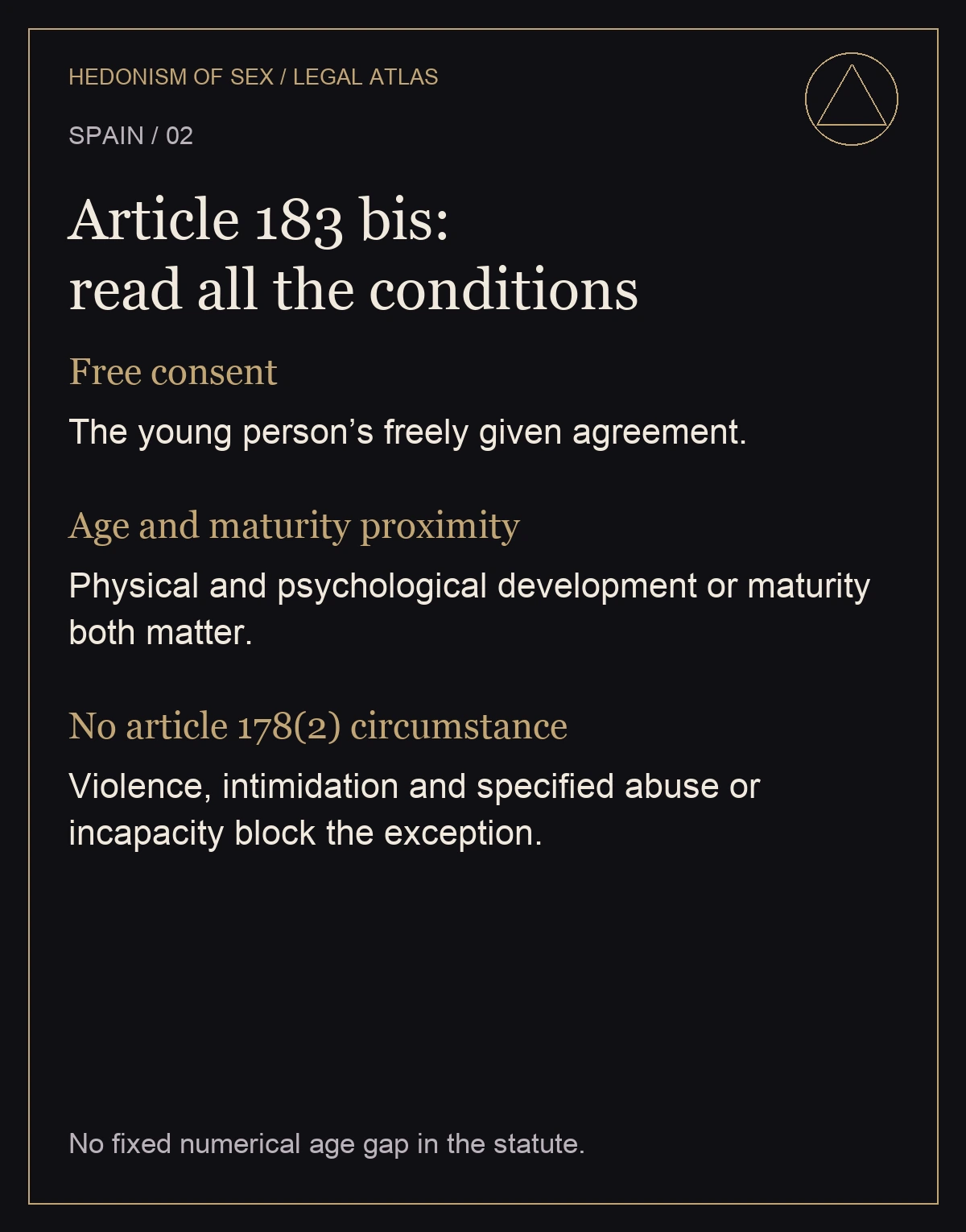
Actual consent and the circumstances that block the exception
Under article 178(1), consent must be freely manifested through acts that clearly express the person’s will in the circumstances. A relationship or a birthday alone cannot answer whether this happened.
Article 178(2), as revised by Organic Law 4/2023, addresses violence, intimidation, abuse of superiority or vulnerability, acts involving someone deprived of awareness or whose mental situation is abused, and cases in which the victim’s will has been overridden for any reason. These are the circumstances to which article 183 bis refers. An age-gap argument cannot neutralise them.
In practice, ask separate questions: was the person old enough under the relevant rule, was consent freely and clearly manifested, and was there an abusive circumstance? A positive answer to the first cannot supply the others.
Ages 16–17: consent, authority and exploitation
The Prosecutor General’s circular, section 7, explains that sexual acts involving 16- or 17-year-olds through abuse of recognised trust, authority or influence fall to be assessed under the sexual-assault framework, including the relevant aggravated forms. The reform did not make that abuse acceptable merely because the younger person was above 16.
This does not mean every relationship carrying an age difference or a professional label is automatically the same offence. The applicable provision and the evidence of abuse still matter.
Article 188 separately addresses inducing, promoting, facilitating or exploiting prostitution involving a minor. Subsection (4) also punishes requesting, accepting or obtaining a sexual relationship with a minor in exchange for remuneration or a promise. Its under-16 aggravation does not make the conduct lawful at 16–17.
Images and online conduct require their own checks
Article 189 covers specified pornographic material involving minors, including production and distribution and, under subsection (5), acquisition or possession for personal use and knowingly accessing it through information technology. Its definition extends to specified simulated or realistic depictions and people appearing to be minors, subject to its stated conditions.
Consequently, being old enough for sexual activity does not clear a photograph for production, possession or sharing. The close-in-age clause belongs to a different chapter; it must not be presented as permission to circulate images of minors.
Article 183 addresses specified online contact with under-16s, including proposals for meetings for the stated criminal purposes accompanied by material steps towards contact, and conduct aimed at inducing pornographic material or images. Article 182 separately concerns making an under-16 witness sexual acts for sexual purposes. Physical contact is therefore not the only conduct that needs assessment.
The national rule and the relevant reform dates
This is a national criminal-law framework. Constitution article 149(1)(6) gives the State exclusive competence over criminal legislation. The general threshold does not become different simply because a case is in Catalonia, Andalusia or Madrid.
- 1 July 2015: the reform raising the general threshold to 16 took effect.
- 7 October 2022: Organic Law 10/2022’s relevant criminal-law reform took effect, including the reorganised provisions and present article 183 bis.
- 29 April 2023: Organic Law 4/2023’s amendments took effect. Read the current article 178(2) and article 181 rather than relying solely on the original 2022 text.
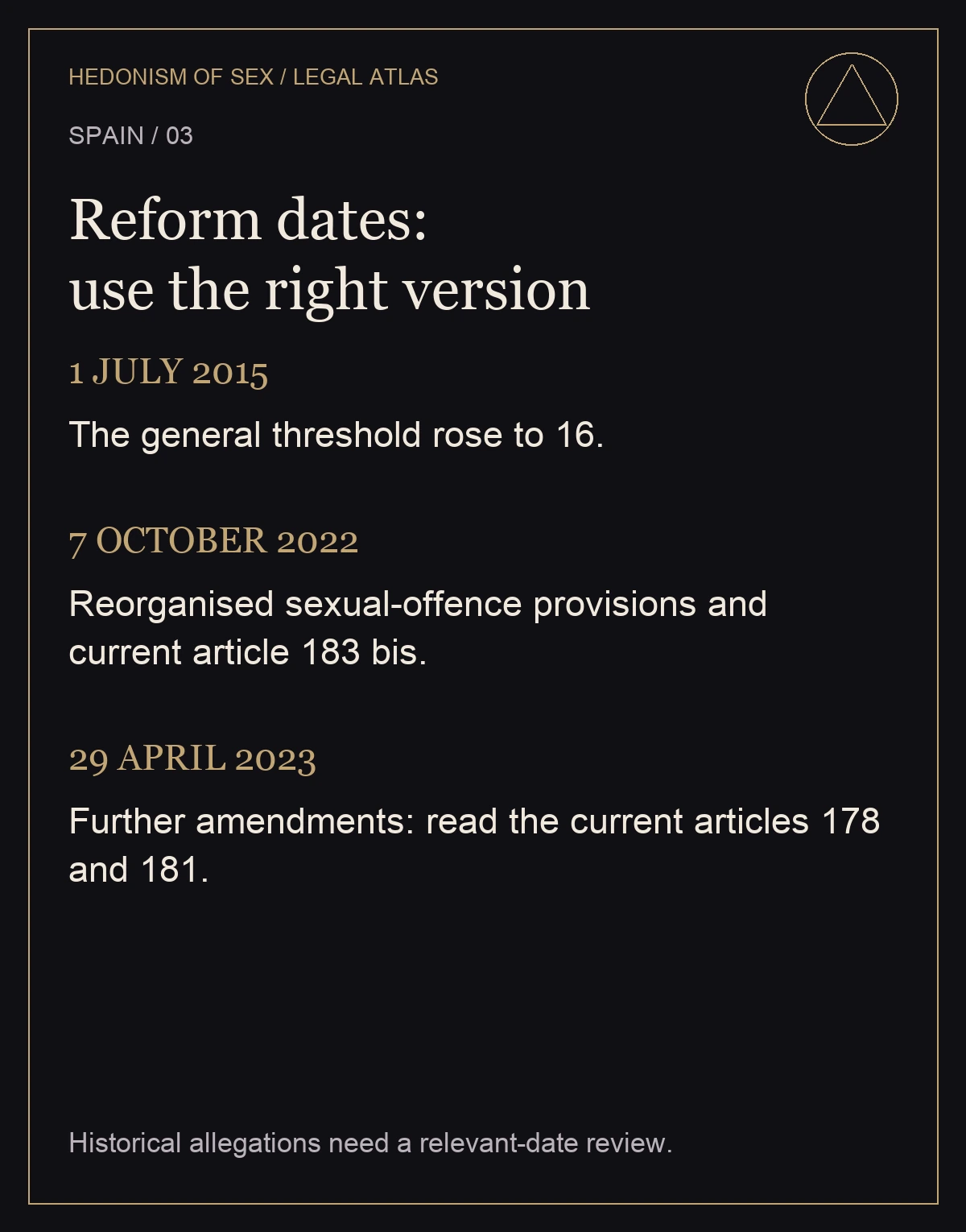
For an allegation concerning older conduct, a lawyer must examine the version at that time and the rules on more favourable criminal laws. Article 2 addresses application in time. A present-day age table cannot determine the historical charge or sentence.
What to check before applying this guide
- Establish both exact ages and the date. Do not substitute an estimated age or a current birthday for the facts at the relevant time.
- Read the exception as a whole. Age proximity, physical and psychological development or maturity, free consent and the exclusions all matter.
- Keep the conduct separate. Contact, online approaches, images and commercial exploitation may engage different articles.
- Obtain Spanish legal advice for a real case. The evidence and legal classification require an individual assessment.
Is Spain’s close-in-age rule a fixed two-year exception?
No. Article 183 bis sets no fixed number of years. Its conditions require a contextual assessment.
Does the rule change between autonomous communities?
The criminal-law age framework described here is national. Local support services or institutions do not set a different general consent threshold.
Where can I compare other countries?
See the separate guides for France, Germany, the United Kingdom and Canada. Their exceptions have different legal conditions.