Belgium’s general age of sexual consent is 16. Article 133 contains exceptions for younger teenagers and additional protections for everyone under 18. The three-year rule in the published code must also be read alongside a Constitutional Court judgment concerning its predecessor. Criminal Code, articles 79, 132–133; judgment 112/2025.
This guide distinguishes what the current statute says from what the Court decided. It explains why an age chart cannot settle a borderline case involving a teenager and a young adult. It also separates consent to sexual contact from the rules about sexual images, authority and exploitation.
Which code applies now?
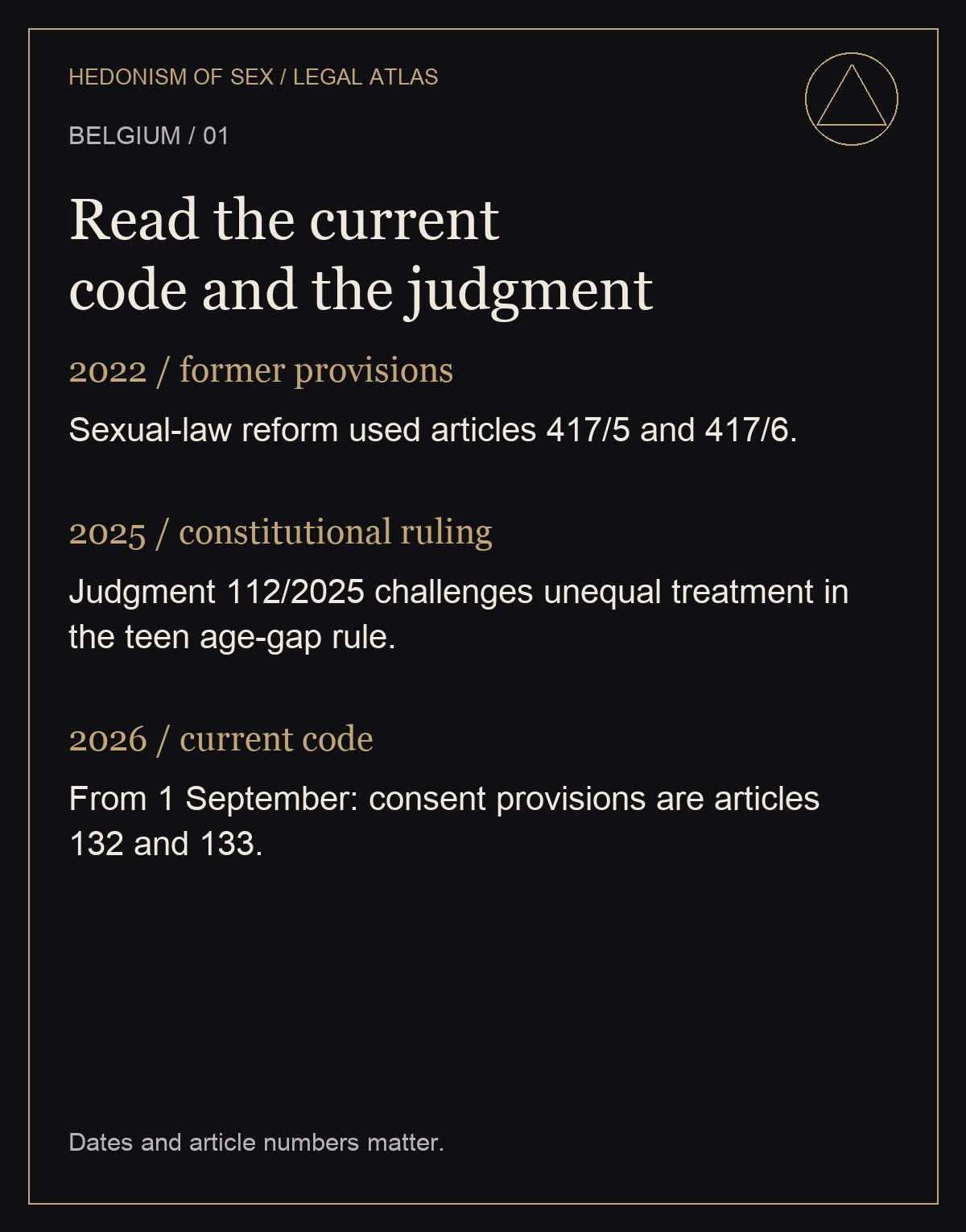
The new Belgian Criminal Code entered into force on 1 September 2026. The Ministry of Justice confirms the commencement, and Justel’s current consolidated code displays that date. Its consent provisions are articles 132–133. Older material commonly cites articles 417/5–417/6 of the former code. Those references remain relevant to historical conduct and the Court’s judgment, but should not be presented as the current numbering. Ministry of Justice: Criminal Code reform; current code.
The date of the conduct matters. Article 2 prohibits retroactive criminalisation or a heavier retrospective penalty and requires the more favourable provisions to be applied when criminal law changes after the offence. An old case therefore needs a comparison of the applicable laws, rather than simply replacing an old article number with a new one. Article 3 addresses territorial application to conduct in Belgium, whether the person is Belgian or foreign. Articles 2–3.
The age rules in article 133
Article 133(1) starts from the position that a person below 16 cannot freely express the relevant consent, subject to paragraph 2. Paragraph 2 contains two separate clauses. First, a person who has reached 14 but not 16 may consent where the age difference is no more than three years. Second, it states that there is no offence between mutually consenting minors who have both reached 14 even where their age difference exceeds three years. A minor is someone below 18 under article 79. Articles 79 and 133(1)–(2).
| Age or circumstance | Starting position |
|---|---|
| Below 14 | The paragraph 2 teen exception does not apply. |
| 14–15 | The text gives a maximum three-year gap, plus a separate clause for mutually consenting minors aged at least 14. |
| 16–17 | The general age bar no longer applies; the under-18 restrictions still matter. |
| Any age | Consent must be freely given. Age does not excuse coercion or other non-consensual conduct. |
These are rules about sexual conduct, not a general definition of when someone may date. They do not make pressure acceptable. Nor does the exception displace the family, trust, authority and exploitation restrictions in paragraph 3. The Court explains that the age difference is calculated from dates of birth, rather than simply subtracting the whole-number ages someone reports. Judgment 112/2025, B.2.4.
The 2025 ruling: why the three-year line needs care
On 17 July 2025, the Constitutional Court decided a preliminary question about former article 417/6(2). It found the challenged difference of treatment unconstitutional. The problem involved mutually consenting teenagers: the provision allowed a relationship between minors aged at least 14 despite a gap exceeding three years, but the older person’s eighteenth birthday could turn the same conduct into a serious offence. The judgment’s factual comparison concerned young adults below 19 and a gap between three and four years. Judgment 112/2025, B.4 and B.10–B.13.
The Court discussed a four-year limit as one way the inconsistency could be avoided. It did not enact a replacement four-year rule. Its operative ruling declares the specified part of the former provision unconstitutional. The current consolidated article 133 inspected for this guide still displays the three-year wording and the separate minor-to-minor clause. These are two facts a reliable explanation must show together. Judgment, B.11 and operative ruling; current article 133.
A preliminary ruling is different from an annulment. The Court explains that the referring court and courts deciding the same case must comply with its answer; a provision found unconstitutional in that procedure remains in the legal order. The ruling also has effects beyond that individual dispute. Constitutional Court: effects of judgments.

Additional protection continues until 18
Article 133(3) removes the possibility of freely consenting in specified family relationships; where a person living with the minor has authority over them; where the act was enabled by using a recognised position of trust, authority or influence; and in the specified sexual-exploitation context. The family wording includes direct-line ascendants, certain relatives or relatives by marriage up to the third collateral degree, and people occupying a comparable family position. Article 145 separately addresses incest involving minors. Articles 133(3) and 145.
For example, a hypothetical situation involving a 17-year-old and someone responsible for their training cannot be assessed by saying “17 is above 16.” The question includes whether the act was made possible through that person’s recognised position. The facts and the statutory relationship matter.
Article 162 criminalises obtaining the specified sexual services of a minor through giving, offering or promising a material or financial advantage. Other provisions address recruitment, facilitation and exploitation. Do not use the ordinary consent threshold as permission for a paid encounter involving someone under 18. Articles 152–169, especially 162.
Freely given consent is a separate requirement
Article 132 requires a contextual assessment of freedom. Lack of resistance does not establish consent, and consent can be withdrawn before or during the act. The provision excludes consent where conduct exploits vulnerability that impairs free will, including through fear, alcohol, drugs, illness or disability. It also excludes consent where the act results from threats, physical or psychological violence, coercion, surprise, deception or other punishable conduct, and where the person is asleep or unconscious. Article 132.
The reference to alcohol is not a numerical drinks rule. The statutory issue is exploitation of vulnerability affecting free will. Equally, being in a relationship does not supply consent for each act. These requirements operate alongside the age restrictions.
Sexual images and online conduct have separate rules
Articles 170–174 define and prohibit specified sexual-abuse images of minors and address production, distribution, possession, acquisition and deliberate online access. Article 170 also covers certain depictions of a person appearing to be a minor and realistic images of a non-existent minor. The general consent threshold is not the age boundary for this framework. Articles 170–174.
Article 176 contains a limited justification for minors in the 16–17 category making their own sexual content with mutual consent, sending it to one another and possessing it. Consent is needed for creation, possession and mutual transmission. The justification does not apply to showing or distributing it to a third party, a third party attempting to obtain it, or the specified family, authority and influence situations. It is not permission for an adult to solicit such images or for someone to repost a private image. Article 176.
Article 136 separately prohibits non-consensual distribution even if the person originally agreed to the recording. Article 151 covers proposing a meeting with a minor with the intent to commit an offence in the chapter, followed by material acts capable of leading to that meeting. Its elements should not be reduced to “any message is grooming,” or ignored because no physical encounter has yet occurred. Articles 136 and 151.

Practical questions
Does the threshold change between Brussels, Flanders and Wallonia?
The provisions discussed here belong to the federal Criminal Code, listed by Justel among codes in force throughout the territory. This guide does not identify different regional ages of consent. Language, education and service arrangements should not be confused with a different criminal-law age threshold. Justel’s federal code index.
Does turning 16 resolve every legal issue?
No. Article 133(3), the actual-consent requirements and the separate image and exploitation offences still need checking. Identify the relationship and the conduct, not only the ages.
Can an age-gap calculator give a reliable answer?
It can calculate dates, but cannot decide the Court ruling’s application, whether consent was free, or whether trust or authority was used. For a real borderline case, give a Belgian lawyer the exact birth dates, date of conduct and relationship circumstances.
For further reading, use our Law & Rights library and the separate guides to France, Germany and the Netherlands. A neighbouring country’s exception should never be transferred to Belgium.
Sources and verification
- Justel: Criminal Code 2024. Current header: entry into force 1 September 2026; consolidation updated 2 April 2026. Key provisions checked: articles 2–3, 79, 132–151, 152–163 and 170–176.
- Ministry of Justice: Criminal Code reform. Official confirmation of actual commencement.
- Constitutional Court judgment 112/2025, 17 July 2025. Especially B.2.4, B.4, B.10–B.13 and the operative ruling.
- Constitutional Court: jurisdiction and effects of judgments. Explains preliminary rulings and annulments.
- Justel federal code index. Distinguishes federal, community and regional codes.